



 Chat with AI
Exam 4: Infectious Diseases

Exam 1: Introduction to Preliminary Diagnosis of Oral Lesions50 Questions
Exam 2: Inflammation and Repair59 Questions
Exam 3: Immunity and Immunologic Oral Lesions60 Questions
Exam 4: Infectious Diseases64 Questions
Exam 5: Developmental Disorders60 Questions
Exam 6: Genetics87 Questions
Exam 7: Neoplasia99 Questions
Exam 8: Nonneoplastic Diseases of Bone28 Questions
Exam 9: Oral Manifestations of Systemic Diseases72 Questions
Exam 10: Diseases Affecting the Temporomandibular Joint38 Questions
Select questions type


The gingivae shown are painful and erythematous. The interdental papillae appear as punched-out, necrotic, cratering areas. The overall sloughing of the necrotic tissue appears as a pseudomembrane over the tissues. The patient experiences a foul odor and metallic taste. 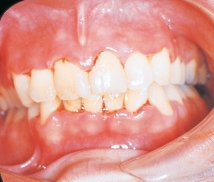 On the basis of these features, you suspect that this patient has:
Free
(Multiple Choice)
4.9/5  (78)
(78) Correct Answer: Verified
C
Tonsillitis and pharyngitis are caused by group A ß-hemolytic streptococci. These conditions are significant because of their relationship to scarlet fever and rheumatic fever. Which one of the following may be related to heart valve damage?
Free
(Multiple Choice)
4.8/5 (67)
(67) Correct Answer:Verified
VerifiedA
The intraoral lesion seen in patients with measles is:
Free
(Multiple Choice)
5.0/5 (82)
(82) Correct Answer:Verified
VerifiedC
MATCHING
For each clinical appearance listed below, select the most closely linked disorder from the list provided.
-White, papillary exophytic lesion resembling a papilloma
(Multiple Choice)
4.8/5 (89)
(89) The image shows an oral condyloma acuminatum presenting in a child. 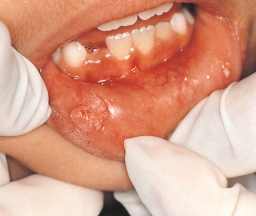 The presence of condyloma acuminatum in a child suggests:
 (Multiple Choice)
4.8/5 (96)
(96) This lesion in the commissure is most likely caused by Candida albicans or a nutritional deficiency and is called: 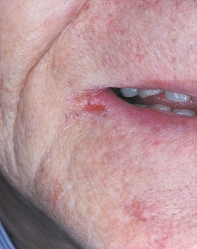
(Multiple Choice)
4.9/5 (73)
(73) MATCHING
For each clinical appearance listed below, select the most closely linked disorder from the list provided.
-Pink, papillary lesion(s), more diffuse than papilloma
(Multiple Choice)
4.8/5 (78)
(78) Which disease is caused by the spirochete Treponema pallidum?
(Multiple Choice)
4.7/5 (80)
(80) Which one of the following does not occur as a manifestation of the immune deficiency caused by HIV infection?
(Multiple Choice)
4.9/5 (71)
(71) The initial infection and signs and symptoms of deep fungal infections, including histoplasmosis, coccidioidomycosis, and blastomycosis, are usually related to disease in which of the following locations?
(Multiple Choice)
4.9/5 (79)
(79) For each disorder listed below, select the most closely linked clinical appearance from the list provided.
-Koplik spots in the oral cavity and skin rash that results from a paramyxovirus
(Multiple Choice)
4.9/5 (74)
(74) In herpes labialis, the amount of virus present is highest in the _____ stage.
(Multiple Choice)
4.8/5 (81)
(81) For each disorder listed below, select the most closely linked clinical appearance from the list provided.
-Epidemic parotitis characterized by bilateral swelling of the parotid glands
(Multiple Choice)
4.9/5 (70)
(70) In HIV infection, which of the following tests identifies the viral titer rather than circulating antibody?
(Multiple Choice)
5.0/5 (72)
(72) Histoplasmosis, coccidioidomycosis, blastomycosis, and cryptococcosis are all examples of what type of infection?
(Multiple Choice)
4.8/5 (78)
(78) Involvement and enlargement of the submandibular and cervical lymph nodes in tuberculosis is called:
(Multiple Choice)
4.8/5 (82)
(82) Which of the following statements is not true about syphilis?
(Multiple Choice)
4.8/5 (86)
(86) Which one of the following is associated with scarlet fever?
(Multiple Choice)
4.9/5 (96)
(96) MATCHING
For each clinical appearance listed below, select the most closely linked disorder from the list provided.
-Draining abscesses, "sulfur granules"
(Multiple Choice)
4.9/5 (70)
(70) 
Filters
- Essay(0)
- Multiple Choice(0)
- Short Answer(0)
- True False(0)
- Matching(0)