Multiple Choice
This lesion in the commissure is most likely caused by Candida albicans or a nutritional deficiency and is called: 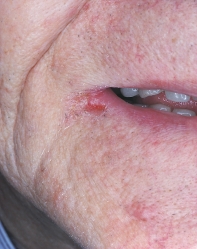
A) pseudomembranous candidiasis.
B) angular cheilitis.
C) chronic mucocutaneous candidiasis.
D) chronic atrophic candidiasis.
Correct Answer:

Verified
Correct Answer:
Verified
Related Questions
Q1: The gingivae shown are painful and erythematous.
Q1: For each clinical appearance listed below, select
Q2: Tonsillitis and pharyngitis are caused by group
Q3: The intraoral lesion seen in patients with
Q5: The image shows an oral condyloma acuminatum
Q8: Which disease is caused by the spirochete
Q9: Which one of the following does not
Q10: The initial infection and signs and symptoms
Q11: Which of the following is used to
Q29: For each clinical appearance listed below, select