



 Chat with AI
Exam 8: Nonneoplastic Diseases of Bone

Exam 1: Introduction to Preliminary Diagnosis of Oral Lesions50 Questions
Exam 2: Inflammation and Repair59 Questions
Exam 3: Immunity and Immunologic Oral Lesions60 Questions
Exam 4: Infectious Diseases64 Questions
Exam 5: Developmental Disorders60 Questions
Exam 6: Genetics87 Questions
Exam 7: Neoplasia99 Questions
Exam 8: Nonneoplastic Diseases of Bone28 Questions
Exam 9: Oral Manifestations of Systemic Diseases72 Questions
Exam 10: Diseases Affecting the Temporomandibular Joint38 Questions
Select questions type


Giant cell granulomas located in the gingiva or alveolar mucosa are referred to as central. Giant cell granulomas located within the maxilla or mandible are referred to as peripheral.

Free
(Multiple Choice)
4.7/5  (75)
(75) Correct Answer: Verified
B
Numerous gritty pieces of soft and hard tissue that contain fibrous connective tissue interspersed with bone trabeculae and cementum-like material is characteristic of which of the following?
Free
(Multiple Choice)
4.9/5 (73)
(73) Correct Answer:Verified
VerifiedA
A lesion of bone identical to the central giant cell granuloma and called a brown tumor occurs in patients with what type of disease?
Free
(Multiple Choice)
4.8/5 (83)
(83) Correct Answer:Verified
VerifiedA
Which of the following types of lesions occurs most often in black women older than 40 years of age and is characterized by disordered cementum and bone, typically affecting more than one quadrant of the maxilla and mandible, and often in the posterior area?
(Multiple Choice)
4.8/5 (69)
(69) Mosaic bone may be observed in a patient with Paget disease as a result of:
(Multiple Choice)
4.8/5 (87)
(87) The most common type of fibrous dysplasia, characterized by involvement of a single bone, is referred to as:
(Multiple Choice)
5.0/5 (71)
(71) All of the following statements are characteristic of osteomalacia except one. Which one is the exception?
(Multiple Choice)
4.8/5 (82)
(82) Osteitis deformans and leontiasis ossea are other names for what chronic metabolic bone disease?
(Multiple Choice)
4.9/5 (89)
(89) All of the following are benign fibrous-osseous lesions that affect the maxilla and mandible except one. Which one is the exception?
(Multiple Choice)
4.8/5 (72)
(72) This 74-year-old patient presents with an enlargement of the maxilla, pain, and a chief complaint that his dentures no longer fit. Radiographic examination reveals a patchy radiolucency and radiopacity that resembles cotton wool. 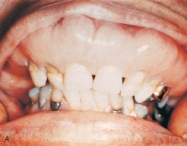 This is indicative of what disease of bone?
 (Multiple Choice)
4.7/5 (80)
(80) _____ fibrous dysplasia is characterized by endocrine abnormalities, including precocious puberty in females and stunting or deformity of skeletal growth in both sexes as a result of early epiphyseal plate closure.
(Multiple Choice)
4.8/5 (74)
(74) Characteristics of monostotic fibrous dysplasia include that:
(Multiple Choice)
4.8/5 (80)
(80) Light brown skin macules associated with polyostotic fibrous dysplasia are referred to as:
(Multiple Choice)
4.8/5 (88)
(88) One of the most widely accepted theories for the unusual fibrous proliferation seen with fibrous dysplasia is that it is the result of abnormal:
(Multiple Choice)
4.9/5 (78)
(78) When osteomalacia occurs in young children, it is usually caused by a nutritional deficiency in vitamin _____.
(Multiple Choice)
4.9/5 (92)
(92) Which of the following types of lesions typically arises in the posterior mandible and appears as an isolated, well-delineated radiolucent-to-radiopaque lesion that is less than 1.5 cm in size?
(Multiple Choice)
5.0/5 (89)
(89) Cementoma is a term once used for periapical cemento-osseous dysplasia. Because the disease does not represent a neoplasm, cementoma has been replaced with periapical cemento-osseous dysplasia.
(Multiple Choice)
4.7/5 (86)
(86) 
Filters
- Essay(0)
- Multiple Choice(0)
- Short Answer(0)
- True False(0)
- Matching(0)