



 Chat with AI
Exam 2: Inflammation and Repair

Exam 1: Introduction to Preliminary Diagnosis of Oral Lesions50 Questions
Exam 2: Inflammation and Repair59 Questions
Exam 3: Immunity and Immunologic Oral Lesions60 Questions
Exam 4: Infectious Diseases64 Questions
Exam 5: Developmental Disorders60 Questions
Exam 6: Genetics87 Questions
Exam 7: Neoplasia99 Questions
Exam 8: Nonneoplastic Diseases of Bone28 Questions
Exam 9: Oral Manifestations of Systemic Diseases72 Questions
Exam 10: Diseases Affecting the Temporomandibular Joint38 Questions
Select questions type


A decrease in the size and function of a cell, a tissue, an organ, or the whole body is referred to as:
(Multiple Choice)
4.8/5  (97)
(97) Each of the following is a factor that may impair healing except one. Which one is the exception?
(Multiple Choice)
4.7/5 (74)
(74) During the microscopic event of inflammation, pain may be caused by which of the following?
(Multiple Choice)
4.9/5 (88)
(88) A tooth must be extracted if internal root resorption is present and a perforation occurs.
(Multiple Choice)
4.8/5 (81)
(81) All of the following are true concerning the neutrophil except that the neutrophil is:
(Multiple Choice)
4.8/5 (84)
(84) These elongated folds of tissue are a result of irritation from an ill-fitting denture. 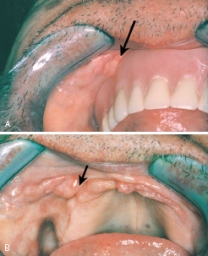 The accurate diagnosis for this lesion is:
 (Multiple Choice)
4.8/5 (92)
(92) Which one of the following does not cause gingival enlargement?
(Multiple Choice)
4.8/5 (78)
(78) Which of the following is defined as an increase in the number of cells in a tissue or organ?
(Multiple Choice)
4.9/5 (94)
(94) The wearing away of tooth structure during mastication is called:
(Multiple Choice)
4.8/5 (70)
(70) This granular, erythematous papillary surface of the palatal vault was caused by: 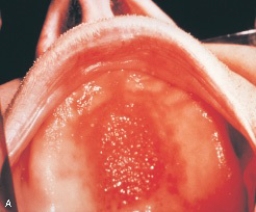
(Multiple Choice)
4.9/5 (80)
(80) A wedge-shaped defect at the cervical area of a tooth, the cause of which is related to microfracture of the tooth structure in areas of concentration of stress, is called:
(Multiple Choice)
4.7/5 (89)
(89) Hyperemia is responsible for which two clinical signs of inflammation?
(Multiple Choice)
4.8/5 (87)
(87) This sessile-based lesion is on the gingiva of a 13-year-old female. It is soft to palpation and bleeds easily. 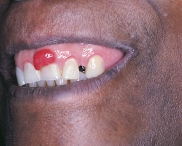 The accurate diagnosis for this lesion is:
 (Multiple Choice)
5.0/5 (67)
(67) 
Filters
- Essay(0)
- Multiple Choice(0)
- Short Answer(0)
- True False(0)
- Matching(0)