



 Chat with AI
Exam 2: Inflammation and Repair

Exam 1: Introduction to Preliminary Diagnosis of Oral Lesions50 Questions
Exam 2: Inflammation and Repair59 Questions
Exam 3: Immunity and Immunologic Oral Lesions60 Questions
Exam 4: Infectious Diseases64 Questions
Exam 5: Developmental Disorders60 Questions
Exam 6: Genetics87 Questions
Exam 7: Neoplasia99 Questions
Exam 8: Nonneoplastic Diseases of Bone28 Questions
Exam 9: Oral Manifestations of Systemic Diseases72 Questions
Exam 10: Diseases Affecting the Temporomandibular Joint38 Questions
Select questions type


Which type of inflammation occurs when the injury is minimal and brief and its source is removed from the tissue?
(Multiple Choice)
4.8/5  (88)
(88) Which one of the following is not a classic local sign of inflammation?
(Multiple Choice)
4.9/5 (74)
(74) A process during inflammation in which white blood cells move to the blood vessel wall is referred to as:
(Multiple Choice)
4.9/5 (82)
(82) The inflammatory response is a dynamic process, continually changing in response to injury and repair. Repair of tissue occurs only if the persistent source of injury is removed.
(Multiple Choice)
4.7/5 (79)
(79) Neutrophils constitute how much of the entire white blood cell population?
(Multiple Choice)
5.0/5 (94)
(94) Which of the following is most likely to result in frictional keratosis?
(Multiple Choice)
4.9/5 (83)
(83) Which type of cell is the first to arrive at the site of injury and is the primary cell type involved in acute inflammation?
(Multiple Choice)
4.8/5 (71)
(71) This white raised line observed on the buccal mucosa along the occlusal plane of the teeth is: 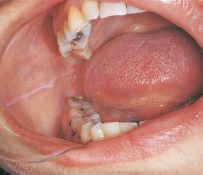
(Multiple Choice)
4.7/5 (90)
(90) During the acute inflammatory process, the second type of white blood cell to emigrate from the blood vessel into the injured tissue is the:
(Multiple Choice)
4.8/5 (74)
(74) A patient comes to the office for an emergency visit. The patient complains of a toothache in the left mandibular posterior area. On clinical examination you notice a gray-to-white patch on the left posterior buccal mucosa. On questioning, the patient tells you that this area is also painful. After reviewing the patient's medical history, you question the patient regarding his recent use of: 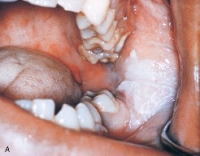
(Multiple Choice)
4.8/5 (76)
(76) Which one of the following inflammatory periapical lesions is most painful?
(Multiple Choice)
4.7/5 (93)
(93) When formation of exudate is excessive, a drainage tract may develop through the injured tissue. This channel is often called:
(Multiple Choice)
4.8/5 (69)
(69) Which one of the following is a steroidal antiinflammatory drug?
(Multiple Choice)
4.9/5 (85)
(85) 
Filters
- Essay(0)
- Multiple Choice(0)
- Short Answer(0)
- True False(0)
- Matching(0)