



 Chat with AI
Exam 22: Nutrition and Renal Diseases

Exam 1: Overview of Nutrition and Health78 Questions
Exam 2: Digestion and Absorption71 Questions
Exam 3: Carbohydrates74 Questions
Exam 4: Lipids82 Questions
Exam 5: Protein78 Questions
Exam 6: Energy Balance and Body Composition69 Questions
Exam 7: Weight Management70 Questions
Exam 8: The Vitamins85 Questions
Exam 9: Water and the Minerals80 Questions
Exam 10: Nutrition Through the Life Span: Pregnancy and Infancy95 Questions
Exam 11: Nutrition Through the Life Span: Childhood and Adolescence85 Questions
Exam 12: Nutrition Through the Life Span: Later Adulthood67 Questions
Exam 13: Nutrition Care and Assessment82 Questions
Exam 14: Nutrition Intervention and Diet-Drug Interactions89 Questions
Exam 15: Enteral and Parenteral Nutrition Support127 Questions
Exam 16: Nutrition in Metabolic and Respiratory Stress70 Questions
Exam 17: Nutrition and Upper Gastrointestinal Disorders83 Questions
Exam 18: Nutrition and Lower Gastrointestinal Disorders110 Questions
Exam 19: Nutrition and Liver Diseases95 Questions
Exam 20: Nutrition and Diabetes Mellitus108 Questions
Exam 21: Nutrition and Disorders of the Heart and Blood Vessels94 Questions
Exam 22: Nutrition and Renal Diseases95 Questions
Exam 23: Nutrition, Cancer, and Hiv Infection88 Questions
Select questions type


The primary goal(s) of medical nutrition therapy for Mr.Wilson at this time should be:
(Multiple Choice)
4.9/5  (83)
(83) Discuss techniques to use in increasing clients' compliance with renal diets.
(Essay)
5.0/5 (78)
(78) The nurse recognizes that clients with chronic kidney disease need generous amounts of these water-soluble vitamins:
(Multiple Choice)
4.8/5 (74)
(74) Side effects of immunosuppressive drug therapy following a kidney transplant may include all of the following except:
(Multiple Choice)
4.7/5 (71)
(71) The anorexia associated with chronic kidney disease has many potential causes, but _____ is/are not one of them.
(Multiple Choice)
4.7/5 (94)
(94) Patients with chronic kidney disease are often encouraged to consume high-fat foods to improve their energy intake.An appropriate high-fat food choice for such a patient is:
(Multiple Choice)
4.7/5 (84)
(84) For clients on fluid-restricted diets who experience extreme thirst, you should suggest:
(Multiple Choice)
4.8/5 (77)
(77) The potassium content of vegetables can be reduced by a process called:
(Multiple Choice)
4.8/5 (86)
(86) Since this is Mr.Bradley's first visit to the center, you, as his primary care nurse, spend hours speaking to him while his dialysis progresses.You explain that within the next week he will be seen by _____, who will counsel him about his nutrition therapy.
(Multiple Choice)
4.9/5 (81)
(81) A patient with renal disease is restricted to 2 liters of water per day and complains of thirst.The nurse offers the following suggestion for controlling thirst:
(Multiple Choice)
4.8/5 (78)
(78) A client with acute kidney injury has a urine output of 500 milliliters per day.The nurse determines his daily fluid needs to be:
(Multiple Choice)
5.0/5 (80)
(80) The diet for acute kidney injury is usually restricted to about _____ per kilogram of body weight per day for noncatabolic patients not on dialysis.
(Multiple Choice)
4.9/5 (66)
(66) The medical nutrition therapy for nephrotic syndrome helps to prevent protein-energy malnutrition and alleviate edema.
(True/False)
4.9/5 (72)
(72) Mrs.Clark weighs 59 kg and has chronic kidney disease with a GFR <50.How much protein should her daily diet include?
(Multiple Choice)
4.9/5 (82)
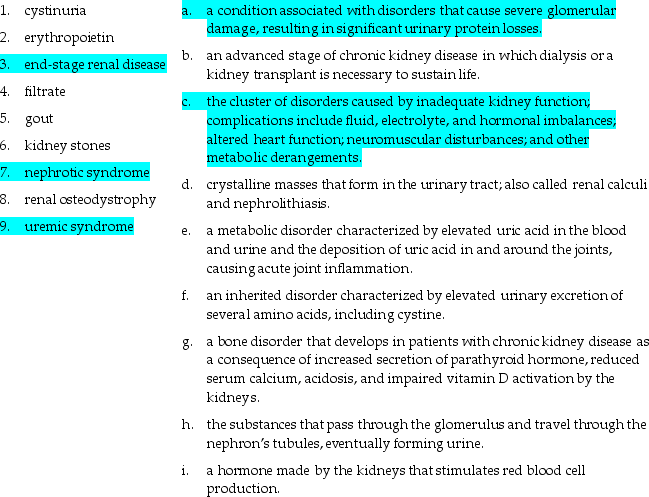
(82) 
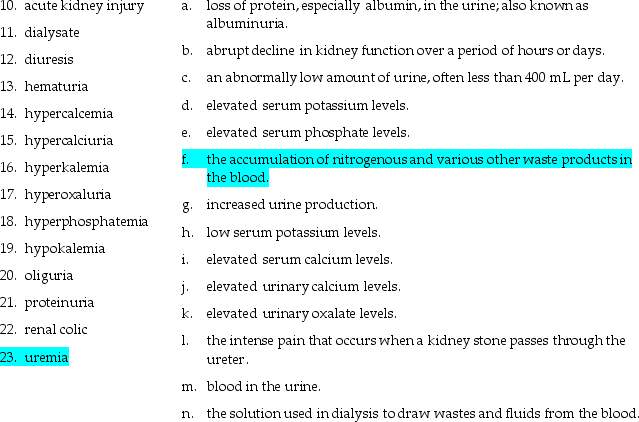

Filters
- Essay(0)
- Multiple Choice(0)
- Short Answer(0)
- True False(0)
- Matching(0)