



 Chat with AI
Exam 8: Thermodynamics: The First Law

Exam 1: The Quantum World100 Questions
Exam 2: Quantum Mechanics in Action: Atoms100 Questions
Exam 3: Chemical Bonds83 Questions
Exam 4: Molecular Shape and Structure95 Questions
Exam 5: The Properties of Gases94 Questions
Exam 6: Liquids and Solids95 Questions
Exam 7: Inorganic Materials100 Questions
Exam 8: Thermodynamics: The First Law94 Questions
Exam 9: Thermodynamics: The Second and Third Laws95 Questions
Exam 10: Physical Equilibria94 Questions
Exam 11: Chemical Equilibria94 Questions
Exam 12: Acids and Bases94 Questions
Exam 13: Aqueous Equilibria94 Questions
Exam 14: Electrochemistry94 Questions
Exam 15: Chemical Kinetics93 Questions
Exam 16: The Elements: the Main Group Elements189 Questions
Exam 17: The Elements: The D Block94 Questions
Exam 18: Nuclear Chemistry95 Questions
Exam 19: Organic Chemistry I94 Questions
Exam 20: Organic Chemistry II95 Questions
Select questions type


What is the total motional contribution to the molar internal energy of gaseous BF3?
(Multiple Choice)
4.8/5  (91)
(91) The standard enthalpy of formation of gaseous water is -241.82 kJ.mol-1 at 298 K.Estimate this value at 370 K.The molar heat capacities of hydrogen,oxygen,and gaseous water are 28.82,29.36,and 33.58 J.K-1 .mol-1
(Multiple Choice)
4.8/5 (80)
(80) A CD player and its battery together do 500 kJ of work.The battery also releases 250 kJ of energy as heat and the CD player releases 50 kJ as heat due to friction from spinning.What is the change in internal energy of the system,with the system regarded as the CD player alone? Assume that the battery does 500 kJ of work on the CD player,which then does the same amount of work on the surroundings.
(Multiple Choice)
4.9/5 (77)
(77) Calculate the standard enthalpy of vaporization of liquid bromine if the standard enthalpy of sublimation of solid bromine is +40.1 kJ.mol-1 and the standard enthalpy of fusion of solid bromine is +10.6 kJ.mol-1.
(Multiple Choice)
4.8/5 (79)
(79) Calculate the standard reaction enthalpy for the following
reaction:
2NO2(g) 2NO(g)+ O2(g)
From the standard reaction enthalpies of
N2(g)+ O2 2NO(g)
H° = +180.5 kJ.mol-1
2NO2(g) N2(g)+ 2O2(g)
H° = -66.4 kJ.mol-1
(Multiple Choice)
4.9/5 (82)
(82) What is the total motional contribution to the molar internal energy of gaseous H2O at 25 C?
(Multiple Choice)
4.7/5 (79)
(79) The standard enthalpy of formation of ammonia gas is -46.11 kJ.mol-1 at 298 K.What is the standard reaction enthalpy for the Haber process at 500 C? The molar heat capacities of nitrogen,hydrogen,and ammonia are 29.12,28.82,and 35.06 kJ.mol-1 respectively.
(Multiple Choice)
4.9/5 (77)
(77) Give Hr values for each of the following reactions from the information below.
Hf (HCl(g))= -92.31 kJ.mol-1
H-Cl bond enthalpy = +431 kJ.mol-1
O-H bond enthalpy = +463 kJ.mol-1
Hf (H2O(g))= -241.8 kJ.mol-1
(a)2H(g)+ O(g) H2O(g)
(b)H2(g)+ Cl2(g) 2HCl(g)
(c)H(g)+ Cl(g) HCl(g)
(Short Answer)
4.8/5 (89)
(89) An isolated system can exchange energy and small particles with the surroundings.
(True/False)
4.9/5 (78)
(78) The lattice enthalpy of calcium oxide is the energy change for the reaction
(Multiple Choice)
4.8/5 (94)
(94) Calculate the change in internal energy when 2.50 kJ of energy is transferred as heat to 1.50 mol BF3 at 298 K and 1 atm at constant pressure.
(Multiple Choice)
4.9/5 (72)
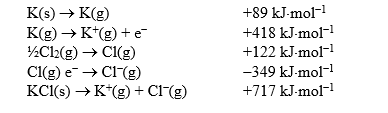
(72) Calculate the standard enthalpy of formation of potassium chloride given the following enthalpy data.
(Short Answer)
4.8/5 (71)
(71) The combustion of 1 mole of ethanol,C2H5OH(l),to produce carbon dioxide and gaseous water has Hr = -1235 kJ.mol-1 at 298 K.What is the change in internal energy for this reaction?
(Multiple Choice)
4.8/5 (68)
(68) The combustion of one mole of octane,C8H18(l),in a bomb calorimeter released 5460 kJ of heat at 298 K.The products of the reaction are carbon dioxide and liquid water.What is the enthalpy change for this reaction?
(Multiple Choice)
4.9/5 (92)
(92) 
Filters
- Essay(0)
- Multiple Choice(0)
- Short Answer(0)
- True False(0)
- Matching(0)