



 Chat with AI
Exam 8: Thermodynamics: The First Law

Exam 1: The Quantum World100 Questions
Exam 2: Quantum Mechanics in Action: Atoms100 Questions
Exam 3: Chemical Bonds83 Questions
Exam 4: Molecular Shape and Structure95 Questions
Exam 5: The Properties of Gases94 Questions
Exam 6: Liquids and Solids95 Questions
Exam 7: Inorganic Materials100 Questions
Exam 8: Thermodynamics: The First Law94 Questions
Exam 9: Thermodynamics: The Second and Third Laws95 Questions
Exam 10: Physical Equilibria94 Questions
Exam 11: Chemical Equilibria94 Questions
Exam 12: Acids and Bases94 Questions
Exam 13: Aqueous Equilibria94 Questions
Exam 14: Electrochemistry94 Questions
Exam 15: Chemical Kinetics93 Questions
Exam 16: The Elements: the Main Group Elements189 Questions
Exam 17: The Elements: The D Block94 Questions
Exam 18: Nuclear Chemistry95 Questions
Exam 19: Organic Chemistry I94 Questions
Exam 20: Organic Chemistry II95 Questions
Select questions type


In the combustion of coal,C(s),the C=O bonds are stronger than the O=O bond.
(True/False)
4.9/5  (67)
(67) For the reaction CO2(aq) CO2(g), Hr = 19.4 kJ.mol-1 at 298.At constant temperature and pressure,which of the following statements is true?
(Multiple Choice)
4.7/5 (88)
(88) The enthalpy of sublimation of a substance is related to its enthalpy of vaporization and enthalpy of fusion by the equation, Hsublimation = Hvaporization - Hfusion.True or false?
(True/False)
4.8/5 (78)
(78) If 2.00 mol of an ideal gas at 300 K and 3.00 atm expands from 6.00 L to 18.00 L and a final pressure of 1.20 atm in two steps: (1)the gas is cooled at constant volume until its pressure has fallen to 1.20 atm,and (2)it is heated and allowed to expand against a constant pressure of 1.20 atm until its volume reaches 18.00 L,which of the following is correct?
(Multiple Choice)
4.9/5 (90)
(90) A CD player and its battery together do 500 kJ of work.The battery also releases 250 kJ of energy as heat and the CD player releases 50 kJ as heat due to friction from spinning.What is the change in internal energy of the system,with the system regarded as the battery and CD player together?
(Multiple Choice)
4.8/5 (82)
(82) Calculate the final temperature when 2.50 kJ of energy is transferred as heat to 1.50 mol N2 at 298 K and 1 atm at constant pressure.
(Multiple Choice)
5.0/5 (89)
(89) If the standard enthalpy of combustion of ethanol,C2H5OH(l),at 298 K is -1368 kJ.mol-1 ,what is the standard enthalpy of formation of ethanol? The standard enthalpies of formation of carbon dioxide and liquid water are -393.51 and -285.83 kJ.mol-1 ,respectively.
(Multiple Choice)
4.9/5 (83)
(83) If the standard reaction enthalpy for the reaction NO2(g) NO(g)+ O(g)
Is needed,calculate it from the standard enthalpy of formation of ozone,+142.7 kJ.mol-1 ,and from the reactions listed below:
O2(g) 2O(g)
H° = +498.4 kJ.mol-1
NO(g)+ O3(g) NO2(g)+ O2(g)
H° = -200 kJ.mol-1
(Multiple Choice)
4.8/5 (66)
(66) A piece of a newly synthesized material of mass 25.0 g at 80.0 C is placed in a calorimeter containing 100.0 g of water at 20.0 C.If the final temperature of the system is 24.0 C,what is the specific heat capacity of this material?
(Multiple Choice)
4.9/5 (91)
(91) Calculate the final temperature when 2.50 kJ of energy is transferred as heat to 1.50 mol N2 at 298 K and 1 atm at constant volume.
(Multiple Choice)
4.9/5 (86)
(86) When a solution of 1.691 g of silver nitrate is mixed with an excess of sodium chloride in a calorimeter of heat capacity 216 J.( C)-1,the temperature rises 3.03 C.What is the reaction enthalpy?
(Multiple Choice)
4.7/5 (79)
(79) A battery does 35 kJ of work driving an electric motor and 7 kJ of heat are released.What is the change in internal energy of the system?
(Multiple Choice)
4.9/5 (80)
(80) Hot coffee in a vacuum flask (thermos)is an example of a(n)__________________ (open,closed,isolated)system.
(Short Answer)
4.7/5 (71)
(71) 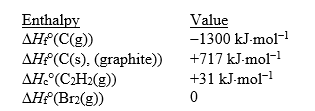
Given the standard reaction enthalpies below:
N2(g)+ O2 2NO(g)
H° = +180.5 kJ.mol-1
2NO2(g) N2(g)+ 2O2(g)
H° = -66.4 kJ.mol-1
Calculate the standard reaction enthalpy for the oxidation of nitric oxide to nitrogen dioxide,shown below:
2NO(g)+ O2(g) 2NO2(g)
(Multiple Choice)
5.0/5 (63)
(63) The heat flow for the reaction
C2H6(g)+ 3.5O2(g) 2CO2(g)+ 3H2O(l)
Measured in a bomb calorimeter is -1553.5 kJ/mol at 298 K.At this temperature, U is
(Multiple Choice)
4.9/5 (96)
(96) Calculate the final temperature when 2.50 kJ of energy is transferred as heat to 1.50 mol BF3 at 298 K and 1 atm at constant pressure.
(Multiple Choice)
4.9/5 (84)
(84) What is the total motional contribution to the molar internal energy of gaseous HCN?
(Multiple Choice)
4.8/5 (98)
(98) 
Filters
- Essay(0)
- Multiple Choice(0)
- Short Answer(0)
- True False(0)
- Matching(0)