



 Chat with AI
Exam 24: Gausss Law

Exam 1: Foundations48 Questions
Exam 1: A: Foundations2 k Questions
Exam 2: Motion in One Dimension15 Questions
Exam 3: Acceleration48 Questions
Exam 4: Momentum7 Questions
Exam 5: Energy15 Questions
Exam 6: Principle of Relativity5 Questions
Exam 7: Interactions7 Questions
Exam 8: Force76 Questions
Exam 9: Work48 Questions
Exam 10: Motion in a Plane134 Questions
Exam 11: Motion in a Circle54 Questions
Exam 12: Torque68 Questions
Exam 13: Gravity44 Questions
Exam 14: Special Relativity49 Questions
Exam 15: Periodic Motion49 Questions
Exam 16: Waves in One Dimension23 Questions
Exam 17: Waves in Two and Three Dimensions44 Questions
Exam 18: Fluids54 Questions
Exam 19: Entropy27 Questions
Exam 20: Energy Transferred Thermally30 Questions
Exam 21: Degradation of Energy39 Questions
Exam 22: Electric Interactions20 Questions
Exam 23: The Electric Field34 Questions
Exam 24: Gausss Law46 Questions
Exam 25: Work and Energy in Electrostatics53 Questions
Exam 26: Charge Separation and Storage33 Questions
Exam 27: Magnetic Interactions37 Questions
Exam 28: Magnetic Fields of Charged Particles in Motion35 Questions
Exam 29: Changing Magnetic Fields38 Questions
Exam 30: Changing Electric Fields30 Questions
Exam 31: Electric Circuits68 Questions
Exam 32: Electronics46 Questions
Exam 33: Ray Optics65 Questions
Exam 34: Wave and Particle Optics100 Questions
Select questions type


A nonuniform electric field is directed along the x-axis at all points in space.This magnitude of the field varies with x,but not with respect to y or z.The axis of a cylindrical surface,0.80 m long and 0.20 m in diameter,is aligned parallel to the x-axis,as shown in the figure.The electric fields E1 and E2,at the ends of the cylindrical surface,have magnitudes of 9000 N/C and 5000 N/C respectively,and are directed as shown.(ε0 = 8.85 × 10⁻¹² C2/N • m2)The charge enclosed by the cylindrical surface is closest to 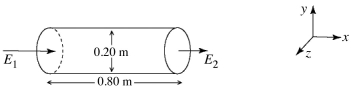
(Multiple Choice)
4.8/5  (67)
(67) Two extremely large nonconducting horizontal sheets each carry uniform charge density on the surfaces facing each other.The upper sheet carries +5.00 µC/m2.The electric field midway between the sheets is 4.25 × 10⁵ N/C pointing downward.What is the surface charge density on the lower sheet?
(ε0 = 8.85 × 10⁻¹² C2/N • m2)
(Short Answer)
4.9/5 (89)
(89) Two long straight parallel lines,#1 and #2,carry uniform positive linear charge densities.The charge density on line #2 is twice as great as the charge density on line #1.The locus of points where the electric field due to these lines is zero is
(Multiple Choice)
4.8/5 (91)
(91) A hollow conducting spherical shell has radii of 0.80 m and 1.20 m,as shown in the figure.The sphere carries a net excess charge of -500 nC.A point charge of +300 nC is present at the center.
(k = 1/4πε0 = 8.99 × 10⁹ N • m2/C)The radial component of the electric field at a point that is 0.60 m from the center is closest to 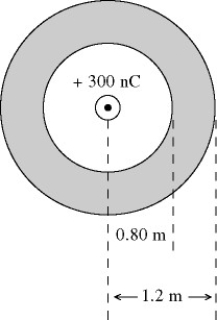
(Multiple Choice)
4.9/5 (70)
(70) A very large sheet of a conductor carries a uniform charge density of 4.00 pC/mm2 on its surfaces.What is the electric field strength 3.00 mm outside the surface of the conductor?
(ε0 = 8.85 × 10⁻¹² C2/N • m2)
(Multiple Choice)
4.8/5 (69)
(69) The cross section of a long coaxial cable is shown in the figure,with radii as given.The linear charge density on the inner conductor is -30 nC/m and the linear charge density on the outer conductor is
-70 nC/m. The inner and outer cylindrical surfaces are respectively denoted by A,B,C,and D,as shown.(ε0 = 8.85 × 10⁻¹² C2/N • m2) The radial component of the electric field at a point that 34 mm from the axis is closest to 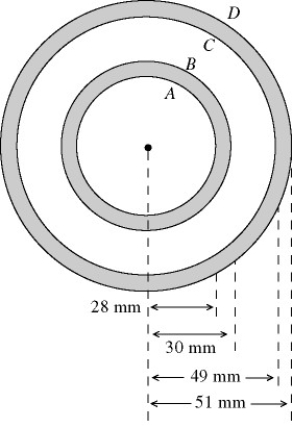
(Multiple Choice)
4.9/5 (64)
(64) 
Filters
- Essay(0)
- Multiple Choice(0)
- Short Answer(0)
- True False(0)
- Matching(0)