



 Chat with AI
Exam 23: The Electric Field

Exam 1: Foundations48 Questions
Exam 1: A: Foundations2 k Questions
Exam 2: Motion in One Dimension15 Questions
Exam 3: Acceleration48 Questions
Exam 4: Momentum7 Questions
Exam 5: Energy15 Questions
Exam 6: Principle of Relativity5 Questions
Exam 7: Interactions7 Questions
Exam 8: Force76 Questions
Exam 9: Work48 Questions
Exam 10: Motion in a Plane134 Questions
Exam 11: Motion in a Circle54 Questions
Exam 12: Torque68 Questions
Exam 13: Gravity44 Questions
Exam 14: Special Relativity49 Questions
Exam 15: Periodic Motion49 Questions
Exam 16: Waves in One Dimension23 Questions
Exam 17: Waves in Two and Three Dimensions44 Questions
Exam 18: Fluids54 Questions
Exam 19: Entropy27 Questions
Exam 20: Energy Transferred Thermally30 Questions
Exam 21: Degradation of Energy39 Questions
Exam 22: Electric Interactions20 Questions
Exam 23: The Electric Field34 Questions
Exam 24: Gausss Law46 Questions
Exam 25: Work and Energy in Electrostatics53 Questions
Exam 26: Charge Separation and Storage33 Questions
Exam 27: Magnetic Interactions37 Questions
Exam 28: Magnetic Fields of Charged Particles in Motion35 Questions
Exam 29: Changing Magnetic Fields38 Questions
Exam 30: Changing Electric Fields30 Questions
Exam 31: Electric Circuits68 Questions
Exam 32: Electronics46 Questions
Exam 33: Ray Optics65 Questions
Exam 34: Wave and Particle Optics100 Questions
Select questions type


An electric dipole is made of two charges of equal magnitudes and opposite signs.The positive charge,q = 1.0 μC,is located at the point (x,y,z)= (0.00 cm,1.0 cm,0.00 cm),while the negative charge is located at the point (x,y,z)= (0.00 cm,-1.0 cm,0.00 cm).How much work will be done by an electric field  = (3.0 × 10⁶ N/C)
 To bring the dipole to its stable equilibrium position?
= (3.0 × 10⁶ N/C)
To bring the dipole to its stable equilibrium position?
Free
(Multiple Choice)
4.8/5  (66)
(66) Correct Answer: Verified
A
A pair of charged conducting plates produces a uniform field of 12,000 N/C,directed to the right,between the plates.The separation of the plates is 40 mm.An electron is projected from plate A,directly toward plate B,with an initial velocity of vo = 2.0 × 10⁷ m/s,as shown in the figure.(e = 1.60 × 10⁻¹⁹ C,
Ε0 = 8.85 × 10⁻¹² C2/N • m2,mel = 9.11 × 10⁻³¹ kg)The velocity of the electron as it strikes plate B is closest to 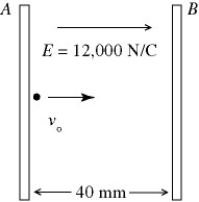
Free
(Multiple Choice)
4.8/5 (92)
(92) Correct Answer:Verified
VerifiedB
An initially-stationary electric dipole of dipole moment  = (5.00 × 10⁻¹⁰ C • m)
 Placed in an electric field
 = (2.00 × 10⁶ N/C)
 + (2.00 × 10⁶ N/C)
 )What is the magnitude of the maximum torque that the electric field exerts on the dipole?
= (5.00 × 10⁻¹⁰ C • m)
Placed in an electric field
= (2.00 × 10⁶ N/C)
+ (2.00 × 10⁶ N/C)
)What is the magnitude of the maximum torque that the electric field exerts on the dipole?Free
(Multiple Choice)
4.9/5 (70)
(70) Correct Answer:Verified
VerifiedE
An electron is initially moving to the right when it enters a uniform electric field directed upwards.Which trajectory shown below will the electron follow? 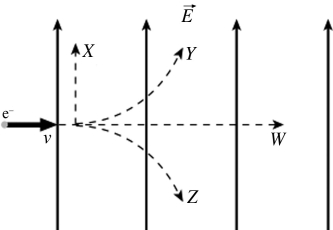
(Multiple Choice)
4.7/5 (77)
(77) A thin,circular disk of radius 30.0 cm is oriented in the yz-plane with its center at the origin.The disk carries a total charge of +3.00 μC distributed uniformly over its surface.Calculate the magnitude of the electric field due to the disk at the point x = 15.0 cm along the x-axis.(ε0 = 8.85 × 10⁻¹² C2/N • m2)
(Multiple Choice)
5.0/5 (65)
(65) A pair of charged conducting plates produces a uniform field of 12,000 N/C,directed to the right,between the plates.The separation of the plates is 40 mm.An electron is projected from plate A,directly toward plate B,with an initial velocity of v0 = 1.0 × 10⁷ m/s,as shown in the figure.(e = 1.60 × 10⁻¹⁹ C,
Ε0 = 8.85 × 10⁻¹² C2/N • m2,mel = 9.11 × 10⁻³¹ kg)The distance of closest approach of the electron to plate B is nearest to 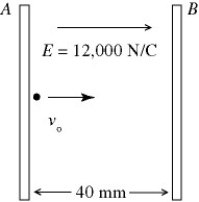
(Multiple Choice)
4.8/5 (77)
(77) Two thin 80.0-cm rods are oriented at right angles to each other.Each rod has one end at the origin of the coordinates,and one of them extends along the +x-axis while the other extends along the +y-axis.The rod along the +x-axis carries a charge of -15.0 µC distributed uniformly along its length,and the other rod carries +15.0 µC uniformly over its length.Find the magnitude and direction of the net electrical force that these two rods exert on an electron located at the point (40.0 cm,40.0 cm).(e = 1.60 × 10⁻¹⁹ C,
ε0 = 8.85 × 10⁻¹² C2/N • m2)
(Essay)
4.8/5 (77)
(77) Three equal negative point charges are placed at three of the corners of a square of side d.What is the magnitude of the net electric field at the center of the square? (k = 1/4πε0 = 8.99 × 10⁹ N • m2/C2)
(Short Answer)
4.7/5 (81)
(81) At a distance of 4.3 cm from the center of a very long uniformly charged wire,the electric field has magnitude 2000 N/C and is directed toward the wire.What is the charge on a 1.0 cm length of wire near the center? (ε0 = 8.85 × 10⁻¹² C2/N • m2)
(Multiple Choice)
4.8/5 (86)
(86) The electric field 1.5 cm from a very small charged object points toward the object with a magnitude of 180,000 N/C.What is the charge on the object? (k = 1/4πε0 = 8.99 × 10⁹ N • m2/C2)
(Multiple Choice)
4.9/5 (76)
(76) The figure shows two unequal point charges,q and Q,of opposite sign.Charge Q has greater magnitude than charge q.In which of the regions X,Y,Z will there be a point at which the net electric field due to these two charges is zero? 
(Multiple Choice)
4.9/5 (74)
(74) A 5.0-μC point charge is placed at the 0.00 cm mark of a meter stick and a -4.0-μC point charge is placed at the 50 cm mark. At what point on a line joining the two charges is the electric field due to these charges equal to zero?
(Short Answer)
4.7/5 (69)
(69) What is the minimum magnitude of an electric field that balances the weight of a plastic sphere of mass 6.4 g that has been charged to -3.0 nC?
(Multiple Choice)
4.8/5 (78)
(78) Four equal negative point charges are located at the corners of a square,their positions in the xy-plane being (1,1),(-1,1),(-1,-1),(1,-1).The electric field on the x-axis at (1,0)points in the same direction as
(Multiple Choice)
4.8/5 (76)
(76) A metal sphere of radius 10 cm carries a charge of +2.0 μC uniformly distributed over its surface. What is the magnitude of the electric field due to this sphere at a point 5.0 cm outside the sphere's surface? (k = 1/4πε0 = 8.99 × 10⁹ N • m2/C2)
(Multiple Choice)
4.7/5 (78)
(78) An atomic nucleus has a charge of +40e. What is the magnitude of the electric field at a distance of
1)0 m from the center of the nucleus? (k = 1/4πε0 = 8.99 × 10⁹ N • m2/C2,e = 1.60 × 10⁻¹⁹C)
(Multiple Choice)
4.8/5 (82)
(82) Two point charges,Q1 = -1.0 μC and Q2 = + 4.0 μC,are placed as shown in the figure.
(k = 1/4πε0 = 8.99 × 10⁹ N • m2/C2)The y component of the electric field,at the origin O,is closest to 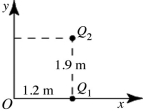
(Multiple Choice)
4.8/5 (85)
(85) An electric dipole consists of charges ±5.00 µC separated by 1.20 mm.It is placed in a vertical electric field of magnitude 525 N/C oriented as shown in the figure.The magnitude of the net torque this field exerts on the dipole is closest to 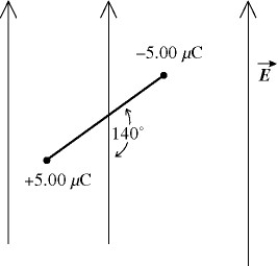
(Multiple Choice)
4.8/5 (62)
(62) Three +3.0-μC point charges are at the three corners of a square of side 0.50 m. The last corner is occupied by a -3.0-μC charge. Find the magnitude of the electric field at the center of the square.
(k = 1/4πε0 = 8.99 × 10⁹ N • m2/C2)
(Short Answer)
4.7/5 (66)
(66) Two point charges Q1 and Q2 of equal magnitudes and opposite signs are positioned as shown in the figure.Which of the arrows best represents the net electric field at point P due to these two charges? 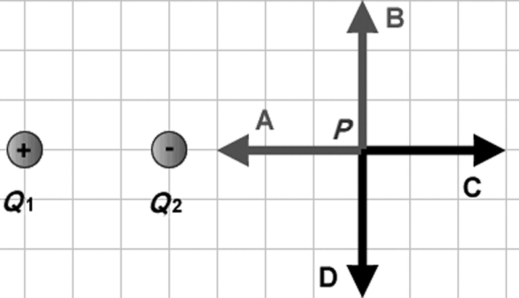
(Multiple Choice)
4.9/5 (84)
(84) 
Filters
- Essay(0)
- Multiple Choice(0)
- Short Answer(0)
- True False(0)
- Matching(0)