



 Chat with AI
Exam 20: Energy Transferred Thermally

Exam 1: Foundations48 Questions
Exam 1: A: Foundations2 k Questions
Exam 2: Motion in One Dimension15 Questions
Exam 3: Acceleration48 Questions
Exam 4: Momentum7 Questions
Exam 5: Energy15 Questions
Exam 6: Principle of Relativity5 Questions
Exam 7: Interactions7 Questions
Exam 8: Force76 Questions
Exam 9: Work48 Questions
Exam 10: Motion in a Plane134 Questions
Exam 11: Motion in a Circle54 Questions
Exam 12: Torque68 Questions
Exam 13: Gravity44 Questions
Exam 14: Special Relativity49 Questions
Exam 15: Periodic Motion49 Questions
Exam 16: Waves in One Dimension23 Questions
Exam 17: Waves in Two and Three Dimensions44 Questions
Exam 18: Fluids54 Questions
Exam 19: Entropy27 Questions
Exam 20: Energy Transferred Thermally30 Questions
Exam 21: Degradation of Energy39 Questions
Exam 22: Electric Interactions20 Questions
Exam 23: The Electric Field34 Questions
Exam 24: Gausss Law46 Questions
Exam 25: Work and Energy in Electrostatics53 Questions
Exam 26: Charge Separation and Storage33 Questions
Exam 27: Magnetic Interactions37 Questions
Exam 28: Magnetic Fields of Charged Particles in Motion35 Questions
Exam 29: Changing Magnetic Fields38 Questions
Exam 30: Changing Electric Fields30 Questions
Exam 31: Electric Circuits68 Questions
Exam 32: Electronics46 Questions
Exam 33: Ray Optics65 Questions
Exam 34: Wave and Particle Optics100 Questions
Select questions type


The process shown in the pV diagram in the figure is 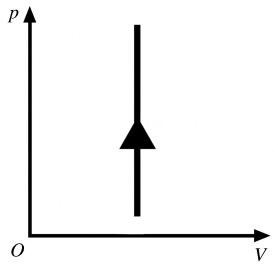

Free
(Multiple Choice)
4.9/5  (86)
(86) Correct Answer: Verified
C
During an isothermal process,5.0 J of heat is removed from an ideal gas. How much work does the gas do during this process?
Free
(Multiple Choice)
4.9/5 (80)
(80) Correct Answer:Verified
VerifiedD
(a)Internal human body temperature is often stated to be normal at 98.6°F. What is this temperature on the Celsius and Kelvin scales?
(b)Gallium boils at 2205°C.What is the corresponding temperature in the Fahrenheit and Kelvin scales?
(c)The boiling point of liquid nitrogen is 77.0 K.What is the corresponding temperature in the Fahrenheit and Celsius scales?
Free
(Short Answer)
4.7/5 (87)
(87) Correct Answer:Verified
Verified(a)37.0°C
,310 K
(b)4001°F
,2478 K
(c)-321°F
,-196°C
When a fixed amount of ideal gas goes through an isochoric process
(Multiple Choice)
4.8/5 (72)
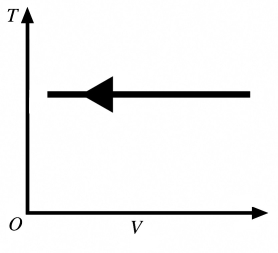
(72) When a fixed amount of ideal gas goes through an isothermal expansion
(Multiple Choice)
4.8/5 (81)
(81) A container of ideal gas has a movable frictionless piston.This container is placed in a very large water bath and slowly compressed so that the temperature of the gas remains constant and equal to the temperature of the water.Which of the following statements about this gas are true for this process? (There may be more than one correct choice.)
(Multiple Choice)
4.8/5 (87)
(87) During an adiabatic process,an ideal gas does 25 J of work. What is the change in the internal (thermal)energy of the gas during this process?
(Multiple Choice)
4.8/5 (74)
(74) An ideal gas is compressed in a well-insulated chamber using a well-insulated piston.This process is
(Multiple Choice)
4.9/5 (71)
(71) It is a well-known fact that water has a higher specific heat than iron.Now,consider equal masses of water and iron that are initially in thermal equilibrium.The same amount of heat,30 calories,is added to each one.Which statement is true?
(Multiple Choice)
4.8/5 (66)
(66) An ideal gas with γ = 1.67 is initially at 0°C in a volume of 10.0 L at a pressure of 1.00 atm.It is then expanded adiabatically to a volume of 10.4 L.What is the final temperature of the gas?
(Multiple Choice)
4.9/5 (84)
(84) A system has a heat source supplying heat to an ideal gas at a rate of 187.0 W and the gas is doing work at a rate of 130.9 W.At what rate is the internal (thermal)energy of the gas changing?
(Multiple Choice)
4.8/5 (80)
(80) When a fixed amount of ideal gas goes through an adiabatic expansion
(Multiple Choice)
4.9/5 (80)
(80) An ideal gas increases in temperature from 22°C to 42°C by two different processes.In one process,the temperature increases at constant volume,and in the other process the temperature increases at constant pressure.Which of the following statements about this gas are correct? (There may be more than one correct choice.)
(Multiple Choice)
4.8/5 (72)
(72) An ideal gas is allowed to expand slowly at constant temperature to twice its original volume. During the expansion,the gas absorbs 200 kJ of heat.
(a)What is the change in the internal (thermal)energy of the gas during the expansion?
(b)How much work does the gas do during the expansion?
(Short Answer)
4.7/5 (79)
(79) 
Heat is added to a pure substance in a closed container at a constant rate.The figure shows a graph of the temperature of the substance as a function of time.If Lf = latent heat of fusion and Lv = latent heat of vaporization,what is the value of the ratio Lv / Lf for this substance? 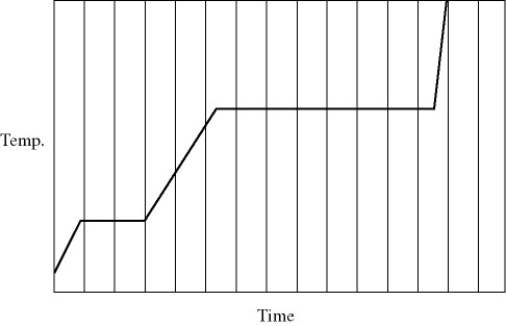
(Multiple Choice)
4.9/5 (90)
(90) An adiabatic compression is performed on an ideal gas.The final pressure is equal to 0.560 times the initial pressure and the final volume equals 1.50 times the initial volume.What is the adiabatic constant for the gas?
(Multiple Choice)
4.8/5 (75)
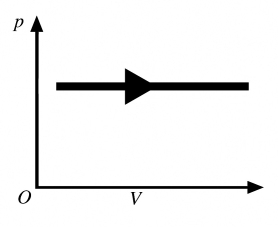
(75) When a fixed amount of ideal gas goes through an isobaric expansion
(Multiple Choice)
4.9/5 (85)
(85) 

Filters
- Essay(0)
- Multiple Choice(0)
- Short Answer(0)
- True False(0)
- Matching(0)