



 Chat with AI
Exam 31: Electric Circuits

Exam 1: Foundations48 Questions
Exam 1: A: Foundations2 k Questions
Exam 2: Motion in One Dimension15 Questions
Exam 3: Acceleration48 Questions
Exam 4: Momentum7 Questions
Exam 5: Energy15 Questions
Exam 6: Principle of Relativity5 Questions
Exam 7: Interactions7 Questions
Exam 8: Force76 Questions
Exam 9: Work48 Questions
Exam 10: Motion in a Plane134 Questions
Exam 11: Motion in a Circle54 Questions
Exam 12: Torque68 Questions
Exam 13: Gravity44 Questions
Exam 14: Special Relativity49 Questions
Exam 15: Periodic Motion49 Questions
Exam 16: Waves in One Dimension23 Questions
Exam 17: Waves in Two and Three Dimensions44 Questions
Exam 18: Fluids54 Questions
Exam 19: Entropy27 Questions
Exam 20: Energy Transferred Thermally30 Questions
Exam 21: Degradation of Energy39 Questions
Exam 22: Electric Interactions20 Questions
Exam 23: The Electric Field34 Questions
Exam 24: Gausss Law46 Questions
Exam 25: Work and Energy in Electrostatics53 Questions
Exam 26: Charge Separation and Storage33 Questions
Exam 27: Magnetic Interactions37 Questions
Exam 28: Magnetic Fields of Charged Particles in Motion35 Questions
Exam 29: Changing Magnetic Fields38 Questions
Exam 30: Changing Electric Fields30 Questions
Exam 31: Electric Circuits68 Questions
Exam 32: Electronics46 Questions
Exam 33: Ray Optics65 Questions
Exam 34: Wave and Particle Optics100 Questions
Select questions type


For the circuit shown in the figure,what is the current through resistor R1? 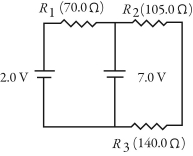

Free
(Multiple Choice)
4.8/5  (81)
(81) Correct Answer: Verified
A
Consider the circuit shown in the figure.Note that two currents are shown.Calculate the emfs ε1 and ε3. 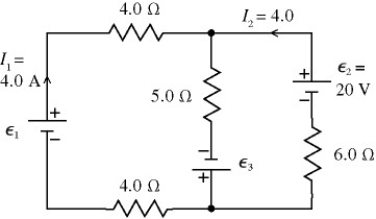
Free
(Short Answer)
5.0/5 (67)
(67) Correct Answer:Verified
Verifiedε1 = 28 V
,ε3 = 44 V
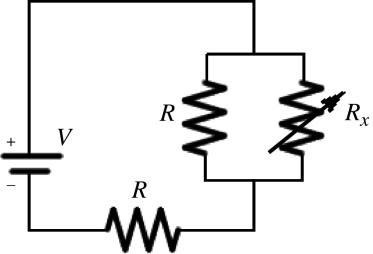
Two identical resistors of resistance R = 24 Ω and a variable resistor Rx are connected to an ideal battery of voltage V as shown in the figure. What should be the value of the variable resistance Rx to make the voltage across the two parallel resistors equal to  .
. Free
(Multiple Choice)
4.9/5 (79)
(79) Correct Answer:Verified
VerifiedC
In the circuit shown in the figure,four identical resistors labeled A to D are connected to a battery as shown.S1 and S2 are switches.Which of the following actions would result in the GREATEST amount of current through resistor A? 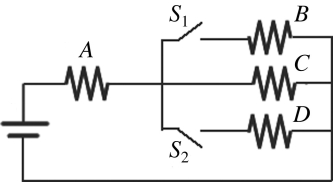
(Multiple Choice)
4.8/5 (75)
(75) A multiloop circuit is shown in the figure.Some circuit quantities are not labeled.It is not necessary to solve the entire circuit.The current I2 is closest to 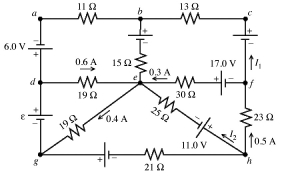
(Multiple Choice)
5.0/5 (86)
(86) When four identical resistors are connected to an ideal battery of voltage V = 10 V as shown in the figure,the current I is equal to 0.20 A.What is the value of the resistance R of the resistors? 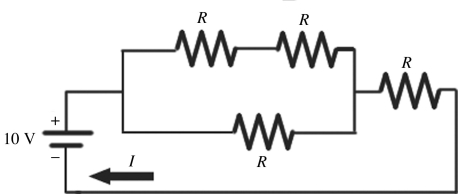
(Multiple Choice)
4.9/5 (94)
(94) The voltage and power ratings of a particular light bulb,which are its normal operating values,are 110 V and 60 W.Assume the resistance of the filament of the bulb is constant and is independent of operating conditions.If the light bulb is operated at a reduced voltage and the power drawn by the bulb is 36 W,what is the operating voltage of the bulb?
(Multiple Choice)
5.0/5 (69)
(69) A resistor is made out of a long wire having a length L.Each end of the wire is attached to a terminal of a battery providing a constant voltage V0.A current I flows through the wire.If the wire were cut in half,making two wires of length L/2,and both wires were attached to the battery (the end of both wires attached to one terminal,and the other ends attached to the other terminal),what would be the total current flowing through the two wires?
(Multiple Choice)
4.8/5 (83)
(83) In the figure a current of 6.0 A is drawn from the battery.What is the terminal voltage Vab of the battery? 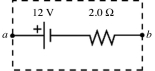
(Multiple Choice)
4.8/5 (77)
(77) A multiloop circuit is shown in the figure.Some circuit quantities are not labeled.It is not necessary to solve the entire circuit.The current I1 is closest to 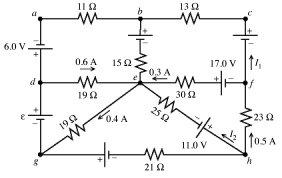
(Multiple Choice)
4.8/5 (80)
(80) An electric device delivers a current of 5.0 A to a device.How many electrons flow through this device in 10 s? (e = 1.60 × 10⁻¹⁹C)
(Multiple Choice)
4.9/5 (79)
(79) As current flows through a uniform wire,the wire gets hotter because the electrons stop moving and therefore transform their lost kinetic energy into thermal energy in the wire.
(True/False)
4.9/5 (77)
(77) When a potential difference of 10 V is placed across a certain solid cylindrical resistor,the current through it is 2 A.If the diameter of this resistor is now tripled,the current will be
(Multiple Choice)
4.9/5 (84)
(84) If the current density in a wire or radius R is given by J = kr,0 < r < R,what is the current in the wire?
(Multiple Choice)
4.9/5 (72)
(72) The diameter of a 12-gauge copper wire is 0.081 in. The maximum safe current it can carry (in order to prevent fire danger in building construction)is 20 A. At this current,what is the drift velocity of the electrons? The number of electron carriers in 1.0 cm3 of copper is 8.5 × 10²² and e = 1.60 × 10⁻¹⁹ C.
(Multiple Choice)
4.8/5 (84)
(84) Thirteen resistors are connected across points A and B as shown in the figure.If all the resistors are accurate to 2 significant figures,what is the equivalent resistance between points A and B? 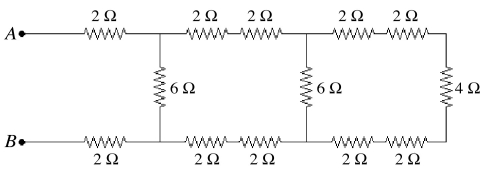
(Multiple Choice)
4.9/5 (80)
(80) The figure shows three identical lightbulbs connected to a battery having a constant voltage across its terminals.What happens to the brightness of lightbulb 1 when the switch S is closed? 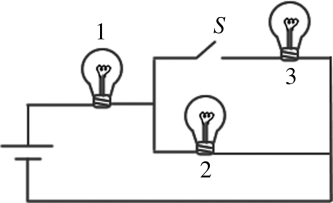
(Multiple Choice)
5.0/5 (68)
(68) A multiloop circuit is shown in the figure.Some circuit quantities are not labeled.It is not necessary to solve the entire circuit.The emf ε is closest to 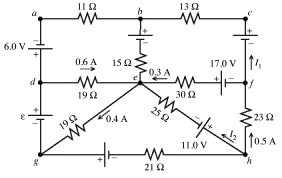
(Multiple Choice)
4.7/5 (78)
(78) A wire has a cross-sectional area of 0.10 mm2.If there are 4.0 × 1028 atoms per cubic meter in this wire,and if each atom contributes 2 free electrons,what is the drift velocity of the electrons when the current in the wire is 6.0 A? (e = 1.60 × 10⁻¹⁹C)
(Multiple Choice)
4.8/5 (83)
(83) You are given a copper bar of dimensions 3 cm × 5 cm × 8 cm and asked to attach leads to it in order to make a resistor.
(a)If you want to achieve the SMALLEST possible resistance,you should attach the leads to the opposite faces that measure
A)3 cm × 5 cm.
B)3 cm × 8 cm.
C)5 cm × 8 cm.
D)Any pair of faces produces the same resistance.
(b) If you want to achieve the LARGEST possible resistance,you should attach the leads to the opposite faces that measure
A)3 cm × 5 cm.
B)3 cm × 8 cm.
C)5 cm × 8 cm.
D)Any pair of faces produces the same resistance
(Short Answer)
4.9/5 (82)
(82) 
Filters
- Essay(0)
- Multiple Choice(0)
- Short Answer(0)
- True False(0)
- Matching(0)