



 Chat with AI
Exam 15: Periodic Motion

Exam 1: Foundations48 Questions
Exam 1: A: Foundations2 k Questions
Exam 2: Motion in One Dimension15 Questions
Exam 3: Acceleration48 Questions
Exam 4: Momentum7 Questions
Exam 5: Energy15 Questions
Exam 6: Principle of Relativity5 Questions
Exam 7: Interactions7 Questions
Exam 8: Force76 Questions
Exam 9: Work48 Questions
Exam 10: Motion in a Plane134 Questions
Exam 11: Motion in a Circle54 Questions
Exam 12: Torque68 Questions
Exam 13: Gravity44 Questions
Exam 14: Special Relativity49 Questions
Exam 15: Periodic Motion49 Questions
Exam 16: Waves in One Dimension23 Questions
Exam 17: Waves in Two and Three Dimensions44 Questions
Exam 18: Fluids54 Questions
Exam 19: Entropy27 Questions
Exam 20: Energy Transferred Thermally30 Questions
Exam 21: Degradation of Energy39 Questions
Exam 22: Electric Interactions20 Questions
Exam 23: The Electric Field34 Questions
Exam 24: Gausss Law46 Questions
Exam 25: Work and Energy in Electrostatics53 Questions
Exam 26: Charge Separation and Storage33 Questions
Exam 27: Magnetic Interactions37 Questions
Exam 28: Magnetic Fields of Charged Particles in Motion35 Questions
Exam 29: Changing Magnetic Fields38 Questions
Exam 30: Changing Electric Fields30 Questions
Exam 31: Electric Circuits68 Questions
Exam 32: Electronics46 Questions
Exam 33: Ray Optics65 Questions
Exam 34: Wave and Particle Optics100 Questions
Select questions type


An ideal massless spring with a spring constant of 2.00 N/m is attached to an object of 75.0 g.The system has a small amount of damping.If the amplitude of the oscillations decreases from 10.0 mm to 5.00 mm in 15.0 s,what is the magnitude of the damping constant b?

Free
(Multiple Choice)
4.8/5  (87)
(87) Correct Answer: Verified
A
A large stick is pivoted about one end and allowed to swing back and forth with no friction as a physical pendulum.The mass of the stick is 5.40 kg and its center of gravity (found by finding its balance point)is 1.80 m from the pivot.If the period of the swinging stick is 6.90 seconds,what is the moment of inertia of the stick about an axis through the pivot?
Free
(Short Answer)
4.9/5 (79)
(79) Correct Answer:Verified
Verified115 kg • m2
A 0.28-kg block on a horizontal frictionless surface is attached to an ideal massless spring whose spring constant is 500 N/m.The block is pulled from its equilibrium position at x = 0.00 m to a displacement x = +0.080 m and is released from rest.The block then executes simple harmonic motion along the horizontal x-axis.When the displacement is x = -0.052 m,find the acceleration of the block.
Free
(Multiple Choice)
4.9/5 (84)
(84) Correct Answer:Verified
VerifiedA
An object is undergoing simple harmonic motion with frequency f = 9.7 Hz and an amplitude of 0.12 m.At t = 0.00 s the object is at x = 0.00 m.How long does it take the object to go from x = 0.00 m to
x = 0.048 m?
(Short Answer)
4.9/5 (77)
(77) The position x of an object varies with time t.For which of the following equations relating x and t is the motion of the object simple harmonic motion? (There may be more than one correct choice.)
(Multiple Choice)
4.9/5 (73)
(73) A 56.0 kg bungee jumper jumps off a bridge and undergoes simple harmonic motion.If the period of oscillation is 11.2 s,what is the spring constant of the bungee cord,assuming it has negligible mass compared to that of the jumper?
(Multiple Choice)
4.9/5 (86)
(86) If we double only the spring constant of a vibrating ideal mass-and-spring system,the mechanical energy of the system
(Multiple Choice)
5.0/5 (76)
(76) A 1.6-kg block on a horizontal frictionless surface is attached to an ideal massless spring whose spring constant is 190 N/m.The block is pulled from its equilibrium position at x = 0.00 m to a displacement
X = +0.080 m and is released from rest.The block then executes simple harmonic motion along the horizontal x-axis.What is the velocity of the block at time t = 0.40 s?
(Multiple Choice)
4.9/5 (92)
(92) A mass M is attached to an ideal massless spring.When this system is set in motion with amplitude A,it has a period T.What is the period if the amplitude of the motion is increased to 2A?
(Multiple Choice)
4.8/5 (75)
(75) A 0.025-kg block on a horizontal frictionless surface is attached to an ideal massless spring whose spring constant is 150 N/m.The block is pulled from its equilibrium position at x = 0.00 m to a displacement x = +0.080 m and is released from rest.The block then executes simple harmonic motion along the horizontal x-axis.When the displacement is x = 0.024 m,what is the kinetic energy of the block?
(Multiple Choice)
4.9/5 (76)
(76) A 2.0 kg block on a frictionless table is connected to two ideal massless springs with spring constants k1 and k2 whose opposite ends are fixed to walls,as shown in the figure.What is angular frequency of the oscillation if k1 = 7.6 N/m and k2 = 5.0 N/m? 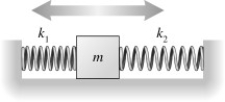
(Multiple Choice)
4.9/5 (94)
(94) If we double only the mass of a vibrating ideal mass-and-spring system,the mechanical energy of the system
(Multiple Choice)
4.8/5 (82)
(82) An object of mass 6.8 kg is attached to an ideal massless spring of spring constant 1690 N/m.The object is Calculate the maximum speed the object reaches during its motion.
(Short Answer)
4.8/5 (81)
(81) The angle that a swinging simple pendulum makes with the vertical obeys the equation
Θ(t)= (0.150 rad)cos[(2.85 rad/s)t + 1.66].
(a)What is the length of the pendulum?
A)0.15 m
B)0.83 m
C)1.21 m
D)2.02 m
E)It cannot be determined from the information given.
(b)What is the mass of the swinging bob at the end of the pendulum?
A)2.85 kg
B)1.66 kg
C)0.454 kg
D)0.150 kg
E)It cannot be determined from the information given.
(Short Answer)
4.7/5 (80)
(80) If we double only the amplitude of a vibrating ideal mass-and-spring system,the mechanical energy of the system
(Multiple Choice)
4.7/5 (79)
(79) A frictionless pendulum clock on the surface of the earth has a period of 1.00 s.On a distant planet,the length of the pendulum must be shortened slightly to have a period of 1.00 s.What is true about the acceleration due to gravity on the distant planet?
(Multiple Choice)
4.9/5 (70)
(70) A 0.50-kg object is attached to an ideal massless spring of spring constant 20 N/m along a horizontal,frictionless surface. The object oscillates in simple harmonic motion and has a speed of 1.5 m/s at the equilibrium position.
(a)What is the amplitude of vibration?
(b)At what location are the kinetic energy and the potential energy of the system the same?
(Short Answer)
4.8/5 (91)
(91) A frictionless pendulum released from 65 degrees with the vertical will vibrate with the same frequency as if it were released from 5 degrees with the vertical because the period is independent of the amplitude and mass.
(True/False)
4.7/5 (94)
(94) The amplitude of a lightly damped harmonic oscillator decreases from 60.0 cm to 40.0 cm in 10.0 s. What will be the amplitude of the harmonic oscillator after another 10.0 s passes?
(Multiple Choice)
4.8/5 (79)
(79) A 5.0-kg block is attached to an ideal massless spring whose spring constant is 125 N/m.The block is pulled from its equilibrium position at x = 0.00 m to a position at x = +0.687 m and is released from rest.The block then executes lightly damped oscillation along the x-axis,and the damping force is proportional to the velocity.When the block first returns to x = 0.00 m,its x component of velocity is -2.0 m/s and its x component of acceleration is +5.6 m/s2.
(a)What is the magnitude of the acceleration of the block upon release at x = +0.687 m.
(b)Find the damping constant b.
(Short Answer)
4.8/5 (82)
(82) 
Filters
- Essay(0)
- Multiple Choice(0)
- Short Answer(0)
- True False(0)
- Matching(0)