



 Chat with AI
Exam 24: Gausss Law

Exam 1: Foundations48 Questions
Exam 1: A: Foundations2 k Questions
Exam 2: Motion in One Dimension15 Questions
Exam 3: Acceleration48 Questions
Exam 4: Momentum7 Questions
Exam 5: Energy15 Questions
Exam 6: Principle of Relativity5 Questions
Exam 7: Interactions7 Questions
Exam 8: Force76 Questions
Exam 9: Work48 Questions
Exam 10: Motion in a Plane134 Questions
Exam 11: Motion in a Circle54 Questions
Exam 12: Torque68 Questions
Exam 13: Gravity44 Questions
Exam 14: Special Relativity49 Questions
Exam 15: Periodic Motion49 Questions
Exam 16: Waves in One Dimension23 Questions
Exam 17: Waves in Two and Three Dimensions44 Questions
Exam 18: Fluids54 Questions
Exam 19: Entropy27 Questions
Exam 20: Energy Transferred Thermally30 Questions
Exam 21: Degradation of Energy39 Questions
Exam 22: Electric Interactions20 Questions
Exam 23: The Electric Field34 Questions
Exam 24: Gausss Law46 Questions
Exam 25: Work and Energy in Electrostatics53 Questions
Exam 26: Charge Separation and Storage33 Questions
Exam 27: Magnetic Interactions37 Questions
Exam 28: Magnetic Fields of Charged Particles in Motion35 Questions
Exam 29: Changing Magnetic Fields38 Questions
Exam 30: Changing Electric Fields30 Questions
Exam 31: Electric Circuits68 Questions
Exam 32: Electronics46 Questions
Exam 33: Ray Optics65 Questions
Exam 34: Wave and Particle Optics100 Questions
Select questions type


Four dipoles,each consisting of a +10-µC charge and a -10-µC charge,are located in the xy-plane with their centers 1.0 mm from the origin,as shown.A sphere passes through the dipoles,as shown in the figure.What is the electric flux through the sphere due to these dipoles? (ε0 = 8.85 × 10⁻¹² C2/N • m2) 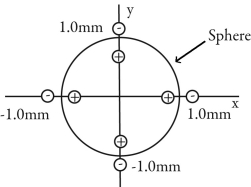

Free
(Multiple Choice)
4.8/5  (81)
(81) Correct Answer: Verified
A
A neutral hollow spherical conducting shell of inner radius 1.00 cm and outer radius 3.00 cm has a +2.00-µC point charge placed at its center.Find the surface charge density
(a)on the inner surface of the shell.
(b)on the outer surface of the shell.
Free
(Short Answer)
4.8/5 (82)
(82) Correct Answer:Verified
Verified(a)-1590 µC/m2
(b)+177 µC/m2
If the electric flux through a closed surface is zero,the electric field at points on that surface must be zero.
Free
(True/False)
5.0/5 (85)
(85) Correct Answer:Verified
VerifiedFalse
A charge of 1.0 × 10⁻⁶ μC is located inside a sphere,1.25 cm from its center.What is the electric flux through the sphere due to this charge? (ε0 = 8.85 × 10⁻¹² C2/N • m2)
(Multiple Choice)
4.9/5 (66)
(66) A cone is resting on a tabletop as shown in the figure with its face horizontal.A uniform electric field of magnitude 4550 N/C points vertically upward.How much electric flux passes through the sloping side surface area of the cone? 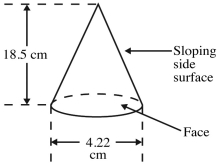
(Short Answer)
5.0/5 (82)
(82) If a rectangular area is rotated in a uniform electric field from the position where the maximum electric flux goes through it to an orientation where only half the flux goes through it,what has been the angle of rotation?
(Multiple Choice)
5.0/5 (81)
(81) A hollow conducting spherical shell has radii of 0.80 m and 1.20 m,as shown in the figure.The sphere carries a net excess charge of -500 nC.A point charge of +300 nC is present at the center.
(k = 1/4πε0 = 8.99 × 10⁹ N • m2/C)The radial component of the electric field at a point that is 1.50 m from the center is closest to 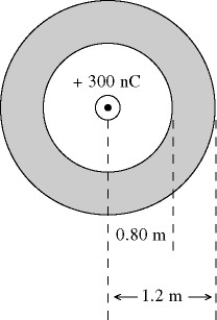
(Multiple Choice)
4.9/5 (63)
(63) A hollow conducting spherical shell has radii of 0.80 m and 1.20 m,as shown in the figure.The sphere carries an excess charge of -500 nC.A point charge of +300 nC is present at the center.The surface charge density on the inner spherical surface is closest to 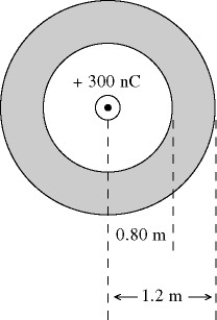
(Multiple Choice)
4.7/5 (77)
(77) Under electrostatic conditions,the electric field just outside the surface of any charged conductor
(Multiple Choice)
4.9/5 (94)
(94) The cross section of a long coaxial cable is shown in the figure,with radii as given.The linear charge density on the inner conductor is -40 nC/m and the linear charge density on the outer conductor is
-50 nC/m.The inner and outer cylindrical surfaces are respectively denoted by A,B,C,and D,as shown.(ε0 = 8.85 × 10⁻¹² C2/N • m2) The magnitude of the electric field at a point that is 94 mm from the axis is closest to 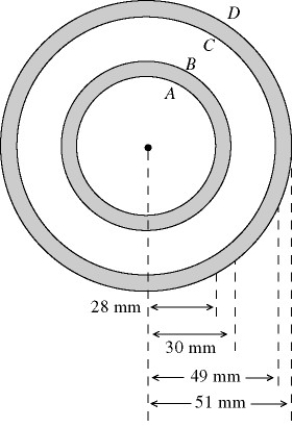
(Multiple Choice)
4.8/5 (85)
(85) A charge q = 2.00 μC is placed at the origin in a region where there is already a uniform electric
Field  = (100 N/C)
 )Calculate the flux of the net electric field through a Gaussian sphere of radius
R = 10.0 cm centered at the origin.(ε0 = 8.85 × 10⁻¹² C2/N • m2)
= (100 N/C)
)Calculate the flux of the net electric field through a Gaussian sphere of radius
R = 10.0 cm centered at the origin.(ε0 = 8.85 × 10⁻¹² C2/N • m2) (Multiple Choice)
4.9/5 (92)
(92) Two very large,flat plates are parallel to each other. Plate A,located at y = 1.0 cm,is along the xz-plane and carries a uniform surface charge density -1.00 μC/m2. Plate B is located at y = -1.0 cm and carries a uniform surface charge density +2.00 μC/m2.What is the electric field vector at the point having x,y,z coordinates (-0.50 cm,0.00 cm,0.00 cm)? (ε0 = 8.85 × 10⁻¹² C2/N • m2)
(Multiple Choice)
4.7/5 (80)
(80) A nonuniform electric field is directed along the x-axis at all points in space.This magnitude of the field varies with x,but not with respect to y or z.The axis of a cylindrical surface,0.80 m long and 0.20 m in diameter,is aligned parallel to the x-axis,as shown in the figure.The electric fields E1 and E2,at the ends of the cylindrical surface,have magnitudes of 6000 N/C and 1000 N/C respectively,and are directed as shown.What is the net electric flux passing through the cylindrical surface? 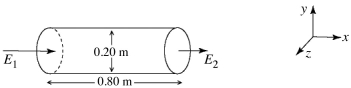
(Multiple Choice)
4.8/5 (82)
(82) The graph in the figure shows the electric field strength (not the field lines)as a function of distance from the center for a pair of concentric uniformly charged spheres.Which of the following situations could the graph plausibly represent? (There may be more than one correct choice.) 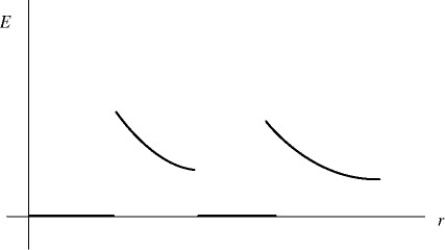
(Multiple Choice)
4.8/5 (80)
(80) Electric charge is uniformly distributed inside a nonconducting sphere of radius 0.30 m.The electric field at a point P,which is 0.50 m from the center of the sphere,is 15,000 N/C and is directed radially outward.What is the maximum magnitude of the electric field due to this sphere?
(Multiple Choice)
5.0/5 (79)
(79) Consider two closely spaced and oppositely charged parallel metal plates.The plates are square with sides of length L and carry charges Q and -Q on their facing surfaces.What is the magnitude of the electric field in the region between the plates?
(Multiple Choice)
4.8/5 (82)
(82) Two large,flat,horizontally oriented plates are parallel to each other,a distance d apart.Half way between the two plates the electric field has magnitude E.If the separation of the plates is reduced to d/2 what is the magnitude of the electric field half way between the plates?
(Multiple Choice)
4.9/5 (88)
(88) A solid nonconducting sphere of radius R carries a charge Q distributed uniformly throughout its volume.At a certain distance r1 (r1 < R)from the center of the sphere,the electric field has magnitude E.If the same charge Q were distributed uniformly throughout a sphere of radius 2R,the magnitude of the electric field at the same distance r1 from the center would be equal to
(Multiple Choice)
4.8/5 (76)
(76) The cube of insulating material shown in the figure has one corner at the origin.Each side of the cube has length 0.080 m so the top face of the cube is parallel to the xz-plane and is at y = 0.080 m.It is observed that there is an electric field  that is in the +y direction and whose magnitude depends only on y.Use Gauss's law to calculate the net charge enclosed by the cube.
(ε0 = 8.85 × 10⁻¹² C2/N • m2)
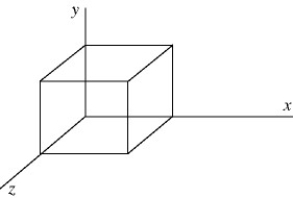
that is in the +y direction and whose magnitude depends only on y.Use Gauss's law to calculate the net charge enclosed by the cube.
(ε0 = 8.85 × 10⁻¹² C2/N • m2) (Short Answer)
4.9/5 (87)
(87) At a distance D from a very long (essentially infinite)uniform line of charge,the electric field strength is 1000 N/C.At what distance from the line will the field strength to be 2000 N/C?
(Multiple Choice)
4.8/5 (82)
(82) 
Filters
- Essay(0)
- Multiple Choice(0)
- Short Answer(0)
- True False(0)
- Matching(0)