



 Chat with AI
Exam 24: Gausss Law

Exam 1: Foundations48 Questions
Exam 1: A: Foundations2 k Questions
Exam 2: Motion in One Dimension15 Questions
Exam 3: Acceleration48 Questions
Exam 4: Momentum7 Questions
Exam 5: Energy15 Questions
Exam 6: Principle of Relativity5 Questions
Exam 7: Interactions7 Questions
Exam 8: Force76 Questions
Exam 9: Work48 Questions
Exam 10: Motion in a Plane134 Questions
Exam 11: Motion in a Circle54 Questions
Exam 12: Torque68 Questions
Exam 13: Gravity44 Questions
Exam 14: Special Relativity49 Questions
Exam 15: Periodic Motion49 Questions
Exam 16: Waves in One Dimension23 Questions
Exam 17: Waves in Two and Three Dimensions44 Questions
Exam 18: Fluids54 Questions
Exam 19: Entropy27 Questions
Exam 20: Energy Transferred Thermally30 Questions
Exam 21: Degradation of Energy39 Questions
Exam 22: Electric Interactions20 Questions
Exam 23: The Electric Field34 Questions
Exam 24: Gausss Law46 Questions
Exam 25: Work and Energy in Electrostatics53 Questions
Exam 26: Charge Separation and Storage33 Questions
Exam 27: Magnetic Interactions37 Questions
Exam 28: Magnetic Fields of Charged Particles in Motion35 Questions
Exam 29: Changing Magnetic Fields38 Questions
Exam 30: Changing Electric Fields30 Questions
Exam 31: Electric Circuits68 Questions
Exam 32: Electronics46 Questions
Exam 33: Ray Optics65 Questions
Exam 34: Wave and Particle Optics100 Questions
Select questions type


As shown in the figure,a square insulating slab 5.0 mm thick measuring 2.0 m × 2.0 m has a charge of 8.0 × 10⁻¹¹ C distributed uniformly throughout its volume.Use Gauss's law to determine the electric field at point P,which is located within the slab beneath its center,1.0 mm from one of the faces.
(ε0 = 8.85 × 10⁻¹² C2/N • m2) 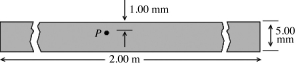
(Multiple Choice)
4.9/5  (71)
(71) A spherical,non-conducting shell of inner radius r1 = 10 cm and outer radius r2 = 15 cm carries a total charge Q = 15 μC distributed uniformly throughout the volume of the shell.What is the magnitude of the electric field at a distance r = 12 cm from the center of the shell? (k = 1/4πε0 = 8.99 × 10⁹ N • m2/C2)
(Multiple Choice)
4.9/5 (76)
(76) Two concentric conducting spherical shells produce a radially outward electric field of magnitude 49,000 N/C at a point 4.10 m from the center of the shells.The outer surface of the larger shell has a radius of 3.75 m.If the inner shell contains an excess charge of -5.30 μC,find the amount of charge on the outer surface of the larger shell.(k = 1/4πε0 = 8.99 × 10⁹ N ∙ m2/C2)
(Short Answer)
5.0/5 (81)
(81) A nonconducting spherical shell of inner radius R1 and outer radius R2 contains a uniform volume charge density ρ throughout the shell.Use Gauss's law to derive an equation for the magnitude of the electric field at the following radial distances r from the center of the sphere.Your answers should be in terms of ρ,R1,R2,r,ε0 ,and π.
(a)r < R1
(b)R1 < r < R2
(c)r > R2
(Essay)
4.9/5 (89)
(89) Charge is distributed uniformly throughout a large insulating cylinder of radius R.The charge per unit length in the cylindrical volume is λ.
(a)Use Gauss's law to find the magnitude of the electric field at a distance r from the central axis of the cylinder for r < R.Your answer should be in terms of r,R,λ,ε0 ,and π.
(b)Check the reasonableness of your answer by evaluating it at the surface of the cylinder.
(Essay)
4.7/5 (73)
(73) Two very large parallel sheets a distance d apart have their centers directly opposite each other.The sheets carry equal but opposite uniform surface charge densities.A point charge that is placed near the middle of the sheets a distance d/2 from each of them feels an electrical force F due to the sheets.If this charge is now moved closer to one of the sheets so that it is a distance d/4 from that sheet,what force will feel?
(Multiple Choice)
4.8/5 (75)
(75) Which of the following statements about Gauss's law are correct? (There may be more than one correct choice.)
(Multiple Choice)
4.9/5 (93)
(93) An uncharged conductor has a hollow cavity inside of it.Within this cavity there is a charge of +10 µC that does not touch the conductor.There are no other charges in the vicinity.Which statement about this conductor is true? (There may be more than one correct choice.)
(Multiple Choice)
4.8/5 (84)
(84) A huge (essentially infinite)horizontal nonconducting sheet 10.0 cm thick has charge uniformly spread over both faces.The upper face carries +95.0 nC/m2 while the lower face carries -25.0 nC/ m2.What is the magnitude of the electric field at a point within the sheet 2.00 cm below the upper face?
(ε0 = 8.85 × 10⁻¹² C2/N • m2)
(Multiple Choice)
4.9/5 (83)
(83) A charge Q is uniformly spread over one surface of a very large nonconducting square elastic sheet having sides of length d.At a point P that is 1.25 cm outside the sheet,the magnitude of the electric field due to the sheet is E.If the sheet is now stretched so that its sides have length 2d,what is the magnitude of the electric field at P?
(Multiple Choice)
4.8/5 (78)
(78) An electric field is set up between two parallel plates,each of area 2.0 m2,by putting 1.0 μC of charge on one plate and -1.0 μC of charge on the other.The plates are separated by 4.0 mm with their centers opposite each other,and the charges are distributed uniformly over the surface of the plates.What is the magnitude of the electric field between the plates at a distance of 1.0 mm from the positive plate,but not near the edges of the plates? (ε0 = 8.85 × 10⁻¹² C2/N • m2)
(Multiple Choice)
4.9/5 (64)
(64) An infinitely long nonconducting cylinder of radius R = 2.00 cm carries a uniform volume charge density of 18.0 µC/m3. Calculate the electric field at distance r = 1.00 cm from the axis of the cylinder. (ε0 = 8.85 × 10⁻¹² C2/N • m2)
(Multiple Choice)
4.9/5 (87)
(87) Two concentric spheres are shown in the figure.The inner sphere is a solid nonconductor and carries a charge of +5.00 µC uniformly distributed over its outer surface.The outer sphere is a conducting shell that carries a net charge of -8.00 µC.No other charges are present.The radii shown in the figure have the values R1 = 10.0 cm,R2 = 20.0 cm,and R3 = 30.0 cm.(k = 1/4πε0 = 8.99 × 10⁹ N • m2/C2)
(a)Find the total excess charge on the inner and outer surfaces of the conducting sphere.
(b)Find the magnitude and direction of the electric field at the following distances r from the center of the inner sphere: (i)r = 9.5 cm,(ii)r = 15.0 cm,(iii)r = 27.0 cm,(iv)r = 35.0 cm. 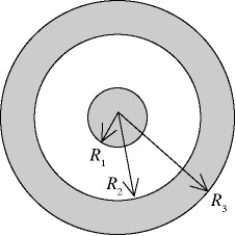
(Essay)
4.9/5 (68)
(68) Two flat 4.0 cm × 4.0 cm electrodes carrying equal but opposite charges are spaced 2.0 mm apart with their midpoints opposite each other.Between the electrodes but not near their edges,the electric field strength is 2.5 × 10⁶ N/C.What is the magnitude of the charge on each electrode?
(ε0 = 8.85 × 10⁻¹² C2/N • m2)
(Multiple Choice)
4.8/5 (78)
(78) The electric field strength in the space between two closely spaced parallel disks is 1.0 × 10⁵ N/C.This field is the result of transferring 3.9 × 10⁹ electrons from one disk to the other.What is the diameter of the disks? (e = 1.60 × 10⁻¹⁹ C,ε0 = 8.85 × 10⁻¹² C2/N • m2)
(Multiple Choice)
4.7/5 (81)
(81) The figure shows four Gaussian surfaces surrounding a distribution of charges. 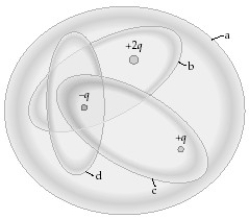 (a)Which Gaussian surfaces have an electric flux of +q/ε0 through them?
(b)Which Gaussian surfaces have no electric flux through them?
(a)Which Gaussian surfaces have an electric flux of +q/ε0 through them?
(b)Which Gaussian surfaces have no electric flux through them? (Short Answer)
4.9/5 (88)
(88) A non-conducting sphere of radius R = 7.0 cm carries a charge Q = 4.0 mC distributed uniformly throughout its volume.At what distance,measured from the center of the sphere,does the electric field reach a value equal to half its maximum value?
(Multiple Choice)
4.7/5 (80)
(80) A solid nonconducting sphere of radius R carries a uniform charge density throughout its volume.At a radial distance r1 = R/4 from the center,the electric field has a magnitude E0. What is the magnitude of the electric field at a radial distance r2 = 2R?
(Multiple Choice)
4.9/5 (97)
(97) Consider a spherical Gaussian surface of radius R centered at the origin.A charge Q is placed inside the sphere.To maximize the magnitude of the flux of the electric field through the Gaussian surface,the charge should be located
(Multiple Choice)
4.8/5 (65)
(65) Electric charge is uniformly distributed inside a nonconducting sphere of radius 0.30 m.The electric field at a point P,which is 0.50 m from the center of the sphere,is 15,000 N/C and is directed radially outward.At what distance from the center of the sphere does the electric field have the same magnitude as it has at P?
(Multiple Choice)
4.9/5 (92)
(92) 
Filters
- Essay(0)
- Multiple Choice(0)
- Short Answer(0)
- True False(0)
- Matching(0)