



 Chat with AI
Exam 23: The Electric Field

Exam 1: Foundations48 Questions
Exam 1: A: Foundations2 k Questions
Exam 2: Motion in One Dimension15 Questions
Exam 3: Acceleration48 Questions
Exam 4: Momentum7 Questions
Exam 5: Energy15 Questions
Exam 6: Principle of Relativity5 Questions
Exam 7: Interactions7 Questions
Exam 8: Force76 Questions
Exam 9: Work48 Questions
Exam 10: Motion in a Plane134 Questions
Exam 11: Motion in a Circle54 Questions
Exam 12: Torque68 Questions
Exam 13: Gravity44 Questions
Exam 14: Special Relativity49 Questions
Exam 15: Periodic Motion49 Questions
Exam 16: Waves in One Dimension23 Questions
Exam 17: Waves in Two and Three Dimensions44 Questions
Exam 18: Fluids54 Questions
Exam 19: Entropy27 Questions
Exam 20: Energy Transferred Thermally30 Questions
Exam 21: Degradation of Energy39 Questions
Exam 22: Electric Interactions20 Questions
Exam 23: The Electric Field34 Questions
Exam 24: Gausss Law46 Questions
Exam 25: Work and Energy in Electrostatics53 Questions
Exam 26: Charge Separation and Storage33 Questions
Exam 27: Magnetic Interactions37 Questions
Exam 28: Magnetic Fields of Charged Particles in Motion35 Questions
Exam 29: Changing Magnetic Fields38 Questions
Exam 30: Changing Electric Fields30 Questions
Exam 31: Electric Circuits68 Questions
Exam 32: Electronics46 Questions
Exam 33: Ray Optics65 Questions
Exam 34: Wave and Particle Optics100 Questions
Select questions type


In the figure,a proton is projected horizontally midway between two parallel plates that are separated by 0.50 cm.The electrical field due to the plates has magnitude 610,000 N/C between the plates away from the edges.If the plates are 5.60 cm long,find the minimum speed of the proton if it just misses the lower plate as it emerges from the field.(e = 1.60 × 10⁻¹⁹ C,ε0 = 8.85 × 10⁻¹² C2/N • m2,
mel = 9.11 × 10⁻³¹ kg) 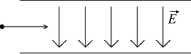
(Short Answer)
4.8/5  (80)
(80) Two point charges of +20.0 μC and -8.00 μC are separated by a distance of 20.0 cm.What is the magnitude of electric field due to these charges at a point midway between them?
(k = 1/4πε0 = 8.99 × 10⁹ N • m2/C2)
(Multiple Choice)
4.8/5 (92)
(92) A very long wire carries a uniform linear charge density of 7.0 nC/m.What is the electric field strength 16.0 m from the center of the wire at a point on the wire's perpendicular bisector?
(ε0 = 8.85 × 10⁻¹² C2/N • m2)
(Multiple Choice)
4.9/5 (72)
(72) A point charge Q of mass 8.50 g hangs from the horizontal ceiling by a light 25.0-cm thread.When a horizontal electric field of magnitude 1750 N/C is turned on,the charge hangs away from the vertical as shown in the figure.The magnitude of Q is closest to 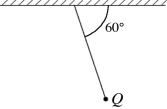
(Multiple Choice)
4.9/5 (76)
(76) A small sphere with a mass of 441 g is moving upward along the vertical +y-axis when it encounters an electric field of 5.00 N/C  . If,due to this field,the sphere suddenly acquires a horizontal acceleration of 13.0 m/s2
 ,what is the charge that it carries?
. If,due to this field,the sphere suddenly acquires a horizontal acceleration of 13.0 m/s2
,what is the charge that it carries? (Multiple Choice)
4.9/5 (78)
(78) The figure shows three electric charges labeled Q1,Q2,Q3,and some electric field lines in the region surrounding the charges.What are the signs of the three charges? 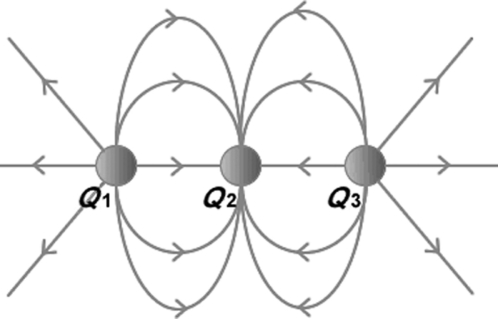
(Multiple Choice)
4.8/5 (79)
(79) In the figure,a ring 0.71 m in radius carries a charge of + 580 nC uniformly distributed over it.A point charge Q is placed at the center of the ring.The electric field is equal to zero at field point P,which is on the axis of the ring,and 0.73 m from its center.(ε0 = 8.85 × 10⁻¹² C2/N • m2)The point charge Q is closest to 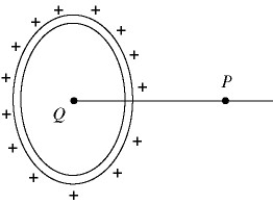
(Multiple Choice)
4.9/5 (88)
(88) A 3.0-μC positive point charge is located at the origin and a 2.0 μC positive point charge is located at
X = 0.00 m,y = 1.0 m. Find the coordinates of the point where the net electric field strength due to these charges is zero.
(Multiple Choice)
4.9/5 (65)
(65) A point charge Q = -500 nC and two unknown point charges,q1 and q2,are placed as shown in the figure.The electric field at the origin O,due to charges Q,q1 and q2,is equal to zero.The charge q1 is closest to 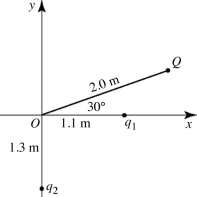
(Multiple Choice)
4.8/5 (79)
(79) A long,thin rod parallel to the y-axis is located at x = -1.0 cm and carries a uniform linear charge density of +1.0 nC/m.A second long,thin rod parallel to the z-axis is located at x = +1.0 cm and carries a uniform linear charge density of -1.0 nC/m.What is the net electric field due to these rods at the origin? (ε0 = 8.85 × 10⁻¹² C2/N • m2)
(Multiple Choice)
5.0/5 (81)
(81) Three equal negative point charges are placed at three of the corners of a square of side d as shown in the figure.Which of the arrows represents the direction of the net electric field at the center of the square? 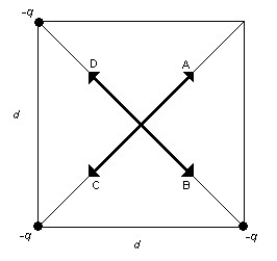
(Multiple Choice)
4.8/5 (79)
(79) A proton is placed in an electric field of intensity 700 N/C.What are the magnitude and direction of the acceleration of this proton due to this field? (mproton = 1.67 × 10⁻²⁷ kg,e = 1.60 × 10⁻¹⁹C)
(Multiple Choice)
4.8/5 (76)
(76) A dipole with a positive charge of 2.0 μC and a negative charge of -2.0 μC is centered at the origin and oriented along the x-axis with the positive charge located to the right of the origin.The charge separation is 0.0010 m.Find the electric field due to this dipole at the point x = 4.0 m,y = 0.0 m.
(k = 1/4πε0 = 8.99 × 10⁹ N • m2/C2)
(Multiple Choice)
4.8/5 (83)
(83) A small glass bead has been charged to 8.0 nC.What is the magnitude of the electric field 2.0 cm from the center of the bead? (k = 1/4πε0 = 8.99 × 10⁹ N • m2/C2)
(Multiple Choice)
4.9/5 (80)
(80) 
Filters
- Essay(0)
- Multiple Choice(0)
- Short Answer(0)
- True False(0)
- Matching(0)