



 Chat with AI
Exam 10: Energy and Work

Exam 1: Representing Motion113 Questions
Exam 2: Motion in One Dimension174 Questions
Exam 3: Vectors and Motion in Two Dimensions183 Questions
Exam 4: Forces and Newtons Laws of Motion64 Questions
Exam 5: Applying Newtons Laws82 Questions
Exam 6: Gravity96 Questions
Exam 7: Rotational Motion95 Questions
Exam 8: Equilibrium Ad Elasticity73 Questions
Exam 9: Momentum103 Questions
Exam 10: Energy and Work223 Questions
Exam 11: Using Energy106 Questions
Exam 12: Thermal Properties of Matter220 Questions
Exam 13: Fluids115 Questions
Exam 14: Oscillations105 Questions
Exam 15: Traveling Waves and Sound94 Questions
Exam 16: Superposition and Standing Waves66 Questions
Exam 17: Wave Optics129 Questions
Exam 18: Ray Optics155 Questions
Exam 19: Optical Instruments137 Questions
Exam 20: Electric Fields and Forces95 Questions
Exam 21: Electric Potential144 Questions
Exam 22: Current and Resistance125 Questions
Exam 23: Circuits157 Questions
Exam 24: Magnetic Fields and Forces168 Questions
Exam 25: EM Induction and Em Waves185 Questions
Exam 26: AC Electricity122 Questions
Exam 27: Relativity126 Questions
Exam 28: Quantum Physics86 Questions
Exam 29: Atoms and Molecules105 Questions
Exam 30: Nuclear Physics175 Questions
Select questions type


A wheel having a moment of inertia of 5.00 kg ∙ m2 starts from rest and accelerates under a constant torque of 3.00 N ∙ m for 8.00 s. What is the wheel's rotational kinetic energy at the end of 8.00 s?
(Multiple Choice)
4.8/5  (84)
(84) A small but dense 2.0-kg stone is attached to one end of a very light rod that is 1.2 m long. The other end of the rod is attached to a frictionless pivot. The rod is raised until it is vertical, with the stone above the pivot. The rod is released and the stone moves in a vertical circle with no air resistance. What is the tension in the rod as the stone moves through the bottom of the circle?
(Multiple Choice)
4.9/5 (90)
(90) A spring-loaded dart gun is used to shoot a dart straight up into the air, and the dart reaches a maximum height of 24 meters. The same dart is shot up a second time from the same gun, but this time the spring is compressed only half as far (compared to the first shot). How far up does the dart go this time (neglect all friction and assume the spring is ideal)?
(Multiple Choice)
4.9/5 (77)
(77) On a frictionless horizontal surface, a 1.50-kg mass traveling at 3.50 m/s suddenly collides with and sticks to a 3.00-kg mass that is initially at rest, as shown in the figure. This system then runs into an ideal spring of force constant (spring constant) 50.0 N/cm.
(a) What will be the maximum compression distance of the spring?
(b) How much mechanical energy is lost during this process? During which parts of the process (the collision and compression of the spring) is this energy lost? 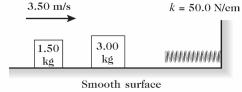
(Short Answer)
4.9/5 (85)
(85) A 30-N box is pulled upward 6.0 m along the surface of a ramp that rises at 37° above the horizontal. How much work does gravity do on the box during this process?
(Multiple Choice)
4.8/5 (83)
(83) On a planet where g = 10.0 m/s2 and air resistance is negligible, a sled is at rest on a rough inclined hill rising at 30° as shown in the figure. The object is allowed to move and it stops on a rough horizontal surface, at a distance of 4.0 m from the bottom of the hill. The coefficient of kinetic friction on the hill is 0.40. What is the coefficient of kinetic friction between the horizontal surface and the sled? 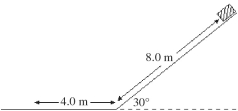
(Multiple Choice)
4.7/5 (81)
(81) A 60-kg skier starts from rest from the top of a 50-m high slope. If the work done by friction is -6.0 kJ, what is the speed of the skier on reaching the bottom of the slope?
(Multiple Choice)
4.9/5 (78)
(78) On a horizontal frictionless air table, a puck runs into an ideal horizontal spring that is fastened to the table. The puck compresses the spring by 15 cm before coming to rest. During the compression process, which quantities are conserved?
(Multiple Choice)
4.9/5 (81)
(81) You carry a 7.0-kg bag of groceries above the ground at constant speed across a room. How much work do you do on the bag in the process?
(Multiple Choice)
4.8/5 (68)
(68) As shown in the figure, a 1.45-kg block is held in place against the spring by a 21-N horizontal external force. The external force is removed, and the block is projected with a velocity as it separates from the spring. The block descends a ramp and has a velocity at the bottom. The track is frictionless between points A and B. The block enters a rough section at B, extending to E. The coefficient of kinetic friction between the block and the rough surface is 0.29. The velocity of the block is at C. The block moves on to D, where it stops. How much work is done by friction between points B and C? 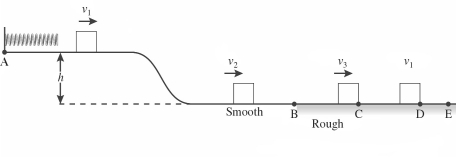
(Multiple Choice)
5.0/5 (71)
(71) The figure shows two blocks connected by a light cord over a pulley. This apparatus is known as an Atwood's machine. There is no slipping between the cord and the surface of the pulley. The pulley itself has negligible friction and it has a radius of 0.12 m and a mass of 10.3 kg. We can model this pulley as a solid uniform disk. At the instant that the heavier block has descended 1.5 m starting from rest, what is the speed of the lighter block? 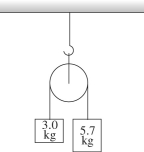
(Short Answer)
4.9/5 (75)
(75) You and your friend, who weighs the same as you, want to go to the top of the Eiffel Tower. Your friend takes the elevator straight up. You decide to walk up the spiral stairway, taking longer to do so. Compare the gravitational potential energy of you and your friend, after you both reach the top.
(Multiple Choice)
4.9/5 (80)
(80) When you drop a pebble from height H, it reaches the ground with kinetic energy K if there is no air resistance. From what height should you drop it so it will reach the ground with twice as much kinetic energy?
(Multiple Choice)
5.0/5 (68)
(68) A 0.12-kg block is held in place against the spring by a 35-N horizontal external force. The external force is removed, and the block is projected with a velocity when it separates from the spring, as shown in the figure. The block descends a ramp and has a velocity at the bottom of the ramp. The track is frictionless between points A and B. The block enters a rough section at B, extending to E. The coefficient of kinetic friction between the block and the rough surface is 0.26. The block moves on to D, where it stops. By how many centimeters was the spring initially compressed? 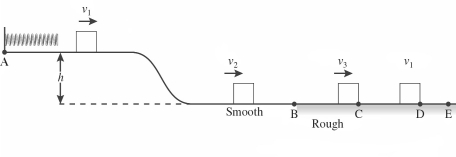
(Multiple Choice)
4.8/5 (59)
(59) A driver, traveling at 22 m/s, slows down her 2000 kg truck to stop for a red light. What work is done on the truck by the friction force of the road?
(Multiple Choice)
4.9/5 (79)
(79) A child does 350 J of work while pulling a box from the ground up to his tree house at a steady speed with a light rope. The tree house is above the ground. What is the mass of the box?
(Multiple Choice)
4.8/5 (81)
(81) If the force on an object is in the negative direction, the work it does on the object must be
(Multiple Choice)
4.9/5 (75)
(75) A uniform solid cylinder with a radius of 10 cm and a mass of 3.0 kg is rotating about its center with an angular speed of 33.4 rpm. What is its kinetic energy?
(Multiple Choice)
4.7/5 (76)
(76) Person X pushes twice as hard against a stationary brick wall as person Y. Which one of the following statements is correct?
(Multiple Choice)
4.9/5 (88)
(88) A 320-g air track cart traveling at 1.25 m/s suddenly collides elastically with a stationary 270-g cart. What is the speed of the 270-g cart just after the collision?
(Multiple Choice)
4.8/5 (83)
(83) 
Filters
- Essay(0)
- Multiple Choice(0)
- Short Answer(0)
- True False(0)
- Matching(0)