



 Chat with AI
Exam 10: Energy and Work

Exam 1: Representing Motion113 Questions
Exam 2: Motion in One Dimension174 Questions
Exam 3: Vectors and Motion in Two Dimensions183 Questions
Exam 4: Forces and Newtons Laws of Motion64 Questions
Exam 5: Applying Newtons Laws82 Questions
Exam 6: Gravity96 Questions
Exam 7: Rotational Motion95 Questions
Exam 8: Equilibrium Ad Elasticity73 Questions
Exam 9: Momentum103 Questions
Exam 10: Energy and Work223 Questions
Exam 11: Using Energy106 Questions
Exam 12: Thermal Properties of Matter220 Questions
Exam 13: Fluids115 Questions
Exam 14: Oscillations105 Questions
Exam 15: Traveling Waves and Sound94 Questions
Exam 16: Superposition and Standing Waves66 Questions
Exam 17: Wave Optics129 Questions
Exam 18: Ray Optics155 Questions
Exam 19: Optical Instruments137 Questions
Exam 20: Electric Fields and Forces95 Questions
Exam 21: Electric Potential144 Questions
Exam 22: Current and Resistance125 Questions
Exam 23: Circuits157 Questions
Exam 24: Magnetic Fields and Forces168 Questions
Exam 25: EM Induction and Em Waves185 Questions
Exam 26: AC Electricity122 Questions
Exam 27: Relativity126 Questions
Exam 28: Quantum Physics86 Questions
Exam 29: Atoms and Molecules105 Questions
Exam 30: Nuclear Physics175 Questions
Select questions type


In the figure, determine the character of the collision. The masses of the blocks, and the velocities before and after, are shown. The collision is 
(Multiple Choice)
4.8/5  (79)
(79) A stone with a mass of 1.0 kg is tied to the end of a light string which keeps it moving in a circle with a constant speed of 4.0 m/s on a perfectly smooth horizontal tabletop. The radius of the path is 0.60 m. How much work does the tension in the string do on the stone as it makes one-half of a complete circle?
(Multiple Choice)
4.8/5 (77)
(77) A stone initially moving at 8.0 m/s on a level surface comes to rest due to friction after it travels 11 m. What is the coefficient of kinetic friction between the stone and the surface?
(Multiple Choice)
4.8/5 (70)
(70) A 0.46-kg block is held in place against the spring by a 30-N horizontal external force. The external force is removed, and the block is projected with a velocity upon separation from the spring, as shown in the figure. The block descends a ramp and has a velocity at the bottom. The track is frictionless between points A and B. The block enters a rough section at point B, extending to E. The coefficient of kinetic friction between the block and the rough surface is 0.38. The velocity of the block is at point C. The block moves on to D, where it stops. What distance does the block travel between points B and D? 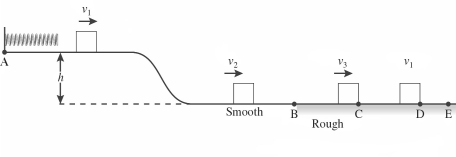
(Multiple Choice)
4.9/5 (80)
(80) If electricity costs 7.06¢/kW∙h, how much would it cost you to run a stereo system per day for
(Multiple Choice)
4.8/5 (78)
(78) A hoop is rolling without slipping along a horizontal surface with a forward speed of 5.50 m/s when it starts up a ramp that makes an angle of 25.0° with the horizontal. What is the speed of the hoop after it has rolled 3.00 m up as measured along the surface of the ramp?
(Multiple Choice)
4.9/5 (88)
(88) A prankster drops a water balloon from the top of a building. If the balloon is traveling at 29.1 m/s when it strikes a window ledge that is 1.5 m above the ground, how tall is the building? Neglect air resistance.
(Multiple Choice)
4.9/5 (68)
(68) An object hits a wall and bounces back with half of its original speed. What is the ratio of the final kinetic energy to the initial kinetic energy of the object?
(Multiple Choice)
4.9/5 (75)
(75) An ideal spring stretches by 21.0 cm when a 135-N object is hung from it. If instead you hang a fish from this spring, what is the weight of a fish that would stretch the spring by
(Multiple Choice)
4.8/5 (72)
(72) A roller coaster starting from rest descends 35 meters in its initial drop and then rises 23 meters when it goes over the first hill, which has a circular shape over the top. If a passenger at the top of the hill feels an apparent weight equal to one-half of her normal weight, what is the radius of curvature of the first hill? Neglect any frictional losses.
(Short Answer)
4.9/5 (73)
(73) Suppose a solid uniform sphere of mass M and radius R rolls without slipping down an inclined plane starting from rest. The angular velocity of the sphere at the bottom of the incline depends on
(Multiple Choice)
4.8/5 (91)
(91) A child pulls on a wagon with a force of 75 If the wagon moves a total of in what is the average power delivered by the child?
(Multiple Choice)
4.7/5 (76)
(76) The figure shows a famous roller coaster ride. You can ignore friction. If the roller coaster leaves point Q from rest, what is its speed at the top of the 25-m peak (point S)? 
(Multiple Choice)
4.9/5 (75)
(75) If 4.0 J of work are performed in stretching an ideal spring with a spring constant (force constant) of 2500 N/m, by what distance is the spring stretched?
(Multiple Choice)
5.0/5 (82)
(82) The graphs shown show the magnitude F of the force exerted by a spring as a function of the distance x the spring has been stretched. For which one of the graphs does the spring obey Hooke's law?
a)
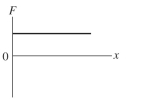 b)
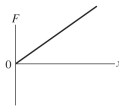 c)
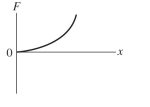 d)
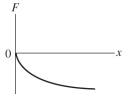 e)
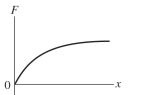
b)
c)
d)
e)
(Multiple Choice)
5.0/5 (90)
(90) A stone can slide down one of four different frictionless ramps, as shown in the figure. For which ramp will the speed of the ball be the greatest at the bottom? 
(Multiple Choice)
4.8/5 (84)
(84) A uniform ball with diameter of 10 cm rolls without slipping on a horizontal tabletop. The moment of inertia of the ball about an axis through its center is 2.2 × 10⁻³ kg ∙ m2, and the translational speed of its center is 0.45 m/s.
(a) What is its angular speed of the ball about its center of mass?
(b) What is the rotational kinetic energy of the ball?
(c) What is the ball's angular momentum about its center of mass?
(Short Answer)
4.9/5 (75)
(75) A solid wooden door, 90 cm wide by 2.0 m tall, has a mass of 35 kg. It is open and at rest. A small 500-g ball is thrown perpendicular to the door with a speed of 20 m/s and hits the door 60 cm from the hinged side, causing it to begin turning. The ball rebounds along the same line with a speed of 16.0 m/s relative to the ground. How much energy is lost during this collision?
(Multiple Choice)
4.8/5 (81)
(81) A 1500-kg car accelerates from rest to 25 m/s in 7.0 s. What is the average power delivered by the engine? (1 hp = 746 W)
(Multiple Choice)
4.9/5 (78)
(78) Two objects of different masses have momentum of equal, non-zero magnitude. Which object has more kinetic energy?
(Multiple Choice)
4.8/5 (84)
(84) 
Filters
- Essay(0)
- Multiple Choice(0)
- Short Answer(0)
- True False(0)
- Matching(0)