



 Chat with AI
Exam 10: Energy and Work

Exam 1: Representing Motion113 Questions
Exam 2: Motion in One Dimension174 Questions
Exam 3: Vectors and Motion in Two Dimensions183 Questions
Exam 4: Forces and Newtons Laws of Motion64 Questions
Exam 5: Applying Newtons Laws82 Questions
Exam 6: Gravity96 Questions
Exam 7: Rotational Motion95 Questions
Exam 8: Equilibrium Ad Elasticity73 Questions
Exam 9: Momentum103 Questions
Exam 10: Energy and Work223 Questions
Exam 11: Using Energy106 Questions
Exam 12: Thermal Properties of Matter220 Questions
Exam 13: Fluids115 Questions
Exam 14: Oscillations105 Questions
Exam 15: Traveling Waves and Sound94 Questions
Exam 16: Superposition and Standing Waves66 Questions
Exam 17: Wave Optics129 Questions
Exam 18: Ray Optics155 Questions
Exam 19: Optical Instruments137 Questions
Exam 20: Electric Fields and Forces95 Questions
Exam 21: Electric Potential144 Questions
Exam 22: Current and Resistance125 Questions
Exam 23: Circuits157 Questions
Exam 24: Magnetic Fields and Forces168 Questions
Exam 25: EM Induction and Em Waves185 Questions
Exam 26: AC Electricity122 Questions
Exam 27: Relativity126 Questions
Exam 28: Quantum Physics86 Questions
Exam 29: Atoms and Molecules105 Questions
Exam 30: Nuclear Physics175 Questions
Select questions type


A hoop with a mass of 2.75 kg is rolling without slipping along a horizontal surface with a speed of 4.5 m/s when it starts down a ramp that makes an angle of 25° below the horizontal. What is the rotational kinetic energy of the hoop after it has rolled 3.0 m down as measured along the surface of the ramp?
(Multiple Choice)
4.8/5  (92)
(92) A force produces power P by doing work W in a time T. What power will be produced by a force that does six times as much work in half as much time?
(Multiple Choice)
5.0/5 (88)
(88) Two objects of different mass have equal, non-zero kinetic energies. Which object has the greater magnitude momentum?
(Multiple Choice)
4.8/5 (80)
(80) Two frisky otters slide down frictionless hillsides of the same height but different slopes. The slope of the hill of otter 1 is 30°, while the slope of the hill of otter 2 is 60°. If both start from rest, which otter is moving faster when she reaches the bottom of her hill?
(Multiple Choice)
4.9/5 (80)
(80) A disk, a hoop, and a solid sphere are released at the same time at the top of an inclined plane. They are all uniform and roll without slipping. In what order do they reach the bottom?
(Multiple Choice)
4.8/5 (73)
(73) A 1200-kg pick-up truck traveling south at 15 m/s suddenly collides with a 750-kg car that is traveling east. The two vehicles stick together and slide along the road after colliding. A highway patrol officer investigating the accident determines that the final position of the wreckage after the collision is 25 m, at an angle of 50° south of east, from the point of impact. She also determines that the coefficient of kinetic friction between the tires and the road at that location was 0.40. What was the speed of the car just before the collision?
(Multiple Choice)
4.8/5 (62)
(62) A heavy sled and a light sled, both moving horizontally with the same kinetic energy, suddenly slide onto a rough patch of snow and eventually come to a stop. The coefficient of kinetic friction between the sleds and the rough snow is the same for both of them. Which of the following statements about these sleds are correct? (There could be more than one correct choice.)
(Multiple Choice)
4.9/5 (81)
(81) Swimmers at a water park have a choice of two frictionless water slides, as shown in the figure. Although both slides drop over the same height h, slide 1 is straight while slide 2 is curved, dropping quickly at first and then leveling out. How does the speed v1 of a swimmer reaching the bottom of slide 1 compare with v2, the speed of a swimmer reaching the end of slide 2? 
(Multiple Choice)
4.8/5 (85)
(85) A 10-kg mass, hung by an ideal spring, causes the spring to stretch 2.0 cm. What is the spring constant (force constant) for this spring?
(Multiple Choice)
4.9/5 (83)
(83) What is the kinetic energy of a 120-cm thin uniform rod with a mass of 450 g that is rotating about its center at 3.60 rad/s?
(Multiple Choice)
4.9/5 (86)
(86) Consider a uniform hoop of radius R and mass M rolling without slipping. Which is larger, its translational kinetic energy or its rotational kinetic energy?
(Multiple Choice)
4.8/5 (77)
(77) Water flows over a waterfall that is 20 m high at the rate of 4.0 × 10⁴ kg/s. If this water powers an electric generator with a 40% efficiency, how many watts of electric power can be supplied?
(Short Answer)
4.8/5 (87)
(87) A roller coaster starts from rest at a height h at the left side of a loop-the-loop, as shown in the figure. It is not attached to the track in anyway, and there is no friction from the track or from air resistance. If the radius of the loop is R = 6.0 m, what is the minimum height h for which the roller coaster will not fall off the track at the top of the loop? 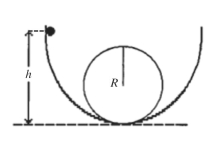
(Multiple Choice)
4.8/5 (75)
(75) Two identical grasshoppers jump into the air with the same initial speed and experience no air resistance. Grasshopper A goes straight up, but grasshopper B goes up at a 66° angle above the horizontal. Which of the following statements about these grasshoppers are correct? (There could be more than one correct choice.)
(Multiple Choice)
4.9/5 (79)
(79) A rubber ball bounces off of a wall with an initial speed v and reverses its direction so its speed is v right after the bounce. As a result of this bounce, which of the following quantities of the ball are conserved? (There could be more than one correct choice.)
(Multiple Choice)
4.8/5 (76)
(76) The figure shows two crates, each of mass m = 24 kg, that are connected by a very light wire. The coefficient of kinetic friction between the crate on the inclined surface and the surface itself is 0.31. Find the speed of the crates after they have moved 1.6 m starting from rest. 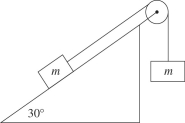
(Short Answer)
4.8/5 (78)
(78) A tennis ball bounces on the floor three times, and each time it loses 23.0% of its energy due to heating. How high does it bounce after the third time, if we released it from the floor?
(Multiple Choice)
4.9/5 (80)
(80) A heavy dart and a light dart are launched horizontally on a frictionless table by identical ideal springs. Both springs were initially compressed by the same amount. Which of the following statements about these darts are correct? (There could be more than one correct choice.)
(Multiple Choice)
4.9/5 (71)
(71) A stone is moving on a rough level surface. It has 24 J of kinetic energy, and the friction force on it is a constant 0.50 N. What is the maximum distance it can slide?
(Multiple Choice)
4.9/5 (89)
(89) Assuming negligible friction, what spring constant (force constant) would be needed by the spring in a "B-B gun" to fire a 10-g pellet to a height of 100 m if the spring is initially compressed by 0.10 m?
(Multiple Choice)
4.9/5 (85)
(85) 
Filters
- Essay(0)
- Multiple Choice(0)
- Short Answer(0)
- True False(0)
- Matching(0)