



 Chat with AI
Exam 10: Energy and Work

Exam 1: Representing Motion113 Questions
Exam 2: Motion in One Dimension174 Questions
Exam 3: Vectors and Motion in Two Dimensions183 Questions
Exam 4: Forces and Newtons Laws of Motion64 Questions
Exam 5: Applying Newtons Laws82 Questions
Exam 6: Gravity96 Questions
Exam 7: Rotational Motion95 Questions
Exam 8: Equilibrium Ad Elasticity73 Questions
Exam 9: Momentum103 Questions
Exam 10: Energy and Work223 Questions
Exam 11: Using Energy106 Questions
Exam 12: Thermal Properties of Matter220 Questions
Exam 13: Fluids115 Questions
Exam 14: Oscillations105 Questions
Exam 15: Traveling Waves and Sound94 Questions
Exam 16: Superposition and Standing Waves66 Questions
Exam 17: Wave Optics129 Questions
Exam 18: Ray Optics155 Questions
Exam 19: Optical Instruments137 Questions
Exam 20: Electric Fields and Forces95 Questions
Exam 21: Electric Potential144 Questions
Exam 22: Current and Resistance125 Questions
Exam 23: Circuits157 Questions
Exam 24: Magnetic Fields and Forces168 Questions
Exam 25: EM Induction and Em Waves185 Questions
Exam 26: AC Electricity122 Questions
Exam 27: Relativity126 Questions
Exam 28: Quantum Physics86 Questions
Exam 29: Atoms and Molecules105 Questions
Exam 30: Nuclear Physics175 Questions
Select questions type


The L-shaped object shown in the figure consists of three small masses connected by thin uniform rods, each rod of mass 3.00 kg. Assume that the masses shown are accurate to three significant figures. How much work must be done to accelerate the object from rest to an angular speed of 3.25 rad/s about the y-axis? 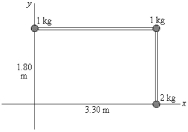
(Short Answer)
4.8/5  (75)
(75) Three cars (car F, car G, and car H) are moving with the same speed and slam on their brakes. The most massive car is car F, and the least massive is car H. If the tires of all three cars have identical coefficients of kinetic friction with the road surface, which car travels the longest distance to skid to a stop?
(Multiple Choice)
4.8/5 (75)
(75) A solid uniform ball of mass 1.0 kg and radius 1.0 cm starts from rest and rolls down a 1.0-m high ramp. There is enough friction on the ramp to prevent the ball from slipping as it rolls down.
(a) What is the forward speed of the ball when it reaches the bottom of the ramp?
(b) What would be the forward speed of the ball if there were no friction on the ramp?
(c) Since the ball starts from the same height in both cases, why is the speed different?
(Essay)
4.7/5 (78)
(78) If a quantity you calculated had units of kg ∙ m/s, what type of quantity could it be? (There could be more than one correct choice.)
(Multiple Choice)
4.8/5 (82)
(82) A ball in the shape of a uniform spherical shell (like a soccer ball) of mass 1.5 kg and radius 15 cm rolls down a 35° incline that is 6.0 m high, measured vertically. The ball starts from rest, and there is enough friction on the incline to prevent slipping of the ball.
(a) How fast is the ball moving forward when it reaches the bottom of the incline, and what is its angular speed at that instant?
(b) If there were no friction on the incline, how fast would the ball be moving forward and what would be its angular speed at the bottom?
(Short Answer)
4.8/5 (83)
(83) An ideal spring with a force constant (spring constant) of 15 N/m is initially compressed by 3.0 cm from its uncompressed position. How much work is required to compress the spring an additional 4.0 cm?
(Multiple Choice)
4.9/5 (78)
(78) Which requires more work, increasing a car's speed from 0 mph to 30 mph or from 50 mph to 60 mph?
(Multiple Choice)
4.8/5 (84)
(84) An ideal spring has a spring constant (force constant) of 2500 N/m. is stretched 4.0 cm. How much work is required to stretch the spring by 4.0 cm?
(Multiple Choice)
4.9/5 (84)
(84) It requires 0.30 kJ of work to fully drive a stake into the ground. If the average resistive force on the stake by the ground is how long is the stake?
(Multiple Choice)
5.0/5 (93)
(93) If the answer to your calculation has units of kg ∙ m2/s2 , what type of quantity could it be? (There could be more than one correct choice.)
(Multiple Choice)
4.8/5 (78)
(78) A string is wrapped tightly around a fixed pulley that has a moment of inertia of 0.0352 kg ∙ m2 and a radius of 12.5 cm. A mass of 423 g is attached to the free end of the string. With the string vertical and taut, the mass is gently released so it can descend under the influence of gravity. As the mass descends, the string unwinds and causes the pulley to rotate, but does not slip on the pulley. What is the speed of the mass after it has fallen through 1.25 m?
(Multiple Choice)
4.8/5 (87)
(87) As shown in the figure, a 4.0-kg block is moving at 5.0 m/s along a horizontal frictionless surface toward an ideal spring that is attached to a wall. After the block collides with the spring, the spring is compressed a maximum distance of 0.68 m. What is the speed of the block when the spring is compressed to only one-half of the maximum distance? 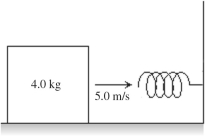
(Short Answer)
4.9/5 (80)
(80) A heavy stone and a light stone are released from rest in such away that they both have the same amount of gravitational potential energy just as they are released. Air resistance is negligibly small. Which of the following statements about these stones are correct? (There could be more than one correct choice.)
(Multiple Choice)
4.8/5 (77)
(77) An object with a mass of 10 kg is initially at rest at the top of a frictionless inclined plane that rises at 30° above the horizontal. At the top, the object is initially 8.0 m from the bottom of the incline, as shown in the figure. When the object is released from this position, it eventually stops at a distance d from the bottom of the inclined plane along a horizontal surface, as shown. The coefficient of kinetic friction between the horizontal surface and the object is 0.20, and air resistance is negligible. Find the distance d. 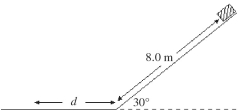
(Multiple Choice)
4.8/5 (67)
(67) An egg falls from a bird's nest in a tree and feels no effects due to the air. As it falls,
(Multiple Choice)
4.8/5 (75)
(75) You want to store 1,000 J of energy in an ideal spring when it is compressed by only 2.5 cm. What should be the force constant (spring constant) of this spring?
(Short Answer)
4.8/5 (88)
(88) Suppose a uniform solid sphere of mass M and radius R rolls without slipping down an inclined plane starting from rest. The linear velocity of the sphere at the bottom of the incline depends on
(Multiple Choice)
4.9/5 (85)
(85) An Atwood machine consists of a mass of 3.5 kg connected by a light string to a mass of 6.0 kg over a frictionless pulley with a moment of inertia of 0.0352 kg ∙ m2 and a radius of 12.5 cm. If the system is released from rest, what is the speed of the masses after they have moved through 1.25 m if the string does not slip on the pulley?
(Multiple Choice)
4.8/5 (91)
(91) A pencil that is 15.7 cm long is released from a vertical position with the eraser end resting on a table. The eraser does not slip as it tips over. Treat the pencil like a uniform rod. What is the angular speed of the pencil just before it hits the table?
(Multiple Choice)
4.8/5 (82)
(82) A 60-kg skier pushes off the top of a frictionless hill with an initial speed of 4.0 m/s. How fast will she be moving after dropping 10 m in elevation? Air resistance is negligible.
(Multiple Choice)
4.8/5 (72)
(72) 
Filters
- Essay(0)
- Multiple Choice(0)
- Short Answer(0)
- True False(0)
- Matching(0)