



 Chat with AI
Exam 10: Energy and Work

Exam 1: Representing Motion113 Questions
Exam 2: Motion in One Dimension174 Questions
Exam 3: Vectors and Motion in Two Dimensions183 Questions
Exam 4: Forces and Newtons Laws of Motion64 Questions
Exam 5: Applying Newtons Laws82 Questions
Exam 6: Gravity96 Questions
Exam 7: Rotational Motion95 Questions
Exam 8: Equilibrium Ad Elasticity73 Questions
Exam 9: Momentum103 Questions
Exam 10: Energy and Work223 Questions
Exam 11: Using Energy106 Questions
Exam 12: Thermal Properties of Matter220 Questions
Exam 13: Fluids115 Questions
Exam 14: Oscillations105 Questions
Exam 15: Traveling Waves and Sound94 Questions
Exam 16: Superposition and Standing Waves66 Questions
Exam 17: Wave Optics129 Questions
Exam 18: Ray Optics155 Questions
Exam 19: Optical Instruments137 Questions
Exam 20: Electric Fields and Forces95 Questions
Exam 21: Electric Potential144 Questions
Exam 22: Current and Resistance125 Questions
Exam 23: Circuits157 Questions
Exam 24: Magnetic Fields and Forces168 Questions
Exam 25: EM Induction and Em Waves185 Questions
Exam 26: AC Electricity122 Questions
Exam 27: Relativity126 Questions
Exam 28: Quantum Physics86 Questions
Exam 29: Atoms and Molecules105 Questions
Exam 30: Nuclear Physics175 Questions
Select questions type


A solid uniform sphere is rolling without slipping along a horizontal surface with a speed of 5.5 m/s when it starts up a ramp that makes an angle of 25° with the horizontal. What is the speed of the sphere after it has rolled 3.0 m up as measured along the surface of the ramp?
(Multiple Choice)
4.7/5  (70)
(70) A 0.140-kg baseball is dropped from rest from a height of 2.20 m above the ground and experiences negligible air resistance as it falls. It rebounds to a height of 1.60 m. What change in the ball's momentum occurs as it rebounds from the ground?
(Multiple Choice)
4.8/5 (77)
(77) A solid sphere and a solid cylinder, both uniform and of the same mass and radius, roll without slipping at the same forward speed. It is correct to say that the total kinetic energy of the solid sphere is
(Multiple Choice)
5.0/5 (72)
(72) An 8.0-g bullet is suddenly shot into a 4.0-kg block, at rest on a frictionless horizontal surface, as shown in the figure. The bullet remains lodged in the block. The block then moves against a spring and compresses it by 8.9 cm. The force constant (spring constant) of the spring is What is the magnitude of the impulse on the block (including the bullet inside) due to the spring during the entire time interval during which the block compresses the spring? 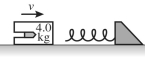
(Multiple Choice)
4.8/5 (85)
(85) A block slides down a frictionless inclined ramp and experiences no significant air resistance. If the ramp angle is 17.0° above the horizontal and the length of the surface of the ramp is find the speed of the block as it reaches the bottom of the ramp, assuming it started sliding from rest at the top.
(Multiple Choice)
4.8/5 (73)
(73) If you want to double the momentum of a gas molecule, by what factor must you increase its kinetic energy?
(Multiple Choice)
4.7/5 (76)
(76) A hoop with a mass of 2.75 kg is rolling without slipping along a horizontal surface with a speed of 4.5 m/s when it starts down a ramp that makes an angle of 25° below the horizontal. What is the forward speed of the hoop after it has rolled 3.0 m down as measured along the surface of the ramp?
(Multiple Choice)
4.9/5 (84)
(84) A 1321-kg car climbs a 5.0° slope at a constant speed of Assuming that air resistance may be neglected, at what rate (in kW) must the engine deliver energy to the drive wheels of the car?
(Multiple Choice)
4.8/5 (87)
(87) What is the minimum energy needed to change the speed of a 1600-kg sport utility vehicle from 15.0 m/s to 40.0 m/s?
(Multiple Choice)
4.9/5 (82)
(82) A sled is moving along a horizontal surface with a speed of 5.7 m/s. It then slides up a rough hill having a slope of 11° above the horizontal. The coefficient of kinetic friction between the sled and the surface of the hill is 0.26. How far along the surface does the block travel up the incline?
(Short Answer)
4.9/5 (78)
(78) Two uniform solid balls, one of radius R and mass M, the other of radius 2R and mass 8M, roll down a high incline. They start together from rest at the top of the incline. Which one will reach the bottom of the incline first?
(Multiple Choice)
4.8/5 (71)
(71) A 1000-kg car experiences a net force of 9500 N while slowing down from 30 m/s to How far does it travel while slowing down?
(Multiple Choice)
4.9/5 (67)
(67) A spinning ice skater on extremely smooth ice is able to control the rate at which she rotates by pulling in her arms. Which of the following statements are true about the skater during this process? (There could be more than one correct choice.)
(Multiple Choice)
5.0/5 (90)
(90) A 2.0-kg object is lifted vertically through 3.00 m by a 150-N force. How much work is done on the object by gravity during this process?
(Short Answer)
4.8/5 (72)
(72) In the figure showing an isolated system, determine the character of the collision. The masses of the blocks, and the velocities before and after, are shown. The collision is 
(Multiple Choice)
4.9/5 (89)
(89) A truck has four times the mass of a car and is moving with twice the speed of the car. If Kt and Kc refer to the kinetic energies of truck and car respectively, it is correct to say that
(Multiple Choice)
5.0/5 (70)
(70) A 4.0 kg object is moving with speed 2.0 m/s. A 1.0 kg object is moving with speed 4.0 m/s. Both objects encounter the same constant braking force, and are brought to rest. Which object travels the greater distance before stopping?
(Multiple Choice)
4.9/5 (78)
(78) If the answer to your calculation has units of kg ∙ m2/s, what type of quantity could it be? (There could be more than one correct choice).
(Multiple Choice)
4.8/5 (86)
(86) A solid ball of mass 1.0 kg and radius 10 cm rolls with a forward speed of 10 m/s when it comes to a hill. There is enough friction on the hill to keep the ball from slipping as it rolls up.
(a) How high vertically up the hill can the ball roll before coming to rest?
(b) How high vertically could the ball go if the hill were totally frictionless?
(c) How is it that the ball can go higher with friction than without friction?
(Essay)
4.9/5 (78)
(78) 
Filters
- Essay(0)
- Multiple Choice(0)
- Short Answer(0)
- True False(0)
- Matching(0)