



 Chat with AI
Exam 10: Energy and Work

Exam 1: Representing Motion113 Questions
Exam 2: Motion in One Dimension174 Questions
Exam 3: Vectors and Motion in Two Dimensions183 Questions
Exam 4: Forces and Newtons Laws of Motion64 Questions
Exam 5: Applying Newtons Laws82 Questions
Exam 6: Gravity96 Questions
Exam 7: Rotational Motion95 Questions
Exam 8: Equilibrium Ad Elasticity73 Questions
Exam 9: Momentum103 Questions
Exam 10: Energy and Work223 Questions
Exam 11: Using Energy106 Questions
Exam 12: Thermal Properties of Matter220 Questions
Exam 13: Fluids115 Questions
Exam 14: Oscillations105 Questions
Exam 15: Traveling Waves and Sound94 Questions
Exam 16: Superposition and Standing Waves66 Questions
Exam 17: Wave Optics129 Questions
Exam 18: Ray Optics155 Questions
Exam 19: Optical Instruments137 Questions
Exam 20: Electric Fields and Forces95 Questions
Exam 21: Electric Potential144 Questions
Exam 22: Current and Resistance125 Questions
Exam 23: Circuits157 Questions
Exam 24: Magnetic Fields and Forces168 Questions
Exam 25: EM Induction and Em Waves185 Questions
Exam 26: AC Electricity122 Questions
Exam 27: Relativity126 Questions
Exam 28: Quantum Physics86 Questions
Exam 29: Atoms and Molecules105 Questions
Exam 30: Nuclear Physics175 Questions
Select questions type


A firecracker explodes in midair and breaks up into many fragments. Which of the following statements are true regarding conditions immediately before and immediately after the explosion:
I. The total momentum of the fragments is equal to the original momentum of the firecracker.
II. The total kinetic energy of the fragments is equal to the original kinetic energy of the firecracker.
(Multiple Choice)
4.8/5  (78)
(78) On an alien planet, an object moving at 4.0 m/s on the horizontal ground comes to rest after traveling a distance of 10 m. If the coefficient of kinetic friction between the object and the surface is 0.20, what is the value of g on that planet?
(Multiple Choice)
4.8/5 (86)
(86) A bead is moving with a speed of 20 m/s at position A on the track shown in the figure. This track is friction-free, and there is no appreciable air resistance. What is the speed of the bead at point C? 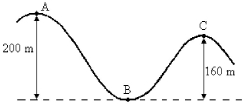
(Multiple Choice)
4.9/5 (78)
(78) A small ball is tied to one end of a light 2.5-m wire, and the other end of the wire is hooked to the ceiling. A person pulls the ball to the side until the wire makes an angle of 35° with the plane of the ceiling and then gently releases it. What is the angular speed of the ball, in rad/s, as it swings through its lowest point?
(Short Answer)
4.8/5 (74)
(74) A 35-N bucket of water is lifted vertically 3.0 m and then returned to its original position. How much work did gravity do on the bucket during this process?
(Multiple Choice)
4.9/5 (84)
(84) A person carries a 2.00-N pebble through the path shown in the figure, starting at point A and ending at point B. The total time from A to B is 6.75 min. How much work did gravity do on the rock between A and B? 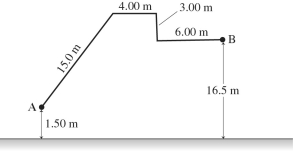
(Multiple Choice)
4.9/5 (70)
(70) If a stone is dropped with an initial gravitational potential energy of 100 J but reaches the ground with a kinetic energy of only 75 J, this is a violation of the principle of conservation of energy.
(True/False)
4.7/5 (88)
(88) How large a net force is required to accelerate a 1600-kg SUV from rest to a speed of 25 m/s in a distance of 200 m?
(Multiple Choice)
4.7/5 (78)
(78) A heavy sled and a light sled, both moving horizontally with the same speed, suddenly slide onto a rough patch of snow and eventually come to a stop. The coefficient of kinetic friction between the sleds and the rough snow is the same for both of them. Which of the following statements about these sleds are correct? (There could be more than one correct choice.)
(Multiple Choice)
4.8/5 (87)
(87) A string is wrapped tightly around a fixed frictionless pulley that has a moment of inertia of 0.0352 kg ∙ m2 and a radius of 12.5 cm. The string is pulled away from the pulley with a constant force of 5.00 N, causing the pulley to rotate. What is the speed of the string after it has unwound 1.25 m if the string does not slip on the pulley?
(Multiple Choice)
5.0/5 (80)
(80) At what minimum rate is a 60.0-kg boy using energy when, in 8.00 s, he runs up a flight of stairs that is 10.0-m high?
(Multiple Choice)
4.8/5 (85)
(85) A proton of mass m is at rest when it is suddenly struck head-on by an alpha particle (which consists of 2 protons and 2 neutrons) moving at speed v. If the collision is perfectly elastic, what speed will the alpha particle have after the collision? (Assume the neutron's mass is equal to the proton's mass.)
(Multiple Choice)
4.8/5 (84)
(84) In a physical fitness program, a woman who weighs 510 N runs up four flights of stairs in 22 s. Each flight rises 3.1 m. (1 hp = 746 W)
(a) What is her total change in potential energy?
(b) What was the minimum average power (in watts) that she expended during the 22 s?
(c) What horsepower motor would be required to generate the same power?
(Short Answer)
4.8/5 (75)
(75) The L-shaped object shown in the figure consists of three small masses connected by extremely light rods. Assume that the masses shown are accurate to three significant figures. How much work must be done to accelerate the object from rest to an angular speed of 3.25 rad/s (a) about the x-axis, (b) about the y-axis? 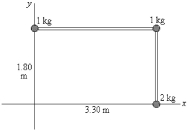
(Short Answer)
4.9/5 (76)
(76) A stone is released from rest at a height h at the left side of a loop-the-loop, as shown in the figure. There is no appreciable friction from the track or from air resistance. If the radius of the loop is R, what is the minimum height h for which the stone will not fall off the track at the top of the loop? 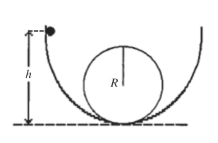
(Multiple Choice)
4.9/5 (74)
(74) If you want to double the kinetic energy of a gas molecule, by what factor must you increase its momentum?
(Multiple Choice)
4.7/5 (75)
(75) A 7.5-kg otter slides down a hill, starting from rest at the top. The sloping surface of the hill is 8.8 m long, and the top is 6.5 m above the base. If the speed of the otter at the bottom of the hill is 9.2 m/s, how much energy was lost to nonconservative forces on the hill?
(Short Answer)
4.9/5 (88)
(88) A uniform ball is released from rest on a no-slip surface, as shown in the figure. After reaching its lowest point, the ball begins to rise again, this time on a frictionless surface. When the ball reaches its maximum height on the frictionless surface, it is 
(Multiple Choice)
4.8/5 (78)
(78) A 1.0-kg object moving in a certain direction has a kinetic energy of 2.0 J. It hits a wall and comes back with half its original speed. What is the kinetic energy of this object at this point?
(Multiple Choice)
4.8/5 (92)
(92) A 50-g ball moving at 10 m/s in the +x direction suddenly collides head-on with a stationary ball of mass 100 g. If the collision is perfectly elastic, what is the velocity of each ball immediately after the collision?
(Multiple Choice)
4.7/5 (76)
(76) 
Filters
- Essay(0)
- Multiple Choice(0)
- Short Answer(0)
- True False(0)
- Matching(0)