Short Answer
On a frictionless horizontal surface, a 1.50-kg mass traveling at 3.50 m/s suddenly collides with and sticks to a 3.00-kg mass that is initially at rest, as shown in the figure. This system then runs into an ideal spring of force constant (spring constant) 50.0 N/cm.
(a) What will be the maximum compression distance of the spring?
(b) How much mechanical energy is lost during this process? During which parts of the process (the collision and compression of the spring) is this energy lost? 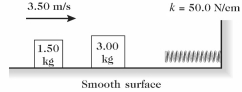
Correct Answer:

Verified
(a) 3.50 cm, (b) 6.1...View Answer
Unlock this answer now
Get Access to more Verified Answers free of charge
Correct Answer:
Verified
View Answer
Unlock this answer now
Get Access to more Verified Answers free of charge
Q5: A 30-N box is pulled upward 6.0
Q25: A solid ball of mass 1.0 kg
Q50: A wheel having a moment of inertia
Q54: A 60-kg skier starts from rest from
Q56: A spring-loaded dart gun is used to
Q61: A small but dense 2.0-kg stone is
Q101: On a horizontal frictionless air table,a puck
Q199: If the answer to your calculation has
Q206: On a planet where g = 10.0
Q209: You carry a 7.0-kg bag of