



 Chat with AI
Exam 9: Monopoly Markets

Exam 1: Economics Foundations and Models160 Questions
Exam 2: Choices and Trade - Offs in the Market192 Questions
Exam 3: Where Prices Come Frome : The Interaction of Demand and Supply202 Questions
Exam 4: Elasticity: The Responsiveness of Demand and Supply226 Questions
Exam 5: Economic Efficiency , Government Price Setting and Taxes187 Questions
Exam 6: Concumer Choice and Behavioural Economics254 Questions
Exam 7: Technology , Production and Costs300 Questions
Exam 8: Firms in Perfectly Compitive Markets270 Questions
Exam 9: Monopoly Markets281 Questions
Exam 10: Monopolistic Competition : The Competitive Model in More Realistic Setting255 Questions
Exam 11: Oligopoly : Firms in Less Competitve Markets186 Questions
Exam 12: The Market for Labour and Other Factors of Production253 Questions
Exam 13: International Trade111 Questions
Exam 14: Government Intervention in the Market122 Questions
Exam 15: Externalities , Environmental Policy and Public Goods212 Questions
Exam 16: The Distribution of Income and Social Policy120 Questions
Select questions type


One reason why airlines charge business travelers and leisure travelers different prices is
(Multiple Choice)
4.8/5  (84)
(84) The 10-year protection period from generic competition for drug manufacturers is a form of
(Multiple Choice)
4.8/5 (81)
(81) 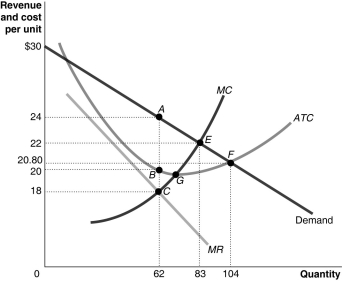 -Refer to Figure 9-6. The monopolist's total revenue is
 -Refer to Figure 9-4. What is likely to happen to this monopoly in the long run?
 (Multiple Choice)
4.8/5 (77)
(77) Which of the following is not a way by which price-discriminating firms can segment a market?
(Multiple Choice)
4.8/5 (85)
(85) Which of the following is not an example of price discrimination?
(Multiple Choice)
4.8/5 (73)
(73)  -Refer to Figure 9-10. Compared to a perfectly competitive market, consumer surplus is lower in a monopoly by an amount equal to the
 (Multiple Choice)
4.9/5 (88)
(88) Perfect price discrimination will lead a firm to produce up to the point where price equals marginal cost, the efficient level of output.
(True/False)
4.8/5 (93)
(93)  -Refer to Figure 9-11. If this industry was organised as a perfectly competitive industry, the market output and market price would be
 (Multiple Choice)
4.9/5 (77)
(77) Which of the following statements applies to a monopolist but not to a perfectly competitive firm at their profit maximising outputs?
(Multiple Choice)
4.8/5 (91)
(91) Consider the following pricing strategies: a. perfect price discrimination
B. charging different prices to different groups of customers
C. optimal two-part tariff
D. single-price monopoly pricing
Which of the pricing strategies allows a producer to capture the entire consumer surplus that would have gone to consumers under perfect competitive pricing?
(Multiple Choice)
5.0/5 (78)
(78) The market demand curve facing a monopolist is more elastic than the market demand curve facing a monopolistic competitor.
(True/False)
4.7/5 (85)
(85) A monopoly is a firm that is the only seller of a good or service that does not have
(Multiple Choice)
4.9/5 (77)
(77)  -Refer to Figure 9-15. What is the consumer surplus received under perfect price discrimination?
 (Multiple Choice)
4.9/5 (92)
(92)  -Refer to Figure 9-2. The firm's profit-maximising price is
 (Multiple Choice)
4.8/5 (98)
(98) Peet's Coffee and Teas produces some flavourful varieties of Peet's brand coffee. Is Peet's a monopoly?
(Multiple Choice)
4.8/5 (82)
(82) 
Filters
- Essay(0)
- Multiple Choice(0)
- Short Answer(0)
- True False(0)
- Matching(0)