



 Chat with AI
Exam 9: Monopoly Markets

Exam 1: Economics Foundations and Models160 Questions
Exam 2: Choices and Trade - Offs in the Market192 Questions
Exam 3: Where Prices Come Frome : The Interaction of Demand and Supply202 Questions
Exam 4: Elasticity: The Responsiveness of Demand and Supply226 Questions
Exam 5: Economic Efficiency , Government Price Setting and Taxes187 Questions
Exam 6: Concumer Choice and Behavioural Economics254 Questions
Exam 7: Technology , Production and Costs300 Questions
Exam 8: Firms in Perfectly Compitive Markets270 Questions
Exam 9: Monopoly Markets281 Questions
Exam 10: Monopolistic Competition : The Competitive Model in More Realistic Setting255 Questions
Exam 11: Oligopoly : Firms in Less Competitve Markets186 Questions
Exam 12: The Market for Labour and Other Factors of Production253 Questions
Exam 13: International Trade111 Questions
Exam 14: Government Intervention in the Market122 Questions
Exam 15: Externalities , Environmental Policy and Public Goods212 Questions
Exam 16: The Distribution of Income and Social Policy120 Questions
Select questions type


Because a monopoly's demand curve is the same as the market demand curve for its product
(Multiple Choice)
4.9/5  (88)
(88) A firm that has the ability to control to some degree the price of the product it sells
(Multiple Choice)
4.9/5 (70)
(70)  -Refer to Figure 9-2. If the firm's average total cost curve is ATC3, the firm will
 (Multiple Choice)
4.9/5 (74)
(74) Assume that a monopolist practices perfect price discrimination. The firm's marginal revenue curve will
(Multiple Choice)
4.8/5 (88)
(88) A perfectly competitive firm cannot practice price discrimination because
(Multiple Choice)
4.8/5 (81)
(81) 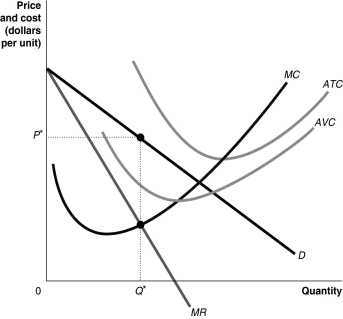 -Refer to Figure 9-5. If the monopolist charges price P* for output Q*, in order to maximise profit or minimise loss in the short run, it should
 (Multiple Choice)
4.9/5 (88)
(88) 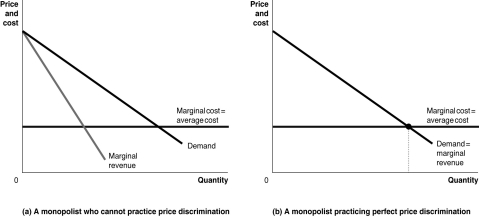 -Refer to Figure 9-16. Graph (a) represents a monopolist who cannot price discriminate and graph (b) represents a monopolist practicing perfect price discrimination. On each graph, identify the monopoly price, the monopoly output, the efficient output, and the areas representing profit, consumer surplus, and deadweight loss.
 (Essay)
4.8/5 (92)
(92)  -Refer to Figure 9-3. Suppose the monopolist represented in the diagram above produces positive output. What is the price charged at the profit-maximising/loss-minimising output level?
 (Multiple Choice)
4.8/5 (81)
(81) In which market structure is it not possible to practice price discrimination?
(Multiple Choice)
4.9/5 (73)
(73)
-Refer to Table 9-1. What is the marginal revenue from the sale of the 12th unit?
(Multiple Choice)
4.9/5 (78)
(78) Most pharmaceutical firms selling prescription drugs continue to earn economic profits long after the patents on the prescription drugs expire because they have established a strong foothold in the market.
(True/False)
4.9/5 (80)
(80) Joss is a marketing consultant. Iris and Daphne are potential customers interested in commissioning Joss to undertake a market survey and compile the findings in a report. Iris is willing to pay $500 for the service while Daphne is willing to pay $800. Suppose that the opportunity cost of Joss's time is $1200. Assume that Iris and Daphne do not know each other. Which of the following statements is true?
(Multiple Choice)
4.8/5 (74)
(74) Consider the following actions undertaken by a firm: a. charging the same price for products of different quality
B. charging different prices to different consumers for the same product when the variation cannot be explained by cost differences
C. charging different prices for products of different qualities
D. charging a lower price to match a competitor's price
Which of the above will be considered price discrimination?
(Multiple Choice)
4.9/5 (90)
(90)
-Refer to Table 9-1. What is the firm's profit-maximising output and what is the price charged to sell this output?
(Multiple Choice)
4.8/5 (87)
(87) Suppose a monopoly is producing its profit-maximising output level. Now suppose the government imposes a lump-sum tax on the monopoly, independent of its output. As a result, the monopolist will increase the price of its product to cover its higher cost.
(True/False)
4.8/5 (81)
(81) 
Filters
- Essay(0)
- Multiple Choice(0)
- Short Answer(0)
- True False(0)
- Matching(0)