



 Chat with AI
Exam 9: Monopoly Markets

Exam 1: Economics Foundations and Models160 Questions
Exam 2: Choices and Trade - Offs in the Market192 Questions
Exam 3: Where Prices Come Frome : The Interaction of Demand and Supply202 Questions
Exam 4: Elasticity: The Responsiveness of Demand and Supply226 Questions
Exam 5: Economic Efficiency , Government Price Setting and Taxes187 Questions
Exam 6: Concumer Choice and Behavioural Economics254 Questions
Exam 7: Technology , Production and Costs300 Questions
Exam 8: Firms in Perfectly Compitive Markets270 Questions
Exam 9: Monopoly Markets281 Questions
Exam 10: Monopolistic Competition : The Competitive Model in More Realistic Setting255 Questions
Exam 11: Oligopoly : Firms in Less Competitve Markets186 Questions
Exam 12: The Market for Labour and Other Factors of Production253 Questions
Exam 13: International Trade111 Questions
Exam 14: Government Intervention in the Market122 Questions
Exam 15: Externalities , Environmental Policy and Public Goods212 Questions
Exam 16: The Distribution of Income and Social Policy120 Questions
Select questions type


A firm that is the only seller of a good or service that does not have a close substitute is called
(Multiple Choice)
4.8/5  (81)
(81) A virtuous cycle refers to the development of new products that follows when a monopoly earns economic profits.
(True/False)
4.8/5 (79)
(79)  -Refer to Figure 9-9. What is the economically efficient output level?
 (Multiple Choice)
4.7/5 (75)
(75) 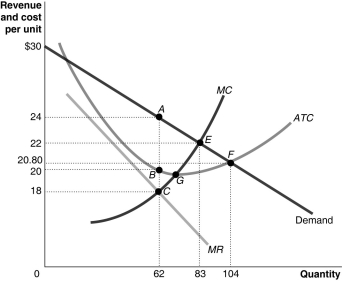 -Refer to Figure 9-6. The profit-maximising output and price for the monopolist are
 (Multiple Choice)
4.8/5 (80)
(80) A monopoly is defined as a firm that has the largest market share in an industry.
(True/False)
4.9/5 (88)
(88)  -Refer to Figure 9-11. What is the amount of consumer surplus if, instead of monopoly, the industry was organised as a perfectly competitive industry?
 (Multiple Choice)
4.7/5 (67)
(67) If we use a narrow definition of monopoly, then a monopoly is defined as a firm
(Multiple Choice)
4.8/5 (87)
(87)  -Refer to Figure 9-4. What is the amount of the monopoly's total revenue?
 (Multiple Choice)
5.0/5 (83)
(83) A monopolist's profit-maximising price and output correspond to the point on a graph
(Multiple Choice)
4.9/5 (85)
(85) A successful strategy of price discrimination requires that a firm be a price-taker.
(True/False)
4.9/5 (71)
(71) a. What is the difference between a horizontal merger and a vertical merger?
b. Give an example of each type of merger.
c. Could a horizontal merger be welfare improving?
(Essay)
4.8/5 (75)
(75)
-Refer to Table 9-3. If Julie charges $10 per hour, how many hours of pet sitting services will be purchased and by whom?
(Multiple Choice)
4.9/5 (84)
(84)  -Refer to Figure 9-2. If the firm's average total cost curve is ATC2, the firm will
 (Multiple Choice)
4.7/5 (77)
(77) Identify four reasons for high entry barriers. Briefly explain each reason.
(Essay)
4.9/5 (75)
(75) A firm that engages in price discrimination must be able to identify the preferences of every customer it serves.
(True/False)
4.9/5 (76)
(76) 'Being the only seller in the market, the monopolist can choose any price and quantity it desires.' Evaluate this statement: Is it true or false? Explain your answer.
(Essay)
4.9/5 (91)
(91) 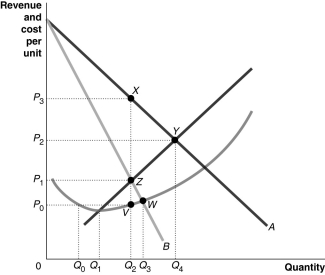 -Refer to Figure 9-8. Use the figure above to answer the following questions.
a. Identify the curves labeled A and B. Identify the curve which contains both point Y and point Z. Identify the curve which contains both point V and point W.
b. What is the profit-maximising quantity and what price will the monopolist charge?
c. What area represents total revenue at the profit-maximising output level?
d. What area represents total cost at the profit-maximising output level?
e. What area represents profit?
f. What is the profit per unit (average profit) at the profit-maximising output level?
g. If this industry was organised as a perfectly competitive industry, what would be the profit-maximising price and quantity?
h. What area represents the deadweight loss as a result of a monopoly?
-Refer to Figure 9-8. Use the figure above to answer the following questions.
a. Identify the curves labeled A and B. Identify the curve which contains both point Y and point Z. Identify the curve which contains both point V and point W.
b. What is the profit-maximising quantity and what price will the monopolist charge?
c. What area represents total revenue at the profit-maximising output level?
d. What area represents total cost at the profit-maximising output level?
e. What area represents profit?
f. What is the profit per unit (average profit) at the profit-maximising output level?
g. If this industry was organised as a perfectly competitive industry, what would be the profit-maximising price and quantity?
h. What area represents the deadweight loss as a result of a monopoly? (Essay)
4.8/5 (74)
(74) A monopolist currently sells 18 units of a good. If marginal revenue on the last unit sold is $117, then the price of the good must be less than $117.
(True/False)
4.9/5 (88)
(88) 
Filters
- Essay(0)
- Multiple Choice(0)
- Short Answer(0)
- True False(0)
- Matching(0)