



 Chat with AI
Exam 6: Concumer Choice and Behavioural Economics

Exam 1: Economics Foundations and Models160 Questions
Exam 2: Choices and Trade - Offs in the Market192 Questions
Exam 3: Where Prices Come Frome : The Interaction of Demand and Supply202 Questions
Exam 4: Elasticity: The Responsiveness of Demand and Supply226 Questions
Exam 5: Economic Efficiency , Government Price Setting and Taxes187 Questions
Exam 6: Concumer Choice and Behavioural Economics254 Questions
Exam 7: Technology , Production and Costs300 Questions
Exam 8: Firms in Perfectly Compitive Markets270 Questions
Exam 9: Monopoly Markets281 Questions
Exam 10: Monopolistic Competition : The Competitive Model in More Realistic Setting255 Questions
Exam 11: Oligopoly : Firms in Less Competitve Markets186 Questions
Exam 12: The Market for Labour and Other Factors of Production253 Questions
Exam 13: International Trade111 Questions
Exam 14: Government Intervention in the Market122 Questions
Exam 15: Externalities , Environmental Policy and Public Goods212 Questions
Exam 16: The Distribution of Income and Social Policy120 Questions
Select questions type


Some online penny auctions charge a fee, such as $1, for every bid placed. Why should these costs of $1 per bid be considered sunk costs? Would it be smart for someone who has 'already invested $5 in bidding costs' to keep bidding to 'protect his or her sunk investments'? Why or why not?

Free
(Essay)
4.9/5  (68)
(68) Correct Answer: Verified
The $1 charge per bid should be considered a sunk cost because this is a cost that has already been paid and cannot be recovered. Even if a person has the winning bid for an auction, each bid he or she placed will cost an extra $1 on top of the winning bid, so whether a person wins or loses, all bids must be paid for. Since sunk costs cannot be recovered, someone who has 'invested' $5 in bidding costs would not be smart to keep bidding to protect this investment.
Assume that Anne has $300 to spend on DVDs and CDs. Her optimal consumption of DVDs and CDs is illustrated by a tangency between a budget line and an indifference curve. Now assume that the price of CDs rises but the price of DVDs falls. How can you show that Anne is made better off by these price changes?
Free
(Multiple Choice)
4.8/5 (80)
(80) Correct Answer:Verified
VerifiedC
A new area of economics studies situations in which people appear to be making choices that do not seem to be economically rational. This area is called
Free
(Multiple Choice)
4.8/5 (75)
(75) Correct Answer:Verified
VerifiedA
-Refer to Table 6-5, which lists the values of Harry Taber's marginal utility and marginal utility per dollar for burgers and sushi rolls. Assume that the price of the burgers is $4 and the price of sushi rolls is $2. When Harry's income is $14 he buys two burgers and three sushi rolls. The last column lists the values of the marginal utility per dollar for sushi rolls when the price of sushi rolls decreases to $1. Complete this statement: As a result of the change in price,
(Multiple Choice)
4.9/5 (66)
(66)
-Refer to Table 6-3. The table above shows Lee's marginal utility per dollar from consuming ice cream cones and cans of Lemonade. The price of an ice cream cone is $2 and the price of Lemonade is $1. Use this information to select the correct statement.
(Multiple Choice)
4.9/5 (84)
(84) Arnold Kim began blogging about Apple products during his fourth year of medical school. Kim's website, MacRumors.com, became so successful that he decided to give up his medical career and work full time on his website, despite the nearly $200 000 he had invested in his education. In making his decision, the $200 000 he spent on his education
(Multiple Choice)
4.8/5 (77)
(77) If the price of lattes, a normal good that you enjoy, falls,
(Multiple Choice)
5.0/5 (80)
(80) The substitution effect of a decrease in the price of movie tickets results in
(Multiple Choice)
4.9/5 (83)
(83) If a consumer receives 20 units of utility from consuming two chocolate bars, and 25 units of utility from consuming three chocolate bars, the marginal utility of the third chocolate bar is
(Multiple Choice)
4.9/5 (78)
(78) Which of the following is likely to occur as the result of the law of diminishing marginal utility?
(Multiple Choice)
4.8/5 (85)
(85) Economists do not think it is possible to compare the relative utility that two people get from consuming an additional unit of a particular good.
(True/False)
4.9/5 (95)
(95) Eliza consumes 12 cappuccinos and 8 apple turnovers per week. The price of cappuccino is $4 each and apple turnovers are $1 each.
a. What is the amount of income allocated to cappuccino and apple turnover consumption?
b. What is the price ratio (the price of cappuccino relative to the price of apple turnovers)?
c. Explain the meaning of the price ratio you computed.
d. If Eliza maximises utility, what is the ratio of the marginal utility of cappuccino to the marginal utility of apple turnovers?
e. If the price of apple turnovers falls, will Eliza consume more apple turnovers, fewer apple turnovers or the same amount of apple turnovers? Explain your answer using the rule of equal marginal utility per dollar.
(Essay)
4.8/5 (79)
(79) 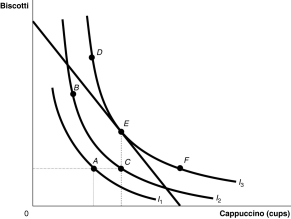 -Refer to Figure 6-6. Given the budget constraint in the diagram, which of the following statements is false?
 (Multiple Choice)
4.8/5 (77)
(77) Suppose the consumer's income increases while the prices of the goods remain constant. Then the
(Multiple Choice)
4.9/5 (82)
(82) 
Filters
- Essay(0)
- Multiple Choice(0)
- Short Answer(0)
- True False(0)
- Matching(0)