



 Chat with AI
Exam 6: Concumer Choice and Behavioural Economics

Exam 1: Economics Foundations and Models160 Questions
Exam 2: Choices and Trade - Offs in the Market192 Questions
Exam 3: Where Prices Come Frome : The Interaction of Demand and Supply202 Questions
Exam 4: Elasticity: The Responsiveness of Demand and Supply226 Questions
Exam 5: Economic Efficiency , Government Price Setting and Taxes187 Questions
Exam 6: Concumer Choice and Behavioural Economics254 Questions
Exam 7: Technology , Production and Costs300 Questions
Exam 8: Firms in Perfectly Compitive Markets270 Questions
Exam 9: Monopoly Markets281 Questions
Exam 10: Monopolistic Competition : The Competitive Model in More Realistic Setting255 Questions
Exam 11: Oligopoly : Firms in Less Competitve Markets186 Questions
Exam 12: The Market for Labour and Other Factors of Production253 Questions
Exam 13: International Trade111 Questions
Exam 14: Government Intervention in the Market122 Questions
Exam 15: Externalities , Environmental Policy and Public Goods212 Questions
Exam 16: The Distribution of Income and Social Policy120 Questions
Select questions type


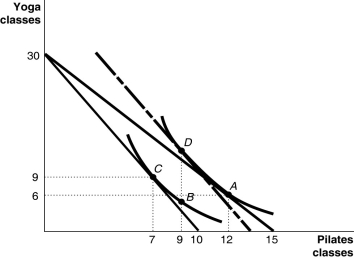 -Refer to Figure 6-5. Suppose the price of Pilates sessions rises to $30 while income and the price of Yoga sessions remain unchanged. The substitution effect of this price change is represented by the movement from
 (Multiple Choice)
4.9/5  (88)
(88) A curve that shows combinations of consumption bundles that give a consumer the same utility is called
(Multiple Choice)
4.9/5 (71)
(71) Grant has $200 to spend each month on restaurant meals and jazz performances at his neighbourhood jazz club. The price of a typical restaurant meal is $20 and the price of a jazz performance ticket is $10. Grant is maximising his utility by consuming 6 restaurant meals and attending 8 jazz performances. Suppose Grant still has $200 to spend, but the price of restaurant meal rises to $25, while the price of jazz performance ticket drops to $8. Is Grant better off or worse off than he was before the price change? Use a budget constraint/indifference curve graph to illustrate your answer.
(Essay)
4.9/5 (75)
(75) Total utility is maximised in the consumption of two goods by
(Multiple Choice)
5.0/5 (74)
(74) All of the following products are most likely to have significant network externalities except
(Multiple Choice)
5.0/5 (65)
(65) The substitution effect of a price increase causes a decrease in the quantity demanded of an inferior good.
(True/False)
4.8/5 (75)
(75) Consider a good whose consumption takes place publicly. Your decision to buy that good depends
(Multiple Choice)
4.8/5 (78)
(78) Economists Robert Jensen and Nolan Miller reasoned that to be a Giffen good, with an income effect larger than its substitution effect, a good must be ________ and make up a ________ portion of a consumer's budget.
(Multiple Choice)
4.8/5 (84)
(84) There are two conditions necessary for a consumer to maximise her utility. One is that the marginal utilities per dollar spent on each good and service consumed are equal. What is the other condition?
(Multiple Choice)
4.8/5 (83)
(83) Many people leave their servers tips in restaurants, even when they are not likely to visit the restaurant again. This is evidence that
(Multiple Choice)
4.7/5 (96)
(96) Farah has $100 to spend each month on bread and chicken. Suppose the price of bread is $4 a loaf and the price of chicken is $5 per pound.
a. Draw her budget constraint and label it BC0. Put bread on the horizontal axis and chicken on the vertical axis. Be sure to identify the intercept values.
b. Suppose Farah is a utility maximiser and she consumes 10 loaves of bread and 12 pounds of chicken. On the same graph you drew in part (a), draw an indifference curve to identify her optimal bundle. Label this bundle 'E.'
c. Is her budget exhausted? Verify your answer.
d. Now suppose Farah's income falls so that she can now devote $80 to the two goods. Prices however remain unchanged. In the same diagram, graph her new budget constraint and label it BC1. Be sure to identify any new intercept values.
e. Following the change in income, can Farah consume the same bundle 'E'? Explain your answer.
f. What must happen to her total utility following the decrease in her income?
(Essay)
4.9/5 (83)
(83)
-Refer to Table 6-2. Holding prices constant, when Keira's income changed from $18 to $23, what happens to her total utility and to the marginal utilities of the last cup of soup and the last sandwich purchased?
(Multiple Choice)
4.8/5 (81)
(81) When the price of audio books, a normal good, falls, causing your purchasing power to rise, you buy more of them due to
(Multiple Choice)
4.9/5 (80)
(80) Arnie Ziffel has $20 per week to spend on any combination of pineapples and green tea. The price of a pineapple is $4 and the price of a bottle of green tea is $2. The table below shows Arnie's utility values. Use the table to answer the questions that follow the table.
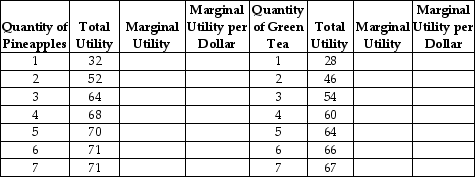 a. Complete the table by filling in the blank spaces.
b. Suppose Arnold purchases 4 pineapples and 2 bottles of green tea. Is he consuming the optimal consumption bundle? If so, explain why. If not, what combination should he buy and why?
a. Complete the table by filling in the blank spaces.
b. Suppose Arnold purchases 4 pineapples and 2 bottles of green tea. Is he consuming the optimal consumption bundle? If so, explain why. If not, what combination should he buy and why? (Essay)
4.8/5 (89)
(89) Why might network externalities result in products that contain inferior technologies?
(Essay)
4.7/5 (71)
(71) 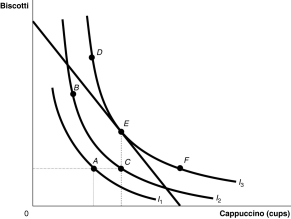 -Refer to Figure 6-6. If the price of biscotti is $1.50 and the price of a cappuccino is $3.00, what is the slope of the budget constraint?
 (Multiple Choice)
4.8/5 (62)
(62) The income effect due to a price decrease will result in an increase in the quantity demanded for
(Multiple Choice)
4.9/5 (75)
(75) Which of the following is held constant along an indifference curve?
(Multiple Choice)
4.9/5 (82)
(82) 
Filters
- Essay(0)
- Multiple Choice(0)
- Short Answer(0)
- True False(0)
- Matching(0)