



 Chat with AI
Exam 10: Monopolistic Competition : The Competitive Model in More Realistic Setting

Exam 1: Economics Foundations and Models160 Questions
Exam 2: Choices and Trade - Offs in the Market192 Questions
Exam 3: Where Prices Come Frome : The Interaction of Demand and Supply202 Questions
Exam 4: Elasticity: The Responsiveness of Demand and Supply226 Questions
Exam 5: Economic Efficiency , Government Price Setting and Taxes187 Questions
Exam 6: Concumer Choice and Behavioural Economics254 Questions
Exam 7: Technology , Production and Costs300 Questions
Exam 8: Firms in Perfectly Compitive Markets270 Questions
Exam 9: Monopoly Markets281 Questions
Exam 10: Monopolistic Competition : The Competitive Model in More Realistic Setting255 Questions
Exam 11: Oligopoly : Firms in Less Competitve Markets186 Questions
Exam 12: The Market for Labour and Other Factors of Production253 Questions
Exam 13: International Trade111 Questions
Exam 14: Government Intervention in the Market122 Questions
Exam 15: Externalities , Environmental Policy and Public Goods212 Questions
Exam 16: The Distribution of Income and Social Policy120 Questions
Select questions type


For a profit-maximising monopolistically competitive firm, for the last unit sold, the marginal cost of production is less than the marginal benefit received by a customer from the purchase of that unit.

Free
(True/False)
4.9/5  (82)
(82) Correct Answer: Verified
True
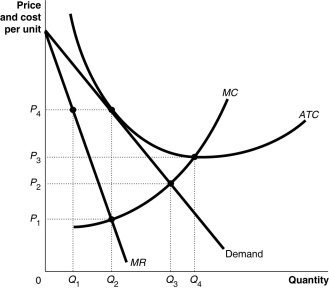 -Refer to Figure 10-12. What is the amount of excess capacity?
Free
(Multiple Choice)
4.8/5 (74)
(74) Correct Answer:Verified
VerifiedB
When a monopolistically competitive firm lowers it price, one bad thing happens to the firm. What is this 'one bad thing' called?
Free
(Multiple Choice)
4.7/5 (64)
(64) Correct Answer:Verified
VerifiedD
When a firm has been granted a trademark, which grants legal protection against other firms using the name of the product that has been granted the trademark, the firm
(Multiple Choice)
4.9/5 (72)
(72) If some monopolistically competitive firms exit their market after suffering short-run losses, the demand curves of remaining firms will shift to the right.
(True/False)
4.8/5 (88)
(88) Which of the following is true of a typical firm in a monopolistically competitive industry?
(Multiple Choice)
4.8/5 (75)
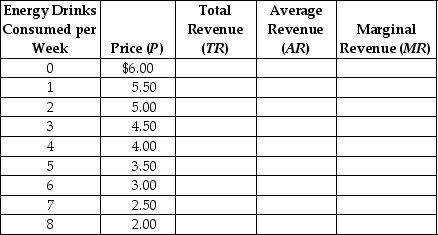
(75) Refer to Table 10-1. What portion of the marginal revenue of the 4th unit is due to the output effect and what portion is due to the price effect?
(Multiple Choice)
4.9/5 (92)
(92) 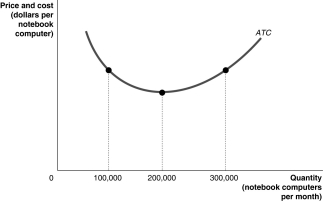 -Refer to Figure 10-11. Suppose the above graph represents the relationship between the average total cost of producing notebook computers and the quantity of notebook computers produced by Dell. On a graph, illustrate the demand, MR, MC, and ATC curves which would represent Dell maximising profits at a quantity of 100 000 per month and identify the area on the graph which represents the profit.
 (Essay)
4.9/5 (87)
(87) 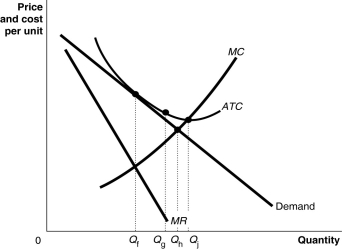 -Refer to Figure 10-17. What is the productively efficient output for the firm represented in the diagram?
 (Multiple Choice)
4.9/5 (79)
(79) 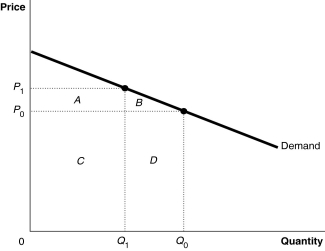 -Refer to Figure 10-1. The marginal revenue from the increase in price from P0 to P1 equals
 (Multiple Choice)
4.9/5 (72)
(72) In the long-run equilibrium, a monopolistically competitive firm earning normal profit produces the allocatively efficient output level.
(True/False)
4.8/5 (75)
(75) If price exceeds average variable cost but is less than average total cost, a firm
(Multiple Choice)
4.9/5 (92)
(92) Consumers in monopolistically competitive markets face a trade-off between paying prices greater than marginal costs and purchasing products that are more closely suited to their tastes.
(True/False)
4.8/5 (72)
(72) When a monopolistically competitive firm breaks even in the long run, this is equivalent to earning a zero accounting profit.
(True/False)
4.9/5 (93)
(93) 
Filters
- Essay(0)
- Multiple Choice(0)
- Short Answer(0)
- True False(0)
- Matching(0)