



 Chat with AI
Exam 10: Monopolistic Competition : The Competitive Model in More Realistic Setting

Exam 1: Economics Foundations and Models160 Questions
Exam 2: Choices and Trade - Offs in the Market192 Questions
Exam 3: Where Prices Come Frome : The Interaction of Demand and Supply202 Questions
Exam 4: Elasticity: The Responsiveness of Demand and Supply226 Questions
Exam 5: Economic Efficiency , Government Price Setting and Taxes187 Questions
Exam 6: Concumer Choice and Behavioural Economics254 Questions
Exam 7: Technology , Production and Costs300 Questions
Exam 8: Firms in Perfectly Compitive Markets270 Questions
Exam 9: Monopoly Markets281 Questions
Exam 10: Monopolistic Competition : The Competitive Model in More Realistic Setting255 Questions
Exam 11: Oligopoly : Firms in Less Competitve Markets186 Questions
Exam 12: The Market for Labour and Other Factors of Production253 Questions
Exam 13: International Trade111 Questions
Exam 14: Government Intervention in the Market122 Questions
Exam 15: Externalities , Environmental Policy and Public Goods212 Questions
Exam 16: The Distribution of Income and Social Policy120 Questions
Select questions type


Is a monopolistically competitive firm productively efficient?
(Multiple Choice)
4.9/5  (79)
(79)  -Refer to Figure 10-14. What is the area that represents the firm's profit?
 (Multiple Choice)
4.9/5 (91)
(91) In the long-run equilibrium, both the perfectly competitive firm and the monopolistically competitive firm produce the output at which MR = MC and charge a price equal to the average total cost of production.
(True/False)
4.8/5 (76)
(76) If a monopolistically competitive firm breaks even, the firm
(Multiple Choice)
4.7/5 (85)
(85) A monopolistically competitive industry that earns economic profits in the short run will
(Multiple Choice)
4.9/5 (72)
(72) Which of the following statements is true about advertising by a monopolistically competitive firm?
(Multiple Choice)
4.8/5 (80)
(80) Economists believe that consumers would be better off if markets were perfectly competitive rather than monopolistically competitive.
(True/False)
5.0/5 (83)
(83) Explain the similarities and differences between the long-run equilibrium for a perfectly competitive firm and a monopolistically competitive firm. Illustrate your answer with a graph demonstrating the long-run equilibrium for the two types of firms.
(Essay)
4.8/5 (74)
(74) Explain the differences between total revenue, average revenue, and marginal revenue.
(Essay)
4.8/5 (80)
(80)  -Refer to Figure 10-12. What is the monopolistic competitor's profit-maximising output?
 (Multiple Choice)
4.8/5 (63)
(63) The table below shows the demand and cost data facing 'Velvet Touches,' a monopolistically competitive producer of velvet throw pillows.
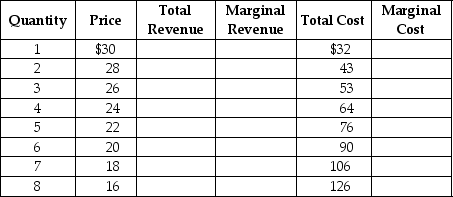 Use the data to answer the following questions.
a. Complete the Total Revenue (TR), Marginal Revenue (MR) and Marginal Cost (MC) columns above.
b. What are the profit-maximising price and quantity for Velvet Touches?
c. Is the firm making a profit or a loss? How much is the profit or loss? Show your work.
d. Is this firm operating in the long run or in the short run? Explain your answer.
e. If the firm's profit or loss is typical of all firms in the market for throw pillows, what is likely to happen in the future? Will there be more firms or will some existing firms leave the industry? Explain your answer.
f. What will happen to the typical firm's profit or loss after all entry/exit adjustments?
Use the data to answer the following questions.
a. Complete the Total Revenue (TR), Marginal Revenue (MR) and Marginal Cost (MC) columns above.
b. What are the profit-maximising price and quantity for Velvet Touches?
c. Is the firm making a profit or a loss? How much is the profit or loss? Show your work.
d. Is this firm operating in the long run or in the short run? Explain your answer.
e. If the firm's profit or loss is typical of all firms in the market for throw pillows, what is likely to happen in the future? Will there be more firms or will some existing firms leave the industry? Explain your answer.
f. What will happen to the typical firm's profit or loss after all entry/exit adjustments? (Essay)
4.9/5 (77)
(77) Which of the following will not happen as a consequence of a monopolistically competitive firm suffering economic losses in the short run?
(Multiple Choice)
4.9/5 (86)
(86)
-Refer to Figure 10-12. What is the productively efficient output for the firm represented in the diagram?
-Refer to Figure 10-12. What is the productively efficient output for the firm represented in the diagram? (Multiple Choice)
4.8/5 (84)
(84) The key characteristics of a monopolistically competitive market structure include
(Multiple Choice)
4.9/5 (86)
(86)  -Refer to Figure 10-8. What is the profit-maximising output level?
 (Multiple Choice)
4.8/5 (74)
(74) What is the difference between zero accounting profit and zero economic profit?
(Essay)
4.8/5 (70)
(70) 
Filters
- Essay(0)
- Multiple Choice(0)
- Short Answer(0)
- True False(0)
- Matching(0)