



 Chat with AI
Exam 6: Concumer Choice and Behavioural Economics

Exam 1: Economics Foundations and Models160 Questions
Exam 2: Choices and Trade - Offs in the Market192 Questions
Exam 3: Where Prices Come Frome : The Interaction of Demand and Supply202 Questions
Exam 4: Elasticity: The Responsiveness of Demand and Supply226 Questions
Exam 5: Economic Efficiency , Government Price Setting and Taxes187 Questions
Exam 6: Concumer Choice and Behavioural Economics254 Questions
Exam 7: Technology , Production and Costs300 Questions
Exam 8: Firms in Perfectly Compitive Markets270 Questions
Exam 9: Monopoly Markets281 Questions
Exam 10: Monopolistic Competition : The Competitive Model in More Realistic Setting255 Questions
Exam 11: Oligopoly : Firms in Less Competitve Markets186 Questions
Exam 12: The Market for Labour and Other Factors of Production253 Questions
Exam 13: International Trade111 Questions
Exam 14: Government Intervention in the Market122 Questions
Exam 15: Externalities , Environmental Policy and Public Goods212 Questions
Exam 16: The Distribution of Income and Social Policy120 Questions
Select questions type


Suppose the marginal utilities for the first three cans of coke are 100, 80 and 60, respectively. The total utility received from consuming 2 cans is
(Multiple Choice)
4.9/5  (69)
(69) Vinny consumes tacos and chicken wings. To keep his utility constant, he must consume more tacos if he consumes fewer chicken wings. This means that
(Multiple Choice)
4.9/5 (83)
(83) Behavioural economists examine choices that consumers make that are not economically rational. Economists generally assume that people are rational; that is, they weigh the benefits and costs of an action and choose an action only if the benefits outweigh the costs. Why do consumers not act rationally when the result is that they make themselves worse off?
(Essay)
4.9/5 (75)
(75) During a study session for an economics exam with three other students, Peter Daltry commented on an example of a consumer who had to decide the on number of slices of pizza and cups of Coca-Cola he would consume. Peter explained that 'To maximise his utility, this consumer must equate the marginal utility per dollar for pizza and Coca-Cola.' Was Peter's analysis correct?
(Multiple Choice)
4.9/5 (73)
(73) 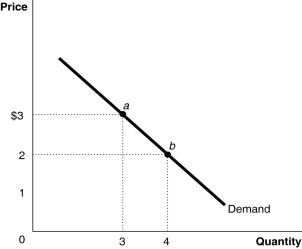 -Refer to Figure 6-2. When the price of ice cream cones increases from $2 to $3, quantity demanded decreases from 4 ice cream cones to 3 ice cream cones. This change in quantity demanded is due to
 (Multiple Choice)
4.8/5 (86)
(86) The substitution effect of an increase in the price of peaches is
(Multiple Choice)
4.9/5 (78)
(78) If Callum is consuming his utility maximising bundle and the price of one good rises, what happens to the marginal utility per dollar spent on this good (MU/P), and what should Callum do?
(Multiple Choice)
4.8/5 (79)
(79) 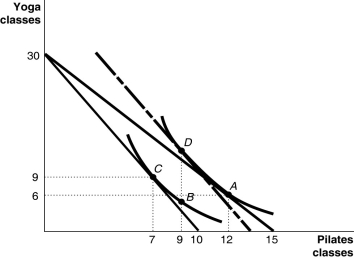 -Refer to Figure 6-5. Suppose the price of Pilates sessions rises to $30 while income and the price of Yoga sessions remain unchanged. What is her new optimal bundle?
 (Multiple Choice)
4.9/5 (72)
(72)
-Refer to Table 6-5, which lists the values of Harry Taber's marginal utility and marginal utility per dollar for burgers and sushi rolls. Assume that the price of the burgers is $4 and the price of sushi rolls is $2. When Harry's income is $14 he buys two burgers and three sushi rolls. The last column lists the values of the marginal utility per dollar for sushi rolls when the price of sushi rolls decreases to $1. Complete this statement: As a result of the change in price, the marginal utility of each sushi roll Harry consumes increases, and
(Multiple Choice)
5.0/5 (78)
(78) A network externality refers to a situation in which the usefulness of a product decreases with the number of consumers who use it.
(True/False)
4.8/5 (89)
(89) Jamal, Lawson and Kyle have been standing in line for almost an hour waiting to be served at Kirala, a popular new Japanese restaurant. It is possible that some of the people in line won't be served at all before the restaurant closes. Which of the following could explain why the restaurant does not simply raise prices high enough to eliminate the lines? a. In situations where consumption takes place publicly, demand for the product is also influenced by how many other people are buying the product. Consequently, a popular restaurant that increased its prices enough to eliminate lines might find that it had also eliminated its popularity.
B. Firms may sometimes not raise their prices for fear that it violates people's sense of fairness and might alienate customers.
C. The demand for restaurant meals is relatively elastic and if the firm raise prices it will lower its profits.
(Multiple Choice)
5.0/5 (64)
(64) An increase in income results in an outward shift of an indifference curve.
(True/False)
4.9/5 (91)
(91) Consider a downward-sloping demand curve. When the price of an inferior good increases, the income and substitution effects
(Multiple Choice)
4.9/5 (76)
(76) If Ewan is consuming his utility maximising bundle and the price of one good falls, what happens to the marginal utility per dollar spent on this good (MU/P), and what should Ewan do?
(Multiple Choice)
4.8/5 (75)
(75) The demand curve for corn is downward sloping. If the price of corn, an inferior good, falls,
(Multiple Choice)
4.9/5 (73)
(73) Assume that you had a ticket for a basketball playoff game that you bought for $50, the maximum price you were willing to pay. If a friend of yours offers to buy the ticket for $100 but you decide not to sell it, how can your decision be explained?
(Multiple Choice)
4.9/5 (101)
(101) 
Filters
- Essay(0)
- Multiple Choice(0)
- Short Answer(0)
- True False(0)
- Matching(0)