



 Chat with AI
Exam 9: Monopoly Markets

Exam 1: Economics Foundations and Models160 Questions
Exam 2: Choices and Trade - Offs in the Market192 Questions
Exam 3: Where Prices Come Frome : The Interaction of Demand and Supply202 Questions
Exam 4: Elasticity: The Responsiveness of Demand and Supply226 Questions
Exam 5: Economic Efficiency , Government Price Setting and Taxes187 Questions
Exam 6: Concumer Choice and Behavioural Economics254 Questions
Exam 7: Technology , Production and Costs300 Questions
Exam 8: Firms in Perfectly Compitive Markets270 Questions
Exam 9: Monopoly Markets281 Questions
Exam 10: Monopolistic Competition : The Competitive Model in More Realistic Setting255 Questions
Exam 11: Oligopoly : Firms in Less Competitve Markets186 Questions
Exam 12: The Market for Labour and Other Factors of Production253 Questions
Exam 13: International Trade111 Questions
Exam 14: Government Intervention in the Market122 Questions
Exam 15: Externalities , Environmental Policy and Public Goods212 Questions
Exam 16: The Distribution of Income and Social Policy120 Questions
Select questions type


For a natural monopoly, the marginal cost of producing an additional unit of its product is relatively small.
(True/False)
4.9/5  (80)
(80) If a monopolist's price is $50 at 63 units of output, and marginal revenue equals marginal cost, and average total cost equals $43, then the firm's total profit is
(Multiple Choice)
4.8/5 (77)
(77) Which of the following is a characteristic shared by a perfectly competitive firm and a monopoly?
(Multiple Choice)
4.7/5 (98)
(98) A product's price approaches its marginal cost as market concentration increases.
(True/False)
5.0/5 (80)
(80) 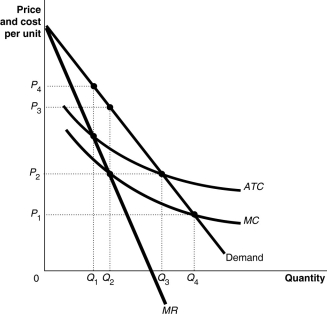 -Refer to Figure 9-12. Why won't regulators require that ETSA Power produce the economically efficient output level?
 (Multiple Choice)
4.9/5 (70)
(70) Equilibrium in a perfectly competitive market results in the greatest amount of economic surplus, or total benefit to society, from the production of a good. Why, then, did Joseph Schumpeter argue that an economy may benefit more from firms that have market power than from firms that are perfectly competitive?
(Essay)
4.9/5 (94)
(94)  -Refer to figure 9-13. In the absence of any government regulation, the profit-maximising owners of this firm will produce ________ units and charge a price of ________.
 (Multiple Choice)
4.9/5 (75)
(75) Which of the following is a necessary condition for successful price discrimination?
(Multiple Choice)
5.0/5 (77)
(77) Joss is a marketing consultant. Iris and Daphne are potential customers interested in commissioning Joss to undertake a market survey and compile the findings in a report. Iris is willing to pay $500 for the service while Daphne is willing to pay $800. Suppose that the opportunity cost of Joss's time is $1200. Assume that Iris and Daphne do not know each other. If the price is $500 per copy,
(Multiple Choice)
4.9/5 (76)
(76)  -Refer to Figure 9-2. To maximise profit, the firm will produce
 (Multiple Choice)
4.8/5 (80)
(80) A natural monopoly is most likely to occur in which of the following industries?
(Multiple Choice)
4.8/5 (84)
(84)  -Refer to Figure 9-3. Suppose the monopolist represented in the diagram above produces positive output. What is the profit-maximising/loss-minimising output level?
 (Multiple Choice)
4.7/5 (76)
(76) What three conditions must hold for a firm to successfully price discriminate?
(Essay)
5.0/5 (86)
(86) Are restaurant coupons a form of price discrimination? Why or why not?
(Essay)
4.8/5 (69)
(69) Price discrimination is a rational strategy for a profit-maximising firm when
(Multiple Choice)
4.9/5 (85)
(85)  -Refer to Figure 9-15. With perfect price discrimination, the firm will produce and sell
 (Multiple Choice)
4.8/5 (81)
(81) Which of the following are necessary condition(s) for successful price discrimination? a. zero transactions cost
B. a perfectly competitive market structure
C. an imperfectly competitive market structure
D. at least two different markets with different price elasticities of demand
E. at least two different markets with different price elasticities of supply
(Multiple Choice)
4.7/5 (77)
(77) Because each customer pays according to her willingness to pay, a consumer maximises her consumer surplus under first-degree price discrimination.
(True/False)
4.9/5 (67)
(67) A monopoly firm is the only seller of a good or service that
(Multiple Choice)
4.8/5 (74)
(74) 
Filters
- Essay(0)
- Multiple Choice(0)
- Short Answer(0)
- True False(0)
- Matching(0)