



 Chat with AI
Exam 9: Monopoly Markets

Exam 1: Economics Foundations and Models160 Questions
Exam 2: Choices and Trade - Offs in the Market192 Questions
Exam 3: Where Prices Come Frome : The Interaction of Demand and Supply202 Questions
Exam 4: Elasticity: The Responsiveness of Demand and Supply226 Questions
Exam 5: Economic Efficiency , Government Price Setting and Taxes187 Questions
Exam 6: Concumer Choice and Behavioural Economics254 Questions
Exam 7: Technology , Production and Costs300 Questions
Exam 8: Firms in Perfectly Compitive Markets270 Questions
Exam 9: Monopoly Markets281 Questions
Exam 10: Monopolistic Competition : The Competitive Model in More Realistic Setting255 Questions
Exam 11: Oligopoly : Firms in Less Competitve Markets186 Questions
Exam 12: The Market for Labour and Other Factors of Production253 Questions
Exam 13: International Trade111 Questions
Exam 14: Government Intervention in the Market122 Questions
Exam 15: Externalities , Environmental Policy and Public Goods212 Questions
Exam 16: The Distribution of Income and Social Policy120 Questions
Select questions type


In reality, because few markets are perfectly competitive, some loss of economic efficiency occurs in the market for nearly every good or service.
(True/False)
4.8/5  (86)
(86) Which one of the following is not a possible barrier to entry high enough to keep competing firms out of a monopoly industry?
(Multiple Choice)
4.9/5 (85)
(85)  -Refer to Figure 9-9. What is the difference between the monopoly output and the perfectly competitive output?
 (Multiple Choice)
4.7/5 (80)
(80) What is the relationship between marginal revenue and average revenue for a monopolist and is it the same for a perfect competitor?
(Essay)
4.9/5 (85)
(85) Refer to Table 9-3. Suppose Julie's marginal cost of providing this service is constant at $7 and she charges each customer according to his or her willingness to pay instead of a uniform price of $7. Which of the following statements is true?
(Multiple Choice)
4.8/5 (88)
(88) Assume a hypothetical case where an industry begins as perfectly competitive and then becomes a monopoly. Which of the following statements comparing the conditions in the industry under both market structures is true?
(Multiple Choice)
4.9/5 (89)
(89) For a firm that can effectively price discriminate, who will be charged a lower price?
(Multiple Choice)
4.7/5 (79)
(79) Which of the following statements about perfect price discrimination is false?
(Multiple Choice)
4.8/5 (78)
(78) What is a public franchise? Are all public franchises natural monopolies?
(Essay)
4.7/5 (72)
(72)
-Refer to Figure 9-9. At the profit-maximising quantity, what is the difference between the monopoly's price and the marginal cost of production?
-Refer to Figure 9-9. At the profit-maximising quantity, what is the difference between the monopoly's price and the marginal cost of production? (Multiple Choice)
4.9/5 (83)
(83) Firms that face downward-sloping demand curves for their output in the product market are called
(Multiple Choice)
4.9/5 (74)
(74) Refer to Table 9-3. Suppose Julie's marginal cost of providing this service is constant at $7 and she decides to charge each customer according to his or her willingness to pay. What is Julie's total revenue and how many hours of service will be purchased?
(Multiple Choice)
4.8/5 (63)
(63) a. What is the defining characteristic of a natural monopoly?
b. Should the government break up a natural monopoly into two or more firms to make the industry more competitive?
c. Suppose the government wants to ensure that some of the benefits of declining average total cost are passed on to consumers. To achieve this goal, it requires that the natural monopoly set its price equal to marginal cost. Is this a feasible goal? Explain.
d. What is an alternative to marginal cost pricing that ensures that consumers reap some of the benefits of declining average total cost?
(Essay)
4.8/5 (80)
(80)  -Refer to Figure 9-13. Suppose the government regulates this industry in order to remove the inefficiency implied by the behaviour of the profit-maximising owners. If regulators require that the firm produces the economically efficient output level, what is this level and what price will be charged?
 (Multiple Choice)
5.0/5 (80)
(80) What happens to a monopoly's revenue when it sells more units of its product?
(Essay)
4.8/5 (89)
(89) If the market for a product begins as perfectly competitive and then becomes a monopoly, there will be a reduction in economic efficiency and a deadweight loss.
(True/False)
4.8/5 (66)
(66) A vertical merger is one that takes place between two companies producing different goods or services for one specific finished product.
(True/False)
4.7/5 (90)
(90)  -Refer to Figure 9-15. What is the economically efficient output level?
 (Multiple Choice)
4.8/5 (91)
(91) The term 'trust' in antitrust refers to a board of trustees that has collusive control over different companies.
(True/False)
4.8/5 (69)
(69) 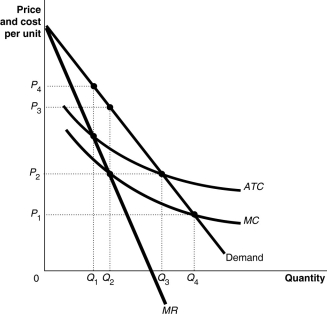 -Refer to Figure 9-12. ETSA Power is a natural monopoly because
 (Multiple Choice)
4.8/5 (69)
(69) 
Filters
- Essay(0)
- Multiple Choice(0)
- Short Answer(0)
- True False(0)
- Matching(0)