



 Chat with AI
Exam 7: Chemical Reactions: Energy, rates, and Equilibrium

Exam 1: Matter and Measurements143 Questions
Exam 2: Atoms and the Periodic Table91 Questions
Exam 3: Ionic Compounds75 Questions
Exam 4: Molecular Compounds75 Questions
Exam 5: Classification and Balancing of Chemical Reactions53 Questions
Exam 6: Chemical Reactions: Mole and Mass Relationships46 Questions
Exam 7: Chemical Reactions: Energy, rates, and Equilibrium73 Questions
Exam 8: Gases, liquids, and Solids73 Questions
Exam 9: Solutions110 Questions
Exam 10: Acids and Bases102 Questions
Exam 11: Nuclear Chemistry88 Questions
Exam 12: Introduction to Organic Chemistry: Alkanes83 Questions
Exam 13: Alkenes, alkynes, and Aromatic Compounds85 Questions
Exam 14: Some Compounds With Oxygen, sulfur, or a Halogen94 Questions
Exam 15: Amines46 Questions
Exam 16: Aldehydes and Ketones77 Questions
Exam 17: Carboxylic Acids and Their Derivatives84 Questions
Exam 18: Amino Acids and Proteins78 Questions
Exam 19: Enzymes and Vitamins75 Questions
Exam 20: The Generation of Biochemical Energy66 Questions
Exam 21: Carbohydrates72 Questions
Exam 22: Carbohydrate Metabolism60 Questions
Exam 23: Lipids79 Questions
Exam 24: Lipid Metabolism58 Questions
Exam 25: Nucleic Acids and Protein Synthesis67 Questions
Exam 26: Genomics38 Questions
Exam 27: Protein and Amino Acid Metabolism47 Questions
Exam 28: Chemical Messengers: Hormones, neurotransmitters, and Drugs73 Questions
Exam 29: Body Fluids63 Questions
Select questions type


A process which is unfavorable with respect to enthalpy,but favorable with respect to entropy
(Multiple Choice)
4.8/5  (77)
(77) Match the following.
-A process or reaction that has a negative value of ΔG
(Multiple Choice)
4.8/5 (91)
(91) Sketch a diagram to illustrate the role of orientation in determining whether a collision between molecules of two different diatomic elements will lead to formation of a compound.How could you illustrate the influence of energy considerations on this reaction?
(Essay)
4.8/5 (81)
(81) For the following reaction,increasing the pressure will cause the equilibrium to ________.
2 SO2 (g)+ O2 (g)  2 SO3 (g)+ heat
 (Multiple Choice)
4.9/5 (80)
(80) Match the following.
-A process or reaction which releases heat
(Multiple Choice)
4.9/5 (67)
(67) Which of the following statements can be assumed to be true about how reactions occur?
(Multiple Choice)
4.8/5 (74)
(74) S + O2 → SO2 ΔH = -70.8 kcal
Based on the reaction shown,which statement is true?
(Multiple Choice)
4.7/5 (75)
(75) Consider the reaction shown:
N2 + O2 → 2 NO ΔH = 43.2 kcal
When 50.0 g of N2 react,________ kcal will be ________.
(Multiple Choice)
4.8/5 (70)
(70) A process or reaction which releases heat to the surroundings is said to be
(Multiple Choice)
4.8/5 (77)
(77) 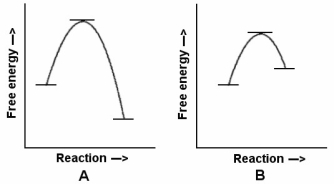 -For a chemical reaction to occur,all of the following must happen except
 (Multiple Choice)
4.8/5 (92)
(92) 
Filters
- Essay(0)
- Multiple Choice(0)
- Short Answer(0)
- True False(0)
- Matching(0)