



 Chat with AI
Exam 7: Chemical Reactions: Energy, rates, and Equilibrium

Exam 1: Matter and Measurements143 Questions
Exam 2: Atoms and the Periodic Table91 Questions
Exam 3: Ionic Compounds75 Questions
Exam 4: Molecular Compounds75 Questions
Exam 5: Classification and Balancing of Chemical Reactions53 Questions
Exam 6: Chemical Reactions: Mole and Mass Relationships46 Questions
Exam 7: Chemical Reactions: Energy, rates, and Equilibrium73 Questions
Exam 8: Gases, liquids, and Solids73 Questions
Exam 9: Solutions110 Questions
Exam 10: Acids and Bases102 Questions
Exam 11: Nuclear Chemistry88 Questions
Exam 12: Introduction to Organic Chemistry: Alkanes83 Questions
Exam 13: Alkenes, alkynes, and Aromatic Compounds85 Questions
Exam 14: Some Compounds With Oxygen, sulfur, or a Halogen94 Questions
Exam 15: Amines46 Questions
Exam 16: Aldehydes and Ketones77 Questions
Exam 17: Carboxylic Acids and Their Derivatives84 Questions
Exam 18: Amino Acids and Proteins78 Questions
Exam 19: Enzymes and Vitamins75 Questions
Exam 20: The Generation of Biochemical Energy66 Questions
Exam 21: Carbohydrates72 Questions
Exam 22: Carbohydrate Metabolism60 Questions
Exam 23: Lipids79 Questions
Exam 24: Lipid Metabolism58 Questions
Exam 25: Nucleic Acids and Protein Synthesis67 Questions
Exam 26: Genomics38 Questions
Exam 27: Protein and Amino Acid Metabolism47 Questions
Exam 28: Chemical Messengers: Hormones, neurotransmitters, and Drugs73 Questions
Exam 29: Body Fluids63 Questions
Select questions type


A process or reaction which takes in heat from the surroundings is said to be

Free
(Multiple Choice)
4.7/5  (80)
(80) Correct Answer: Verified
B
Select the correct figure to match the description.
-A slow reaction with a large positive free energy change
Free
(Multiple Choice)
5.0/5 (73)
(73) Correct Answer:Verified
VerifiedC
Which statement best describes the way a catalyst works?
Free
(Multiple Choice)
4.8/5 (84)
(84) Correct Answer:Verified
VerifiedC
Consider the endothermic reaction:
N2 (g)+ 2 H2 (g)→ N2H4 (l)
The entropy change of this reaction is ________ and the enthalpy change is ________,so at a very high temperature,this reaction is probably ________.
(Multiple Choice)
4.9/5 (95)
(95) Consider the reaction shown:
P4 (s)+ 10 Cl2 (g)→ 4 PCl5 (s)+ 452 kcal
When 50.00 g of P4 react,________ kcal will be ________.
(Multiple Choice)
4.9/5 (76)
(76) 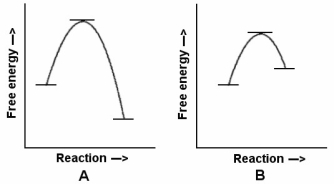 -In the reaction energy diagrams shown,reaction B is ________,and it occurs ________ reaction B.
 (Multiple Choice)
5.0/5 (81)
(81) Match the following.
-A process or reaction which consumes heat
(Multiple Choice)
4.9/5 (87)
(87) The concept of free energy allows prediction of spontaneity of a process by considering the changes in ________ and ________ during the process.
(Multiple Choice)
4.8/5 (86)
(86) 2 Al2O3 (s)→ 4 Al (s)+ 3 O2 (g) ΔG = +138 kcal
Consider the contribution of entropy to the spontaneity of this reaction.As written,the reaction is ________,and the entropy of the system ________.
(Multiple Choice)
4.9/5 (88)
(88) A reaction is said to be ________ if the bonds formed during the reaction are stronger than the bonds broken.
(Multiple Choice)
4.7/5 (82)
(82) Consider the reaction shown:
304.0 kcal + 4 PCl3 (l)→ P4 (s)+ 6 Cl2 (g)
When 50.00 g of PCl3 react,________ kcal will be ________.
(Multiple Choice)
4.9/5 (79)
(79) Select the correct figure to match the description.
-A slow reaction with a negative free energy change
(Multiple Choice)
4.9/5 (78)
(78) To simplify comparisons,the energy value of fuels is expressed in units of
(Multiple Choice)
4.8/5 (84)
(84) Consider the reaction:
2 CO (g)+ O2 (g)  2 CO2 (g)
The equilibrium expression for this reaction is:
2 CO2 (g)
The equilibrium expression for this reaction is: (Multiple Choice)
4.9/5 (75)
(75) The scientific principle which explains the observation that the amount of heat transfer accompanying a change in one direction is numerically equal but opposite in sign to the amount of heat transfer in the opposite direction is
(Multiple Choice)
4.8/5 (70)
(70) Consider the reaction shown:
C3H8 + 5 O2 → 3 CO2 + 4 H2O + 488 kcal
We can say that this reaction is ________ and that the sign of ΔH is ________.
(Multiple Choice)
4.9/5 (85)
(85) Consider the reaction shown:
452 kcal + 4 PCl5 (s)→ P4 (s)+ 10 Cl2 (g)
This reaction is ________ because the sign of ΔH is ________.
(Multiple Choice)
4.9/5 (75)
(75) Select the correct figure to match the description.
-A slow reaction with a large negative free energy change
(Multiple Choice)
4.8/5 (70)
(70) 
Filters
- Essay(0)
- Multiple Choice(0)
- Short Answer(0)
- True False(0)
- Matching(0)