



 Chat with AI
Exam 28: Pericyclic Reactions

Exam 1: Remembering General Chemistry: Electronic Structure and Bonding81 Questions
Exam 2: Acids and Bases: Central to Understanding Organic Chemistry37 Questions
Exam 3: An Introduction to Organic Compounds123 Questions
Exam 4: Isomers: the Arrangement of Atoms in Space111 Questions
Exam 5: Alkenes Thermodynamics and Kinetics76 Questions
Exam 6: Reactions of Alkenes93 Questions
Exam 7: Reactions of Alkynes Introduction to Multistep Synthesis119 Questions
Exam 8: Electron Delocalization, Resonance, and Aromaticity More About Molecular Orbital Theory166 Questions
Exam 9: Substitution Reactions of Alkyl Halides118 Questions
Exam 10: Elimination Reactions of Alkyl Halides Competition Between Substitution and Elimination94 Questions
Exam 11: Reactions of Alcohols, Ethers, Epoxides, and Sulfur-Containing Compounds100 Questions
Exam 12: Organometallic Compounds57 Questions
Exam 13: Reactions of Alkanes, Radicals130 Questions
Exam 14: Mass Spectrometry, Infrared Spectroscopy, and Uvvis Spectroscopy127 Questions
Exam 15: Nmr Spectroscopy110 Questions
Exam 16: Reactions of Carboxylic Acids and Carboxylic Acid Derivatives128 Questions
Exam 17: Reactions of Aldehydes and Ketones116 Questions
Exam 18: Reactions at the Alpha Carbon of Carbonyl Compounds113 Questions
Exam 19: Reactions of Benzene and Substituted Benzenes155 Questions
Exam 20: More About Amines Heterocylic Compounds115 Questions
Exam 21: Carbohydrates100 Questions
Exam 22: Amino Acids, Peptides, and Proteins105 Questions
Exam 23: Catalysis85 Questions
Exam 24: The Organic Mechanisms of the Coenzymes92 Questions
Exam 25: The Chemistry of Metabolism94 Questions
Exam 26: Nucleosides, Nucleotides, and Nucleic Acids85 Questions
Exam 27: Synthetic Polymers106 Questions
Exam 28: Pericyclic Reactions92 Questions
Select questions type


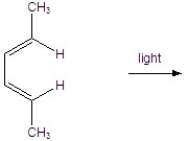
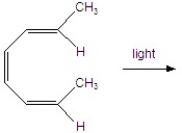
Under photochemical conditions, (2E,4Z)-hexadiene undergoes a ________ ring closure to yield ________.
(Multiple Choice)
4.9/5  (85)
(85) 
Which of the following statements best describes the term suprafacial?
(Multiple Choice)
5.0/5 (88)
(88) Which of the following reactions best describes the Diels-Alder reaction?
(Multiple Choice)
4.9/5 (78)
(78) 
How many nodes does the highest energy molecular orbital of 1,3,5,7-octatetraene have?
(Multiple Choice)
4.7/5 (93)
(93) Through what type of single pericyclic reaction did the reaction shown below proceed? 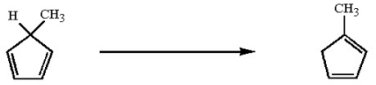
(Multiple Choice)
4.8/5 (91)
(91) Under what conditions would a 1,5-hydrogen shift occur in a sigmatropic rearrangement?
(Multiple Choice)
4.8/5 (85)
(85) Which of the following best describes the sigmatropic rearrangement that occurs in the reaction shown below? 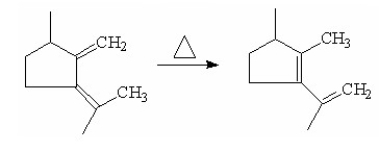
(Multiple Choice)
4.9/5 (97)
(97) Which of the following molecular orbitals is produced when in-phase atomic orbitals overlap?
(Multiple Choice)
5.0/5 (77)
(77) Which molecular orbital is higher in energy: the in-phase or out-of-phase overlap of atomic orbitals?
(Essay)
4.9/5 (90)
(90) Provide the major organic product of the following Diels-Alder cycloaddition. 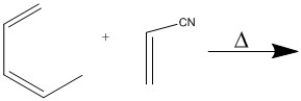
(Essay)
4.7/5 (80)
(80) Indicate whether each of the following reactions is an electrocyclic reaction, a cycloaddition reaction, or a sigmatropic rearrangement. 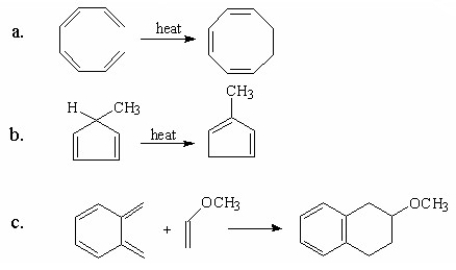
(Essay)
4.9/5 (97)
(97) 
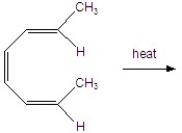
What is the product from the following 1,3-carbon shift reaction? 
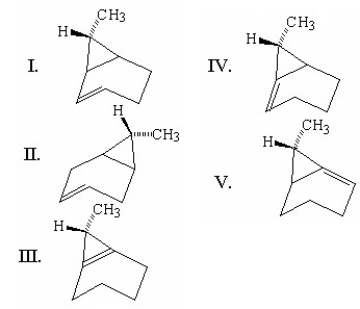
(Multiple Choice)
5.0/5 (77)
(77) (a) Under thermal conditions, will ring closure of (2E,4Z,6Z,8E)-decatetraene be conrotatory or disrotatory? Explain.
(b) Will the product be cis or trans? Explain
(Essay)
5.0/5 (70)
(70) How many nodes would you expect from the following atomic orbital overlap? 
(Essay)
4.7/5 (81)
(81) 
Filters
- Essay(0)
- Multiple Choice(0)
- Short Answer(0)
- True False(0)
- Matching(0)