



 Chat with AI
Exam 21: Carbohydrates

Exam 1: Remembering General Chemistry: Electronic Structure and Bonding81 Questions
Exam 2: Acids and Bases: Central to Understanding Organic Chemistry37 Questions
Exam 3: An Introduction to Organic Compounds123 Questions
Exam 4: Isomers: the Arrangement of Atoms in Space111 Questions
Exam 5: Alkenes Thermodynamics and Kinetics76 Questions
Exam 6: Reactions of Alkenes93 Questions
Exam 7: Reactions of Alkynes Introduction to Multistep Synthesis119 Questions
Exam 8: Electron Delocalization, Resonance, and Aromaticity More About Molecular Orbital Theory166 Questions
Exam 9: Substitution Reactions of Alkyl Halides118 Questions
Exam 10: Elimination Reactions of Alkyl Halides Competition Between Substitution and Elimination94 Questions
Exam 11: Reactions of Alcohols, Ethers, Epoxides, and Sulfur-Containing Compounds100 Questions
Exam 12: Organometallic Compounds57 Questions
Exam 13: Reactions of Alkanes, Radicals130 Questions
Exam 14: Mass Spectrometry, Infrared Spectroscopy, and Uvvis Spectroscopy127 Questions
Exam 15: Nmr Spectroscopy110 Questions
Exam 16: Reactions of Carboxylic Acids and Carboxylic Acid Derivatives128 Questions
Exam 17: Reactions of Aldehydes and Ketones116 Questions
Exam 18: Reactions at the Alpha Carbon of Carbonyl Compounds113 Questions
Exam 19: Reactions of Benzene and Substituted Benzenes155 Questions
Exam 20: More About Amines Heterocylic Compounds115 Questions
Exam 21: Carbohydrates100 Questions
Exam 22: Amino Acids, Peptides, and Proteins105 Questions
Exam 23: Catalysis85 Questions
Exam 24: The Organic Mechanisms of the Coenzymes92 Questions
Exam 25: The Chemistry of Metabolism94 Questions
Exam 26: Nucleosides, Nucleotides, and Nucleic Acids85 Questions
Exam 27: Synthetic Polymers106 Questions
Exam 28: Pericyclic Reactions92 Questions
Select questions type


The open-chain form of D-idose is shown below. Draw the Haworth projection of b-D-idopyranose. 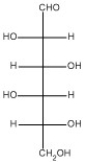
(Essay)
4.9/5  (80)
(80) Which of the following is/are the product(s)obtained from the reduction of D-fructose?
(Multiple Choice)
4.9/5 (77)
(77) 
Which two monosaccharides can be degraded by the Ruff Degradation to D-arabinose? 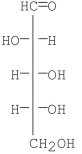
(Multiple Choice)
4.9/5 (90)
(90) Which of the following statements best describes the meaning of mutorotation?
(Multiple Choice)
4.8/5 (78)
(78) Assign the proper configurational descriptor to each asymmetric center in D-gulose below. 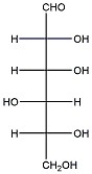
(Essay)
4.9/5 (91)
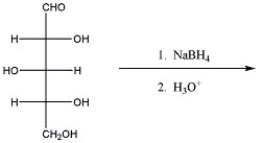
(91) 
Which of the following best represents the process of photosynthesis?
(Multiple Choice)
4.8/5 (76)
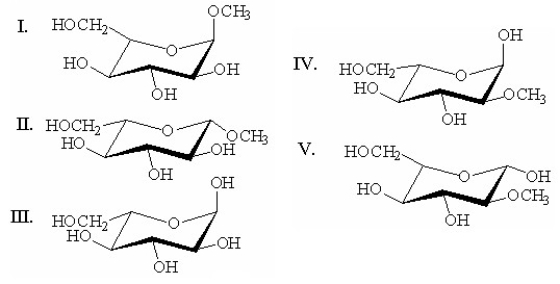
(76) 
An optically active D-aldopentose produced an optically inactive alditol upon treatment with NaBH4. When this aldopentose was subjected to a Ruff degradation, a D-aldotetrose was generated. This aldotetrose gave an optically active aldaric acid upon oxidation with HNO3. Use these data to provide the structure of the starting D-aldopentose.
(Essay)
4.8/5 (81)
(81) 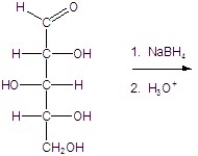
When α-D-xylofuranose is treated with excess methyl iodide in the presence of Ag2O, how many equivalents of methyl iodide react with each equivalent of the furanose?
(Multiple Choice)
4.9/5 (73)
(73) Which of the following represents the general formula of a carbohydrate?
(Multiple Choice)
4.9/5 (69)
(69) Given the structure of D-arabinose below, provide the structure of the glycoside methyl α-D-arabinofuranoside. 
(Essay)
4.9/5 (71)
(71) 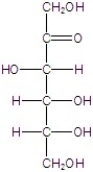
An aqueous solution of glucose behaves as an aldehyde because ________.
(Multiple Choice)
4.8/5 (79)
(79) Which of the following statements best describes the main structural difference between cellulose and chitin?
(Multiple Choice)
4.9/5 (74)
(74) Which monosaccharides are formed in the Kiliani-Fischer synthesis starting with D-xylose? 
(Multiple Choice)
4.9/5 (78)
(78) 
Filters
- Essay(0)
- Multiple Choice(0)
- Short Answer(0)
- True False(0)
- Matching(0)