



 Chat with AI
Exam 18: Reactions at the Alpha Carbon of Carbonyl Compounds

Exam 1: Remembering General Chemistry: Electronic Structure and Bonding81 Questions
Exam 2: Acids and Bases: Central to Understanding Organic Chemistry37 Questions
Exam 3: An Introduction to Organic Compounds123 Questions
Exam 4: Isomers: the Arrangement of Atoms in Space111 Questions
Exam 5: Alkenes Thermodynamics and Kinetics76 Questions
Exam 6: Reactions of Alkenes93 Questions
Exam 7: Reactions of Alkynes Introduction to Multistep Synthesis119 Questions
Exam 8: Electron Delocalization, Resonance, and Aromaticity More About Molecular Orbital Theory166 Questions
Exam 9: Substitution Reactions of Alkyl Halides118 Questions
Exam 10: Elimination Reactions of Alkyl Halides Competition Between Substitution and Elimination94 Questions
Exam 11: Reactions of Alcohols, Ethers, Epoxides, and Sulfur-Containing Compounds100 Questions
Exam 12: Organometallic Compounds57 Questions
Exam 13: Reactions of Alkanes, Radicals130 Questions
Exam 14: Mass Spectrometry, Infrared Spectroscopy, and Uvvis Spectroscopy127 Questions
Exam 15: Nmr Spectroscopy110 Questions
Exam 16: Reactions of Carboxylic Acids and Carboxylic Acid Derivatives128 Questions
Exam 17: Reactions of Aldehydes and Ketones116 Questions
Exam 18: Reactions at the Alpha Carbon of Carbonyl Compounds113 Questions
Exam 19: Reactions of Benzene and Substituted Benzenes155 Questions
Exam 20: More About Amines Heterocylic Compounds115 Questions
Exam 21: Carbohydrates100 Questions
Exam 22: Amino Acids, Peptides, and Proteins105 Questions
Exam 23: Catalysis85 Questions
Exam 24: The Organic Mechanisms of the Coenzymes92 Questions
Exam 25: The Chemistry of Metabolism94 Questions
Exam 26: Nucleosides, Nucleotides, and Nucleic Acids85 Questions
Exam 27: Synthetic Polymers106 Questions
Exam 28: Pericyclic Reactions92 Questions
Select questions type


In theory a poorly planned crossed aldol reaction can produce how many different aldol regioisomers?
(Multiple Choice)
4.8/5  (69)
(69) 
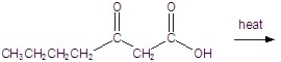
Provide a detailed, stepwise mechanism for the acid-catalyzed enolization of acetaldehyde.
(Essay)
4.9/5 (83)
(83) 
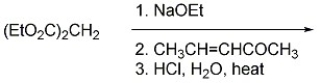

Which of the following underlined alpha hydrogens are the most acidic?
(Multiple Choice)
4.9/5 (82)
(82) Which of the following compounds does not have an alpha hydrogen? 
(Multiple Choice)
4.7/5 (84)
(84) Provide a detailed, stepwise mechanism for the α-bromination of acetone in base.
(Essay)
4.9/5 (87)
(87) Enolates are frequently formed by treating an aldehyde or ketone with LDA. However, the LDA must first be generated by reacting diisopropylamine with butyllithium. Why don't chemists just use butyllithium itself to deprotonate the aldehyde or ketone and form the enolate?
(Essay)
4.7/5 (74)
(74) 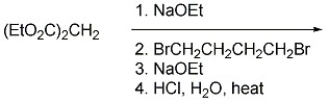

Provide the structure of the alkyl bromide that is needed to prepare 6-methyl-2-heptanone using the acetoacetic ester synthesis.
(Essay)
5.0/5 (83)
(83) 
An enolate attacks an aldehyde and the resulting product is subsequently protonated. What type of reaction is this?
(Multiple Choice)
4.8/5 (85)
(85) 

a) The base-catalyzed reaction of 1 mole of acetone with 2 moles of benzaldehyde yields a yellow solid, C17H14O. What is the structure of the product?
b) What will be the result when only 1 mole of benzaldehyde is added?
c) What will be the result when acetone is not added at all?
d) What will be the result when benzaldehyde is not added at all?
e) Why is the self-condensation of acetone unlikely in the presence of benzaldehyde?
(Essay)
4.7/5 (81)
(81) What is the major organic product of the following reaction? 

(Multiple Choice)
4.8/5 (69)
(69) 


Filters
- Essay(0)
- Multiple Choice(0)
- Short Answer(0)
- True False(0)
- Matching(0)