



 Chat with AI
Exam 17: Reactions of Aldehydes and Ketones

Exam 1: Remembering General Chemistry: Electronic Structure and Bonding81 Questions
Exam 2: Acids and Bases: Central to Understanding Organic Chemistry37 Questions
Exam 3: An Introduction to Organic Compounds123 Questions
Exam 4: Isomers: the Arrangement of Atoms in Space111 Questions
Exam 5: Alkenes Thermodynamics and Kinetics76 Questions
Exam 6: Reactions of Alkenes93 Questions
Exam 7: Reactions of Alkynes Introduction to Multistep Synthesis119 Questions
Exam 8: Electron Delocalization, Resonance, and Aromaticity More About Molecular Orbital Theory166 Questions
Exam 9: Substitution Reactions of Alkyl Halides118 Questions
Exam 10: Elimination Reactions of Alkyl Halides Competition Between Substitution and Elimination94 Questions
Exam 11: Reactions of Alcohols, Ethers, Epoxides, and Sulfur-Containing Compounds100 Questions
Exam 12: Organometallic Compounds57 Questions
Exam 13: Reactions of Alkanes, Radicals130 Questions
Exam 14: Mass Spectrometry, Infrared Spectroscopy, and Uvvis Spectroscopy127 Questions
Exam 15: Nmr Spectroscopy110 Questions
Exam 16: Reactions of Carboxylic Acids and Carboxylic Acid Derivatives128 Questions
Exam 17: Reactions of Aldehydes and Ketones116 Questions
Exam 18: Reactions at the Alpha Carbon of Carbonyl Compounds113 Questions
Exam 19: Reactions of Benzene and Substituted Benzenes155 Questions
Exam 20: More About Amines Heterocylic Compounds115 Questions
Exam 21: Carbohydrates100 Questions
Exam 22: Amino Acids, Peptides, and Proteins105 Questions
Exam 23: Catalysis85 Questions
Exam 24: The Organic Mechanisms of the Coenzymes92 Questions
Exam 25: The Chemistry of Metabolism94 Questions
Exam 26: Nucleosides, Nucleotides, and Nucleic Acids85 Questions
Exam 27: Synthetic Polymers106 Questions
Exam 28: Pericyclic Reactions92 Questions
Select questions type


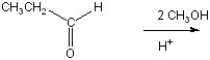

When HOCH2CH2CH2CH2COCH2CH2CH2CH2OH is heated in the presence of an acid catalyst, a reaction occurs. The product has the formula C9H16O2. Provide the structure of this product.
(Essay)
4.9/5  (91)
(91) 
Which of the following alcohols can be prepared by the reaction of methyl formate with excess Grignard reagent?
(Multiple Choice)
4.7/5 (75)
(75) Propose a plausible mechanism that would explain the following conversions: 
(Essay)
4.8/5 (74)
(74) Provide a detailed, stepwise mechanism for the acid-catalyzed condensation reaction between cyclohexanone and H2NOH.
(Essay)
4.8/5 (80)
(80) Provide the sequence of reagents by which a phosphonium ylide can be prepared from 1-bromobutane.
(Essay)
4.9/5 (73)
(73) 
Give three different sets of reagents (a carbonyl compound and a Grignard reagent)that could be used to prepare the following compound. 
(Essay)
4.8/5 (82)
(82) 
Which of the following most typically characterizes the reactions of aldehydes and ketones?
(Multiple Choice)
4.7/5 (76)
(76) Provide the proper IUPAC name for CH3CHOHCH2COCH2C(CH3)2CH2CH3.
(Short Answer)
4.7/5 (94)
(94) 
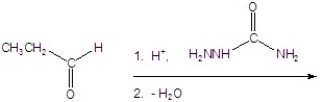
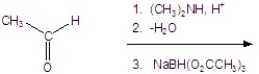
What is the major organic product of the following reaction? 

(Multiple Choice)
4.8/5 (84)
(84) Which of the following is the best method for preparing lactic acid from acetaldehyde? 
(Multiple Choice)
4.9/5 (93)
(93) 
When camphor undergoes nucleophilic attack by CH3CH2MgBr, the major product is the one in which the Grignard reagent has added endo. Explain the stereoselectivity observed. Which face of the carbonyl carbon, re or si, was attacked? 
(Essay)
4.8/5 (75)
(75) Which of the following reagents can be used to reduce acetaldehyde to ethyl alcohol?
(Multiple Choice)
4.9/5 (82)
(82) 
Filters
- Essay(0)
- Multiple Choice(0)
- Short Answer(0)
- True False(0)
- Matching(0)