



 Chat with AI
Exam 5: Alkenes Thermodynamics and Kinetics

Exam 1: Remembering General Chemistry: Electronic Structure and Bonding81 Questions
Exam 2: Acids and Bases: Central to Understanding Organic Chemistry37 Questions
Exam 3: An Introduction to Organic Compounds123 Questions
Exam 4: Isomers: the Arrangement of Atoms in Space111 Questions
Exam 5: Alkenes Thermodynamics and Kinetics76 Questions
Exam 6: Reactions of Alkenes93 Questions
Exam 7: Reactions of Alkynes Introduction to Multistep Synthesis119 Questions
Exam 8: Electron Delocalization, Resonance, and Aromaticity More About Molecular Orbital Theory166 Questions
Exam 9: Substitution Reactions of Alkyl Halides118 Questions
Exam 10: Elimination Reactions of Alkyl Halides Competition Between Substitution and Elimination94 Questions
Exam 11: Reactions of Alcohols, Ethers, Epoxides, and Sulfur-Containing Compounds100 Questions
Exam 12: Organometallic Compounds57 Questions
Exam 13: Reactions of Alkanes, Radicals130 Questions
Exam 14: Mass Spectrometry, Infrared Spectroscopy, and Uvvis Spectroscopy127 Questions
Exam 15: Nmr Spectroscopy110 Questions
Exam 16: Reactions of Carboxylic Acids and Carboxylic Acid Derivatives128 Questions
Exam 17: Reactions of Aldehydes and Ketones116 Questions
Exam 18: Reactions at the Alpha Carbon of Carbonyl Compounds113 Questions
Exam 19: Reactions of Benzene and Substituted Benzenes155 Questions
Exam 20: More About Amines Heterocylic Compounds115 Questions
Exam 21: Carbohydrates100 Questions
Exam 22: Amino Acids, Peptides, and Proteins105 Questions
Exam 23: Catalysis85 Questions
Exam 24: The Organic Mechanisms of the Coenzymes92 Questions
Exam 25: The Chemistry of Metabolism94 Questions
Exam 26: Nucleosides, Nucleotides, and Nucleic Acids85 Questions
Exam 27: Synthetic Polymers106 Questions
Exam 28: Pericyclic Reactions92 Questions
Select questions type


Given an activation energy of 15 kcal/mol, use the Arrhenius equation to estimate how much faster the reaction will occur if the temperature is increased from  to
 R = 1.987 cal/mol ∙ K.
to R = 1.987 cal/mol ∙ K. (Essay)
4.7/5  (86)
(86) Based on the following energy diagram, which compound, A or C, is formed faster from B? Which is more stable, A or C? Explain. 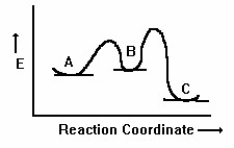
(Essay)
4.8/5 (87)
(87) Consider the single step interconversion of A and B shown below. How is the equilibrium constant K related to the rate constants k1 and k -1 and to the amounts of A and B present at equilibrium? 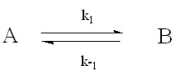
(Essay)
5.0/5 (71)
(71) Calculate the enthalpy for the following reaction.  DH
CH2=CH2, 62 kcal/mole
H-Cl, 103 kcal/mole
CH3CH2-H, 101 kcal/mole
CH3CH2-Cl, 85 kcal/mole
DH
CH2=CH2, 62 kcal/mole
H-Cl, 103 kcal/mole
CH3CH2-H, 101 kcal/mole
CH3CH2-Cl, 85 kcal/mole (Short Answer)
4.9/5 (87)
(87) Give the possibilities in structure for a compound with a formula of C6H10.
(Multiple Choice)
4.8/5 (91)
(91) Draw the curved arrows to show how CH3CH=CHCH3 reacts with HBr to form a carbocation.
(Essay)
4.8/5 (83)
(83) 
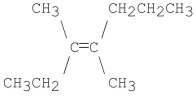
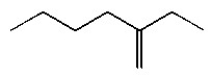
A hydrocarbon with molecular formula C20H34 has what degree of substitution?
(Multiple Choice)
5.0/5 (78)
(78) 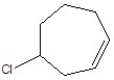
Consider the one-step conversion of F to G. Given that the reaction is endergonic by 5 kcal/mol and that the energy difference between G and the transition state for the process is 15 kcal/mol, sketch a reaction-energy profile for this reaction. Make sure to show how the given energy differences are consistent with your sketch.
(Essay)
4.8/5 (84)
(84) How many transition states are present in the following reaction diagram? 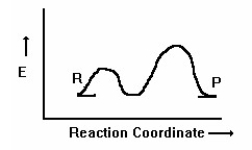
(Multiple Choice)
4.9/5 (82)
(82) 
Identify the nucleophiles and electrophiles.
-OH, BH3, H2O, +CH3, NH3, Br-
(Essay)
4.8/5 (88)
(88) What is the value of ΔH in kcal/mole for the reaction shown? (CH3)3C-H + Cl-Cl → (CH3)3C-Cl + H-Cl
Bond energies are: (CH3)3C-H = 91 kcal/mole
(CH3)3C-Cl = 78.5 kcal/mole
Cl-Cl = 58 kcal/mole
H-Cl = 103 kcal/mole
(Multiple Choice)
4.7/5 (87)
(87) 
Filters
- Essay(0)
- Multiple Choice(0)
- Short Answer(0)
- True False(0)
- Matching(0)