



 Chat with AI
Exam 8: Basic Concepts of Chemical Bonding

Exam 1: Introduction: Matter and Measurement151 Questions
Exam 2: Atoms, Molecules, and Ions230 Questions
Exam 3: Stoichiometry: Calculations With Chemical Formulas and Equations170 Questions
Exam 4: Aqueous Reactions and Solution Stoichiometry177 Questions
Exam 5: Thermochemistry148 Questions
Exam 6: Electronic Structure of Atoms180 Questions
Exam 7: Periodic Properties of the Elements171 Questions
Exam 8: Basic Concepts of Chemical Bonding141 Questions
Exam 9: Molecular Geometry and Bonding Theories177 Questions
Exam 10: Gases172 Questions
Exam 11: Liquids and Intermolecular Forces119 Questions
Exam 12: Solids and Modern Materials78 Questions
Exam 13: Properties of Solutions151 Questions
Exam 14: Chemical Kinetics130 Questions
Exam 15: Chemical Equilibrium92 Questions
Exam 16: Acid-Base Equilibria134 Questions
Exam 17: Additional Aspects of Aqueous Equilibria111 Questions
Exam 18: Chemistry of the Environment121 Questions
Exam 19: Chemical Thermodynamics120 Questions
Exam 20: Electrochemistry110 Questions
Exam 21: Nuclear Chemistry158 Questions
Exam 22: Chemistry of the Nonmetals192 Questions
Exam 23: Transition Metals and Coordination Chemistry147 Questions
Exam 24: The Chemistry of Life: Organic and Biological Chemistry124 Questions
Select questions type


In compounds of __________ and __________, the octet rule is violated due to the presence of fewer than eight valence electrons.
(Short Answer)
4.8/5  (82)
(82) A double bond consists of __________ pairs of electrons shared between two atoms.
(Multiple Choice)
4.7/5 (83)
(83) In a reaction, if the bonds in the reactants are stronger than the bonds in the product, the reaction is __________.
(Short Answer)
4.8/5 (89)
(89) Which of the following does not have eight valence electrons?
(Multiple Choice)
4.8/5 (86)
(86) How many single covalent bonds must a chlorine atom form to have a complete octet in its valence shell?
(Multiple Choice)
4.9/5 (69)
(69) Using the Born-Haber cycle, the ΔHf° of KBr is equal to __________.
(Multiple Choice)
4.8/5 (73)
(73) The Lewis structure of AsH3 shows __________ nonbonding electron pair(s)on As.
(Multiple Choice)
5.0/5 (86)
(86) The chloride of which of the following metals should have the greatest lattice energy?
(Multiple Choice)
4.8/5 (71)
(71) The electron configuration of the sulfide ion (S2-)is __________.
(Multiple Choice)
4.9/5 (82)
(82) Of the possible bonds between carbon atoms (single, double, and triple), __________.
(Multiple Choice)
4.8/5 (70)
(70) In which of the molecules below is the carbon-carbon distance the shortest?
(Multiple Choice)
4.7/5 (90)
(90) How many different types of resonance structures can be drawn for the ion SO32- where all atoms satisfy the octet rule?
(Multiple Choice)
4.7/5 (70)
(70) Atoms surrounded by eight valence electrons tend to lose electrons.
(True/False)
4.9/5 (79)
(79) The halogens, alkali metals, and alkaline earth metals have __________ valence electrons, respectively.
(Multiple Choice)
4.9/5 (86)
(86) Of the atoms below, __________ is the most electropositive.
(Multiple Choice)
4.9/5 (84)
(84) Using the table of bond dissociation energies, the ΔH for the following reaction is __________ kJ. 2HCl (g)+ F2 (g)→ 2HF (g)+ Cl2 (g) 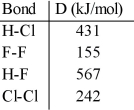
(Multiple Choice)
4.9/5 (79)
(79) A __________ covalent bond between the same two atoms is the longest.
(Multiple Choice)
4.8/5 (78)
(78) 
Filters
- Essay(0)
- Multiple Choice(0)
- Short Answer(0)
- True False(0)
- Matching(0)