



 Chat with AI
Exam 5: Thermochemistry

Exam 1: Introduction: Matter and Measurement151 Questions
Exam 2: Atoms, Molecules, and Ions230 Questions
Exam 3: Stoichiometry: Calculations With Chemical Formulas and Equations170 Questions
Exam 4: Aqueous Reactions and Solution Stoichiometry177 Questions
Exam 5: Thermochemistry148 Questions
Exam 6: Electronic Structure of Atoms180 Questions
Exam 7: Periodic Properties of the Elements171 Questions
Exam 8: Basic Concepts of Chemical Bonding141 Questions
Exam 9: Molecular Geometry and Bonding Theories177 Questions
Exam 10: Gases172 Questions
Exam 11: Liquids and Intermolecular Forces119 Questions
Exam 12: Solids and Modern Materials78 Questions
Exam 13: Properties of Solutions151 Questions
Exam 14: Chemical Kinetics130 Questions
Exam 15: Chemical Equilibrium92 Questions
Exam 16: Acid-Base Equilibria134 Questions
Exam 17: Additional Aspects of Aqueous Equilibria111 Questions
Exam 18: Chemistry of the Environment121 Questions
Exam 19: Chemical Thermodynamics120 Questions
Exam 20: Electrochemistry110 Questions
Exam 21: Nuclear Chemistry158 Questions
Exam 22: Chemistry of the Nonmetals192 Questions
Exam 23: Transition Metals and Coordination Chemistry147 Questions
Exam 24: The Chemistry of Life: Organic and Biological Chemistry124 Questions
Select questions type


A 50.0-g sample of liquid water at 25.0 °C is mixed with 29.0 g of water at 45.0 °C. The final temperature of the water is __________ °C.

Free
(Multiple Choice)
5.0/5  (86)
(86) Correct Answer: Verified
E
A 25.5-g piece of cheddar cheese contains 37% fat, 28% protein, and 4% carbohydrate. The respective fuel values for protein, fat, and carbohydrate are 17, 38, and 17 kJ/g, respectively. The fuel value for this piece of cheese is __________ kJ.
Free
(Multiple Choice)
4.9/5 (69)
(69) Correct Answer:Verified
VerifiedA
Hydrogen peroxide decomposes to water and oxygen at constant pressure by the following reaction: 2H2O2 (l)→ 2H2O (l)+ O2 (g)△H = -196 kJ
Calculate the value of q (kJ)in this exothermic reaction when 4.00 g of hydrogen peroxide decomposes at constant pressure?
Free
(Multiple Choice)
4.8/5 (88)
(88) Correct Answer:Verified
VerifiedB
Given the following reactions N2 (g)+ O2 (g)→ 2NO (g)ΔH = +180.7 kJ
2NO( g)+ O2 (g)→ 2NO2 (g)ΔH = -113.1 kJ
The enthalpy for the decomposition of nitrogen dioxide into molecular nitrogen and oxygen
2NO2 (g)→ N2 (g)+ 2 O2 (g)
Is __________ kJ.
(Multiple Choice)
4.7/5 (90)
(90) A chemical reaction that absorbs heat from the surroundings is said to be __________ and has a __________ ΔH at constant pressure.
(Multiple Choice)
4.9/5 (93)
(93) For which one of the following reactions is the value of ΔH°rxn equal to ΔHf° for the product?
(Multiple Choice)
4.8/5 (79)
(79) Fuel values of hydrocarbons increase as the H/C atomic ratio increases. Which of the following compounds has the highest fuel value?
(Multiple Choice)
5.0/5 (80)
(80) The value of ΔH° for the reaction below is -126 kJ. __________ kj are released when 2.00 mol of NaOH is formed in the reaction? 2 Na2O2 (s)+ 2 H2O (l)→ 4NaOH (s)+ O2 (g)
(Multiple Choice)
4.9/5 (78)
(78) Given the data in the table below, ΔH°rxn for the reaction Ag2O (s)+ H2S (g)→ Ag2S (s)+ H2O (l)
Is __________ kJ. 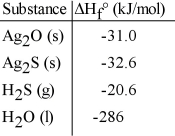
(Multiple Choice)
4.8/5 (60)
(60) A chemical reaction that releases heat to the surroundings is said to be __________ and has a __________ ΔH at constant pressure.
(Multiple Choice)
4.9/5 (78)
(78) Given the following reactions (1)2NO → N2 + O2 ΔH = -180 kJ
(2)2NO + O2 → 2NO2 ΔH = -112 kJ
The enthalpy of the reaction of nitrogen with oxygen to produce nitrogen dioxide
N2 + 2O2 → 2NO2
Is __________ kJ.
(Multiple Choice)
4.9/5 (74)
(74) An 8.29 g sample of calcium carbonate [CaCO3 (s)] absorbs 50.3 J of heat, upon which the temperature of the sample increases from 21.1 °C to 28.5 °C. What is the specific heat of calcium carbonate?
(Multiple Choice)
4.8/5 (79)
(79) Given the data in the table below, ΔH°rxn for the reaction SO3 (g)+ H2O (l)→ H2SO4 (l)
Is __________ kJ. 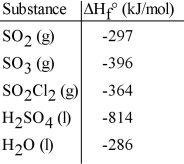
(Multiple Choice)
4.8/5 (89)
(89) The value of ΔH° for the reaction below is -1107 kJ: 2Ba (s)+ O2 (g)→ 2BaO (s)
How many kJ of heat are released when 5.75 g of Ba (s)reacts completely with oxygen to form
BaO (s)?
(Multiple Choice)
4.8/5 (72)
(72) The internal energy can be increased by __________. (a)transferring heat from the surroundings to the system
(b)transferring heat from the system to the surroundings
(c)doing work on the system
(Multiple Choice)
4.8/5 (70)
(70) The kinetic energy of a 12.5-g object moving at a speed of 81.9 m/s is __________ J.
(Multiple Choice)
4.8/5 (83)
(83) 
Filters
- Essay(0)
- Multiple Choice(0)
- Short Answer(0)
- True False(0)
- Matching(0)