



 Chat with AI
Exam 19: Chemical Thermodynamics

Exam 1: Introduction: Matter and Measurement151 Questions
Exam 2: Atoms, Molecules, and Ions230 Questions
Exam 3: Stoichiometry: Calculations With Chemical Formulas and Equations170 Questions
Exam 4: Aqueous Reactions and Solution Stoichiometry177 Questions
Exam 5: Thermochemistry148 Questions
Exam 6: Electronic Structure of Atoms180 Questions
Exam 7: Periodic Properties of the Elements171 Questions
Exam 8: Basic Concepts of Chemical Bonding141 Questions
Exam 9: Molecular Geometry and Bonding Theories177 Questions
Exam 10: Gases172 Questions
Exam 11: Liquids and Intermolecular Forces119 Questions
Exam 12: Solids and Modern Materials78 Questions
Exam 13: Properties of Solutions151 Questions
Exam 14: Chemical Kinetics130 Questions
Exam 15: Chemical Equilibrium92 Questions
Exam 16: Acid-Base Equilibria134 Questions
Exam 17: Additional Aspects of Aqueous Equilibria111 Questions
Exam 18: Chemistry of the Environment121 Questions
Exam 19: Chemical Thermodynamics120 Questions
Exam 20: Electrochemistry110 Questions
Exam 21: Nuclear Chemistry158 Questions
Exam 22: Chemistry of the Nonmetals192 Questions
Exam 23: Transition Metals and Coordination Chemistry147 Questions
Exam 24: The Chemistry of Life: Organic and Biological Chemistry124 Questions
Select questions type


A reaction that is not spontaneous at low temperature can become spontaneous at high temperature if ΔH is __________ and ΔS is __________.

Free
(Multiple Choice)
4.9/5  (83)
(83) Correct Answer: Verified
A
ΔS is negative for the reaction __________.
Free
(Multiple Choice)
5.0/5 (86)
(86) Correct Answer:Verified
VerifiedB
Which reaction produces a decrease in the entropy of the system?
Free
(Multiple Choice)
4.8/5 (74)
(74) Correct Answer:Verified
VerifiedB
The value of ΔG° at 141.0°C for the formation of phosphorous trichloride from its constituent elements, P2 (g)+ 3Cl2 (g)→ 2PCl3 (g)
Is __________ kJ/mol. At 25.0°C for this reaction, ΔH° is -720.5 kJ/mol, ΔG° is -642.9 kJ/mol, and ΔS° is -263.7 J/K.
(Multiple Choice)
4.9/5 (79)
(79) The standard Gibbs free energy of formation of __________ is zero. (a)H2O (l)
(b)Mg (s)
(c)Br2 (l)
(Multiple Choice)
5.0/5 (72)
(72) For a reaction to be spontaneous under standard conditions at all temperatures, the signs of ΔH° and ΔS° must be __________ and __________, respectively.
(Multiple Choice)
4.9/5 (82)
(82) If ΔG° for a reaction is greater than zero, then __________.
(Multiple Choice)
4.8/5 (92)
(92) The value of ΔG° at 25°C for the formation of POCl3 from its constituent elements, P2 (g)+ O2 (g)+ 3Cl2 (g)→ 2POCl3 (g)
Is __________ kJ/mol.
(Multiple Choice)
4.8/5 (74)
(74) The value of ΔH° for the decomposition of gaseous sulfur dioxide to solid elemental sulfur and gaseous oxygen, SO2 (g)→ S (s,rhombic)+ O2 (g)
Is __________ kJ/mol.
(Multiple Choice)
4.8/5 (76)
(76) The entropy change accompanying any process is given by the equation:
(Multiple Choice)
4.8/5 (89)
(89) Given the following table of thermodynamic data, 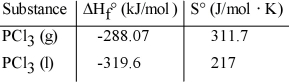 complete the following sentence. The vaporization of PCl3 (l)is __________.
 (Multiple Choice)
4.8/5 (64)
(64) The value of ΔG° at 25°C for the formation of calcium chloride from its constituent elements, Ca (s)+ Cl2 (g)→ CaCl2 (s)
Is __________ kJ/mol.
(Multiple Choice)
4.7/5 (69)
(69) The melting of a substance at its melting point is an isothermal process.
(True/False)
4.8/5 (83)
(83) The value of ΔG° for a reaction conducted at 25°C is 3.05 kJ/mol. The equilibrium constant for a reaction is __________ at this temperature?
(Multiple Choice)
4.9/5 (88)
(88) Calculate ΔG° (in kJ/mol)for the following reaction at 1 atm and 25°C:
C2H6 (g)+ O2 (g)→ CO2 (g)+ H2O (l)(unbalanced)
ΔGf° C2H6 (g)= -32.89 kJ/mol; ΔGf° CO2 (g)= -394.4 kJ/mol; ΔGf° H2O (l)= -237.13 kJ/mol
(Short Answer)
4.9/5 (80)
(80) The standard Gibbs free energy of formation of __________ is zero. (a)Si (s)
(b)F2 (g)
(c)Ni (s)
(Multiple Choice)
4.8/5 (81)
(81) The quantity of energy gained by a system equals the quantity of energy gained by its surroundings.
(True/False)
4.8/5 (82)
(82) 
Filters
- Essay(0)
- Multiple Choice(0)
- Short Answer(0)
- True False(0)
- Matching(0)