



 Chat with AI
Exam 19: Chemical Thermodynamics

Exam 1: Introduction: Matter and Measurement151 Questions
Exam 2: Atoms, Molecules, and Ions230 Questions
Exam 3: Stoichiometry: Calculations With Chemical Formulas and Equations170 Questions
Exam 4: Aqueous Reactions and Solution Stoichiometry177 Questions
Exam 5: Thermochemistry148 Questions
Exam 6: Electronic Structure of Atoms180 Questions
Exam 7: Periodic Properties of the Elements171 Questions
Exam 8: Basic Concepts of Chemical Bonding141 Questions
Exam 9: Molecular Geometry and Bonding Theories177 Questions
Exam 10: Gases172 Questions
Exam 11: Liquids and Intermolecular Forces119 Questions
Exam 12: Solids and Modern Materials78 Questions
Exam 13: Properties of Solutions151 Questions
Exam 14: Chemical Kinetics130 Questions
Exam 15: Chemical Equilibrium92 Questions
Exam 16: Acid-Base Equilibria134 Questions
Exam 17: Additional Aspects of Aqueous Equilibria111 Questions
Exam 18: Chemistry of the Environment121 Questions
Exam 19: Chemical Thermodynamics120 Questions
Exam 20: Electrochemistry110 Questions
Exam 21: Nuclear Chemistry158 Questions
Exam 22: Chemistry of the Nonmetals192 Questions
Exam 23: Transition Metals and Coordination Chemistry147 Questions
Exam 24: The Chemistry of Life: Organic and Biological Chemistry124 Questions
Select questions type


The value of ΔG° at 25°C for the formation of phosphorous trichloride from its constituent elements, P2 (g)+ 3Cl2 (g)→ 2PCl3 (g)
Is __________ kJ/mol.
(Multiple Choice)
4.8/5  (77)
(77) For the reaction 2C4H10 (g)+ 13O2 (g)→ 8CO2 (g)+ 10H2O (g)
ΔH° is -125 kJ/mol and ΔS° is +253 J/K ∙ mol. This reaction is __________.
(Multiple Choice)
4.9/5 (85)
(85) The equilibrium constant for a reaction is 0.35 at 25°C. What is the value of ΔG° (kJ/mol)at this temperature?
(Multiple Choice)
4.8/5 (88)
(88) The value of ΔS° for the formation of calcium chloride from its constituent elements, Ca (s)+ Cl2 (g)→ CaCl2 (s)
Is __________ J/K∙ mol.
(Multiple Choice)
4.9/5 (78)
(78) The value of ΔS° for the oxidation of carbon to carbon dioxide, C (s, graphite)+ O2 (g)→ CO2(g)
Is __________ J/K∙ mol. The combustion of carbon, as in charcoal briquettes, in the presence of abundant oxygen produces carbon dioxide.
(Multiple Choice)
4.8/5 (94)
(94) The value of ΔG° at 100.0°C for the formation of calcium chloride from its constituent elements: Ca (s)+ Cl2 (g)→ CaCl2 (s)
Is __________ kJ/mol. At 25.0°C for this reaction, ΔH° is -795.8 kJ/mol, ΔG° is -748.1 kJ/mol, and ΔS° is -159.8 J/K.
(Multiple Choice)
4.8/5 (87)
(87) Which one of the following correctly indicates the relationship between the entropy of a system and the number of different arrangements, W, in the system?
(Multiple Choice)
4.9/5 (89)
(89) The combustion of ethene in the presence of excess oxygen yields carbon dioxide and water: C2H4 (g)+ 3O2 (g)→ 2CO2 (g)+ 2H2O (l)
The value of ΔS° for this reaction is __________ J/K∙ mol.
(Multiple Choice)
4.9/5 (81)
(81) Given the following table of thermodynamic data, 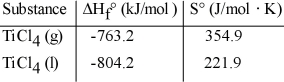 complete the following sentence. The vaporization of TiCl4 is __________.
 (Multiple Choice)
4.8/5 (76)
(76) The equilibrium position corresponds to which letter on the graph of G vs. f (course of reaction)below? 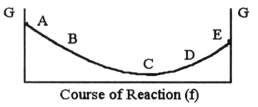
(Multiple Choice)
5.0/5 (68)
(68) The normal boiling point of water is 100.0°C and its molar enthalpy of vaporization is 40.67 kJ/mol. What is the change in entropy in the system in J/K when 39.3 grams of steam at 1 atm condenses to a liquid at the normal boiling point?
(Multiple Choice)
4.9/5 (85)
(85) Consider the reaction: Ag+ (aq)+ Cl- (aq)→ AgCl (s)
Given the following table of thermodynamic data at 298 K: 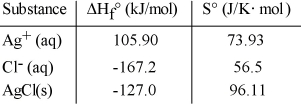 The value of K for the reaction at 25°C is __________.
 (Multiple Choice)
4.8/5 (73)
(73) Which one of the following is always positive when a spontaneous process occurs?
(Multiple Choice)
4.8/5 (80)
(80) The value of ΔH° for the oxidation of solid elemental sulfur to gaseous sulfur trioxide, 2S (s, rhombic)+ 3O2( g)→ 2SO3 (g)
Is __________ kJ/mol.
(Multiple Choice)
5.0/5 (80)
(80) The value of ΔS° for the catalytic hydrogenation of ethene to ethane, C2H4 (g)+ H2(g)→ C2H6 (g)
Is __________ J/K∙ mol.
(Multiple Choice)
4.8/5 (86)
(86) Which one of the following processes produces a decrease of the entropy of the system?
(Multiple Choice)
4.9/5 (76)
(76) The value of ΔH° for the decomposition of calcium chloride into its constituent elements, CaCl2 (s)→ Ca (s)+ Cl2 (g)
Is __________ kJ/mol.
(Multiple Choice)
4.8/5 (93)
(93) Of the following, the entropy of __________ is the largest.
(Multiple Choice)
4.9/5 (71)
(71) The value of ΔH° for the formation of POCl3 from its constituent elements, P2 (g)+ O2 (g)+ 3Cl2 (g)→ 2POCl3 (g)
Is __________ kJ/mol.
(Multiple Choice)
4.7/5 (76)
(76) 
Filters
- Essay(0)
- Multiple Choice(0)
- Short Answer(0)
- True False(0)
- Matching(0)