



 Chat with AI
Exam 5: Thermochemistry

Exam 1: Introduction: Matter and Measurement151 Questions
Exam 2: Atoms, Molecules, and Ions230 Questions
Exam 3: Stoichiometry: Calculations With Chemical Formulas and Equations170 Questions
Exam 4: Aqueous Reactions and Solution Stoichiometry177 Questions
Exam 5: Thermochemistry148 Questions
Exam 6: Electronic Structure of Atoms180 Questions
Exam 7: Periodic Properties of the Elements171 Questions
Exam 8: Basic Concepts of Chemical Bonding141 Questions
Exam 9: Molecular Geometry and Bonding Theories177 Questions
Exam 10: Gases172 Questions
Exam 11: Liquids and Intermolecular Forces119 Questions
Exam 12: Solids and Modern Materials78 Questions
Exam 13: Properties of Solutions151 Questions
Exam 14: Chemical Kinetics130 Questions
Exam 15: Chemical Equilibrium92 Questions
Exam 16: Acid-Base Equilibria134 Questions
Exam 17: Additional Aspects of Aqueous Equilibria111 Questions
Exam 18: Chemistry of the Environment121 Questions
Exam 19: Chemical Thermodynamics120 Questions
Exam 20: Electrochemistry110 Questions
Exam 21: Nuclear Chemistry158 Questions
Exam 22: Chemistry of the Nonmetals192 Questions
Exam 23: Transition Metals and Coordination Chemistry147 Questions
Exam 24: The Chemistry of Life: Organic and Biological Chemistry124 Questions
Select questions type


The value of ΔH° for the following reaction is -3351 kJ: 2Al (s)+ 3O2 (g)→ 2 Al2O3 (s)
The value of ΔHf ° for Al2O3 (s)is __________ kJ.
(Multiple Choice)
4.8/5  (92)
(92) The value of ΔH° for the reaction below is -482 kJ. Calculate the heat (kJ)released to the surroundings when 38.5 g of O2 (g)reacts with excess CO. 2CO (g)+ O2 (g)→ 2CO2 (g)
(Multiple Choice)
4.8/5 (77)
(77) Given the data in the table below, ΔH°rxn for the reaction C2H5OH (l)+ O2 (g)→ CH3CO2H (l)+ H2O (l)
Is __________ kJ. 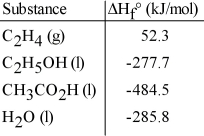
(Multiple Choice)
4.9/5 (84)
(84) The value of ΔH° for the reaction below is -186 kJ. H2 (g)+ Cl2 (g)→ 2HCl (g)
The value of ΔHf° for HCl (g)is __________ kJ/mol.
(Multiple Choice)
4.7/5 (81)
(81) ΔH for an endothermic process is __________ while ΔH for an exothermic process is __________.
(Multiple Choice)
4.8/5 (85)
(85) For which one of the following reactions is the value of ΔH°rxn equal to ΔH°f for the product?
(Multiple Choice)
4.8/5 (71)
(71) For the species in the reaction below, ΔHf° is zero for __________. 2Co (s)+ H2 (g)+ 8PF3 (g)→ 2HCo(PF3)4 (l)
(Multiple Choice)
5.0/5 (84)
(84) The kinetic energy of a 10.3 g golf ball traveling at 48.0 m/s is __________ J.
(Multiple Choice)
4.8/5 (101)
(101) Given the data in the table below, ΔH°rxn for the reaction IF5 (g)+ F2 (g)→ IF7 (g)
Is __________ kJ. 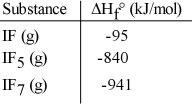
(Multiple Choice)
4.8/5 (87)
(87) Given the following reactions H2O (l)→ H2O (g)ΔH = 44.01 kJ
2 H2 (g)+ O2 (g)→ 2 H2O (g)ΔH = -483.64 kJ
The enthalpy for the decomposition of liquid water into gaseous hydrogen and oxygen
2 H2O (l)→ 2 H2 (g)+ O2 (g)
Is __________ kJ.
(Multiple Choice)
4.9/5 (80)
(80) Given the following reactions N2 (g)+ O2 (g)→ 2NO (g)ΔH = +180.7 kJ
2NO (g)+ O2 (g)→ 2N O2 (g)ΔH = -113.1 kJ
The enthalpy of reaction for
4NO (g)→ 2NO2 (g)+ N2 (g)
Is __________ kJ.
(Multiple Choice)
4.9/5 (74)
(74) The temperature of a 12.58 g sample of calcium carbonate [CaCO3 (s)] increases from 23.6 °C to 38.2 °C. If the specific heat of calcium carbonate is 0.82 J/g-K, how many joules of heat are absorbed?
(Multiple Choice)
4.8/5 (71)
(71) The value of ΔH° for the reaction below is +128.1 kJ: CH3OH (l)→ CO (g)+ 2 H2 (g)
How many kJ of heat are consumed when 15.5 g of CH3OH (l)decomposes as shown in the equation?
(Multiple Choice)
4.9/5 (86)
(86) Given the data in the table below, ΔH°rxn for the reaction 2 Ag2S (s)+ O2 (g)→ 2 Ag2O (s)+ 2S (s)
Is __________ kJ. 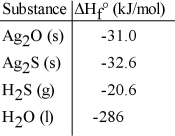
(Multiple Choice)
4.7/5 (85)
(85) Which one of the following conditions would always result in an increase in the internal energy of a system?
(Multiple Choice)
4.9/5 (73)
(73) Which one of the choices below is not considered a fossil fuel?
(Multiple Choice)
4.8/5 (83)
(83) The average fuel value of sugars is 17 kJ/g. A 2.0 L pitcher of sweetened Kool-Aid contains 400 g of sugar. What is the fuel value (in kJ)of a 500 mL serving of Kool-Aid? (Assume that the sugar is the only fuel source.)
(Multiple Choice)
4.9/5 (84)
(84) Given the data in the table below, ΔH°rxn for the reaction 3NO2 (g)+ H2O (l)→ 2HNO3 (aq)+ NO (g)
Is __________ kJ. 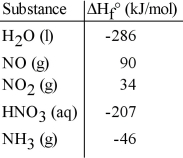
(Multiple Choice)
4.9/5 (76)
(76) The internal energy of a system is always increased by __________.
(Multiple Choice)
4.8/5 (81)
(81) 
Filters
- Essay(0)
- Multiple Choice(0)
- Short Answer(0)
- True False(0)
- Matching(0)