



 Chat with AI
Exam 5: Thermochemistry

Exam 1: Introduction: Matter and Measurement151 Questions
Exam 2: Atoms, Molecules, and Ions230 Questions
Exam 3: Stoichiometry: Calculations With Chemical Formulas and Equations170 Questions
Exam 4: Aqueous Reactions and Solution Stoichiometry177 Questions
Exam 5: Thermochemistry148 Questions
Exam 6: Electronic Structure of Atoms180 Questions
Exam 7: Periodic Properties of the Elements171 Questions
Exam 8: Basic Concepts of Chemical Bonding141 Questions
Exam 9: Molecular Geometry and Bonding Theories177 Questions
Exam 10: Gases172 Questions
Exam 11: Liquids and Intermolecular Forces119 Questions
Exam 12: Solids and Modern Materials78 Questions
Exam 13: Properties of Solutions151 Questions
Exam 14: Chemical Kinetics130 Questions
Exam 15: Chemical Equilibrium92 Questions
Exam 16: Acid-Base Equilibria134 Questions
Exam 17: Additional Aspects of Aqueous Equilibria111 Questions
Exam 18: Chemistry of the Environment121 Questions
Exam 19: Chemical Thermodynamics120 Questions
Exam 20: Electrochemistry110 Questions
Exam 21: Nuclear Chemistry158 Questions
Exam 22: Chemistry of the Nonmetals192 Questions
Exam 23: Transition Metals and Coordination Chemistry147 Questions
Exam 24: The Chemistry of Life: Organic and Biological Chemistry124 Questions
Select questions type


Calculate the kinetic energy in J of an electron moving at 6.00 × 10⁶ m/s. The mass of an electron is 9.11 × 10⁻²⁸ g.
(Multiple Choice)
5.0/5  (79)
(79) The specific heat capacity of lead is 0.13 J/g-K. How much heat (in J)is required to raise the temperature of 15 g of lead from 22 °C to 37 °C?
(Multiple Choice)
4.9/5 (80)
(80) The value of ΔH° for the reaction below is -1107 kJ: 2Ba (s)+ O2 (g)→ 2BaO (s)
How many kJ of heat are released when 15.75 g of Ba (s)reacts completely with oxygen to form BaO (s)?
(Multiple Choice)
5.0/5 (75)
(75) Calculate the kinetic energy in joules of a 150 lb jogger (68.1 kg)traveling at 12.0 mile/hr (5.36 m/s).
(Multiple Choice)
4.8/5 (90)
(90) The value of ΔH° for the reaction below is -336 kJ. Calculate the heat (kJ)released to the surroundings when 23.0 g of HCl is formed. CH4 (g)+ 3 Cl2 (g)→ CHCl3 (l)+ 3HCl (g)
(Multiple Choice)
4.9/5 (75)
(75) A sample of iron absorbs 67.5 J of heat, upon which the temperature of the sample increases from 21.5 °C to 28.5 °C. If the specific heat of iron is 0.450 J/g-K, what is the mass (in grams)of the sample?
(Multiple Choice)
4.9/5 (82)
(82) The value of ΔH° for the reaction below is -482 kJ. Calculate the heat (kJ)released to the surroundings when 6.00 g of CO (g)reacts completely. 2CO (g)+ O2 (g)→ 2CO2 (g)
(Multiple Choice)
4.8/5 (70)
(70) A slice of apple pie contains 14.0 grams of fat, 2.00 grams of protein, and 52.0 grams of carbohydrate. The respective fuel values for protein, fat, and carbohydrate are 17, 38, and 17 kJ/g, respectively. If cycling typically burns 1000.0 kJ/hour, __________ minutes of cycling are required to completely burn off the slice of pie.
(Multiple Choice)
4.8/5 (83)
(83) The specific heat capacity of solid copper metal is 0.385 J/g-K. How many joules of heat are needed to raise the temperature of a 1.55-kg block of copper from 33.0 °C to 77.5 °C?
(Multiple Choice)
4.8/5 (71)
(71) Given the following reactions Fe2O3 (s)+ 3CO (s)→ 2Fe (s)+ 3CO2 (g)ΔH = -28.0 kJ
3Fe (s)+ 4CO2 (s)→ 4CO (g)+ Fe3O4 (s)ΔH = +12.5 kJ
The enthalpy of the reaction of Fe2O3 with CO
3 Fe2O3 (s)+ CO (g)→ CO2 (g)+ 2 Fe3O4 (s)
Is __________ kJ.
(Multiple Choice)
4.9/5 (87)
(87) Given the data in the table below, ΔH°rxn for the reaction PCl3 (g)+ 3 HCl (g)→ 3 Cl2 (g)+ PH3 (g)
Is __________ kJ. 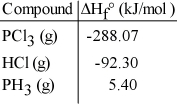
(Multiple Choice)
4.8/5 (81)
(81) Given the following reactions: 2S (s)+ 3O2 (g)→ 2SO3 (g)ΔH = -790 kJ
S (s)+ O2 (g)→ SO2 (g)ΔH = -297 kJ
The enthalpy of the reaction in which sulfur dioxide is oxidized to sulfur trioxide
2SO2 (g)+ O2 (g)→ 2SO3 (g)
Is __________ kJ.
(Multiple Choice)
4.8/5 (82)
(82) The value of ΔH° for the reaction below is -1107 kJ: 2Ba (s)+ O2 (g)→ 2BaO (s)
How many kJ of heat are released when 5.75 g of BaO (s)is produced?
(Multiple Choice)
4.8/5 (83)
(83) Given the following reactions N2 (g)+ 2 O2 (g)→ 2NO2 (g)ΔH = 66.4 kJ
2NO (g)+ O2 (g)→ 2NO2 (g)ΔH = -114.2 kJ
The enthalpy of the reaction of the nitrogen to produce nitric oxide
N2 (g)+ O2 (g)→ 2NO (g)
Is __________ kJ.
(Multiple Choice)
4.9/5 (80)
(80) The specific heat of liquid bromine is 0.226 J/g-K. How much heat (J)is required to raise the temperature of 10.0 mL of bromine from 25.00 °C to 27.30 °C? The density of liquid bromine: 3.12 g/mL.
(Multiple Choice)
4.8/5 (76)
(76) Coal contains hydrocarbons of high molecular weight as well as compounds containing ________, oxygen, or nitrogen.
(Short Answer)
4.8/5 (75)
(75) The specific heat capacity of methane gas is 2.20 J/g-K. How many joules of heat are needed to raise the temperature of 5.00 g of methane from 36.0 °C to 75.0 °C?
(Multiple Choice)
4.8/5 (85)
(85) At what velocity (m/s)must a 20.0 g object be moving in order to possess a kinetic energy of 1.00 J?
(Multiple Choice)
4.8/5 (75)
(75) 
Filters
- Essay(0)
- Multiple Choice(0)
- Short Answer(0)
- True False(0)
- Matching(0)