



 Chat with AI
Exam 5: Thermochemistry

Exam 1: Introduction: Matter and Measurement151 Questions
Exam 2: Atoms, Molecules, and Ions230 Questions
Exam 3: Stoichiometry: Calculations With Chemical Formulas and Equations170 Questions
Exam 4: Aqueous Reactions and Solution Stoichiometry177 Questions
Exam 5: Thermochemistry148 Questions
Exam 6: Electronic Structure of Atoms180 Questions
Exam 7: Periodic Properties of the Elements171 Questions
Exam 8: Basic Concepts of Chemical Bonding141 Questions
Exam 9: Molecular Geometry and Bonding Theories177 Questions
Exam 10: Gases172 Questions
Exam 11: Liquids and Intermolecular Forces119 Questions
Exam 12: Solids and Modern Materials78 Questions
Exam 13: Properties of Solutions151 Questions
Exam 14: Chemical Kinetics130 Questions
Exam 15: Chemical Equilibrium92 Questions
Exam 16: Acid-Base Equilibria134 Questions
Exam 17: Additional Aspects of Aqueous Equilibria111 Questions
Exam 18: Chemistry of the Environment121 Questions
Exam 19: Chemical Thermodynamics120 Questions
Exam 20: Electrochemistry110 Questions
Exam 21: Nuclear Chemistry158 Questions
Exam 22: Chemistry of the Nonmetals192 Questions
Exam 23: Transition Metals and Coordination Chemistry147 Questions
Exam 24: The Chemistry of Life: Organic and Biological Chemistry124 Questions
Select questions type


The enthalpy change for the following reaction is -483.6 kJ: 2 H2 (g)+ O2 (g)→ 2 H2O (g)
Therefore, the enthalpy change for the following reaction is __________ kJ:
4 H2 (g)+ 2 O2 (g)→ 4 H2O (g)
(Multiple Choice)
4.9/5  (71)
(71) ΔH for the reaction IF5 (g)→ IF3 (g)+ F2 (g)
Is __________ kJ, give the data below.
IF (g)+ F2 (g)→ IF3 (g)ΔH = -390 kJ
IF (g)+ 2 F2 (g)→ IF5 (g)ΔH = -745 kJ
(Multiple Choice)
4.9/5 (70)
(70) The British thermal unit (Btu)is commonly used in engineering applications. A Btu is defined as the amount of heat required to raise the temperature of 1 lb of water by 1 °F. There are __________ joules in one Btu. 1 lb = 453.59 g; °C = (5/9)(°F - 32°); specific heat of H2O (l)= 4.184 J/g-K.
(Multiple Choice)
4.9/5 (75)
(75) Given the data in the table below, ΔH°rxn for the reaction 3 Cl2 (g)+ PH3 (g)→ PCl3 (g)+ 3 HCl (g)
Is __________ kJ. 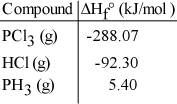
(Multiple Choice)
4.9/5 (87)
(87) The reaction 4Al (s)+ 3O2 (g)→ 2 Al2O3 (s)ΔH° = -3351 kJ
Is __________, and therefore heat is __________ by the reaction.
(Multiple Choice)
4.8/5 (87)
(87) The value of ΔH° for the reaction below is +128.1 kJ: CH3OH (l)→ CO (g)+ 2 H2 (g)
How many kJ of heat are consumed when 5.10 g of H2 (g)is formed as shown in the equation?
(Multiple Choice)
4.9/5 (76)
(76) The value of ΔH° for the reaction below is +128.1 kJ: CH3OH (l)→ CO (g)+ 2 H2 (g)
How many kJ of heat are consumed when 5.10 g of CO (g)is formed as shown in the equation?
(Multiple Choice)
4.8/5 (86)
(86) A 6.50-g sample of copper metal at 25.0 °C is heated by the addition of 84.0 J of energy. The final temperature of the copper is __________°C. The specific heat capacity of copper is 0.38 J/g-K.
(Multiple Choice)
4.9/5 (79)
(79) Of the substances below, the highest fuel value is obtained from __________.
(Multiple Choice)
4.8/5 (96)
(96) The temperature of a 35.2 g sample of iron increases from 23.7 °C to 29.5 °C. If the specific heat of iron is 0.450 J/g-K, how many joules of heat are absorbed?
(Multiple Choice)
4.7/5 (89)
(89) Given the data in the table below, ΔH°rxn for the reaction Ca(OH)2 + 2 H3AsO4 → Ca(H2AsO4)2 + 2 H2O
Is __________ kJ. 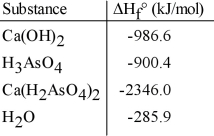
(Multiple Choice)
4.8/5 (63)
(63) A sample of aluminum metal absorbs 8.32 J of heat, upon which the temperature of the sample increases from 23.2 °C to 30.5 °C. Since the specific heat capacity of aluminum is 0.90 J/g-K, the mass of the sample is __________ g.
(Multiple Choice)
4.7/5 (83)
(83) Given the data in the table below and ΔH°rxn for the reaction SO2Cl2 (g)+ 2 H2O (l)→ H2SO4 (l)+ 2HCl (g)ΔH° = -62 kJ
ΔH°f of HCl (g)is __________ kJ/mol. 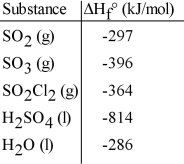
(Multiple Choice)
4.8/5 (90)
(90) The specific heat of bromine liquid is 0.226 J/g ∙ K. The molar heat capacity (in J/mol-K)of bromine liquid is __________.
(Multiple Choice)
4.8/5 (65)
(65) The specific heat capacity of liquid mercury is 0.14 J/g-K. How many joules of heat are needed to raise the temperature of 5.00 g of mercury from 15.0 °C to 36.5 °C?
(Multiple Choice)
4.8/5 (78)
(78) 
Filters
- Essay(0)
- Multiple Choice(0)
- Short Answer(0)
- True False(0)
- Matching(0)