



 Chat with AI
Exam 8: Basic Concepts of Chemical Bonding

Exam 1: Introduction: Matter and Measurement151 Questions
Exam 2: Atoms, Molecules, and Ions230 Questions
Exam 3: Stoichiometry: Calculations With Chemical Formulas and Equations170 Questions
Exam 4: Aqueous Reactions and Solution Stoichiometry177 Questions
Exam 5: Thermochemistry148 Questions
Exam 6: Electronic Structure of Atoms180 Questions
Exam 7: Periodic Properties of the Elements171 Questions
Exam 8: Basic Concepts of Chemical Bonding141 Questions
Exam 9: Molecular Geometry and Bonding Theories177 Questions
Exam 10: Gases172 Questions
Exam 11: Liquids and Intermolecular Forces119 Questions
Exam 12: Solids and Modern Materials78 Questions
Exam 13: Properties of Solutions151 Questions
Exam 14: Chemical Kinetics130 Questions
Exam 15: Chemical Equilibrium92 Questions
Exam 16: Acid-Base Equilibria134 Questions
Exam 17: Additional Aspects of Aqueous Equilibria111 Questions
Exam 18: Chemistry of the Environment121 Questions
Exam 19: Chemical Thermodynamics120 Questions
Exam 20: Electrochemistry110 Questions
Exam 21: Nuclear Chemistry158 Questions
Exam 22: Chemistry of the Nonmetals192 Questions
Exam 23: Transition Metals and Coordination Chemistry147 Questions
Exam 24: The Chemistry of Life: Organic and Biological Chemistry124 Questions
Select questions type


Given the electronegativities below, which covalent single bond is most polar? Element: H C N O
Electronegativity: 2.1 2.5 3.0 3.5
(Multiple Choice)
5.0/5  (71)
(71) There are __________ unpaired electrons in the Lewis symbol for a (an)sodium ion.
(Multiple Choice)
4.9/5 (91)
(91) In the Lewis structure of ClF, the formal charge on Cl is __________ and the formal charge on F is __________.
(Multiple Choice)
4.9/5 (78)
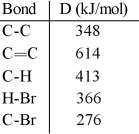
(78) Using the table of bond dissociation energies, the ΔH for the following gas-phase reaction is __________ kJ. 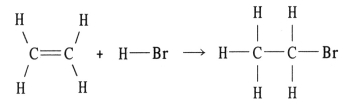
(Multiple Choice)
5.0/5 (79)
(79) Of the bonds C-N, C-N, and C≡N, the C-N bond is __________.
(Multiple Choice)
4.9/5 (71)
(71) In the Lewis structure of HCO3-, the formal charge on H is __________ and the formal charge on C is __________.
(Multiple Choice)
4.9/5 (86)
(86) A valid Lewis structure of __________ cannot be drawn without violating the octet rule.
(Multiple Choice)
4.9/5 (78)
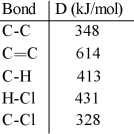
(78) Using the table of bond dissociation energies, the ΔH for the following gas-phase reaction is __________ kJ. 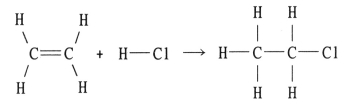
(Multiple Choice)
4.8/5 (85)
(85) Which of the following would have to gain two electrons in order to achieve a noble gas electron configuration? O Sr Na Se Br
(Multiple Choice)
4.8/5 (81)
(81) Of the bonds C-C, C-C, and C≡C, the C-C bond is __________.
(Multiple Choice)
4.9/5 (80)
(80) Which halogen, bromine or iodine, will form the more polar bond with phosphorus?
(Short Answer)
4.9/5 (79)
(79) Using the table of average bond energies below, the ΔH for the reaction is __________ kJ. 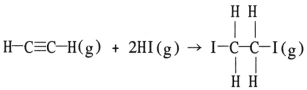 Bond: C≡C C-C H-I C-I C-H D (kJ/mol): 839 348 299 240 413
 (Multiple Choice)
4.8/5 (83)
(83) To produce maximum heat, an explosive compound should have __________ chemical bonds and decompose to molecule with __________ bonds.
(Short Answer)
4.9/5 (76)
(76) The formal charge on sulfur in SO42- is __________, where the Lewis structure of the ion is: 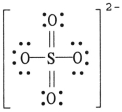
(Multiple Choice)
4.9/5 (74)
(74) Based on the octet rule, magnesium most likely forms a __________ ion.
(Multiple Choice)
4.9/5 (80)
(80) 
Filters
- Essay(0)
- Multiple Choice(0)
- Short Answer(0)
- True False(0)
- Matching(0)