



 Chat with AI
Exam 8: Basic Concepts of Chemical Bonding

Exam 1: Introduction: Matter and Measurement151 Questions
Exam 2: Atoms, Molecules, and Ions230 Questions
Exam 3: Stoichiometry: Calculations With Chemical Formulas and Equations170 Questions
Exam 4: Aqueous Reactions and Solution Stoichiometry177 Questions
Exam 5: Thermochemistry148 Questions
Exam 6: Electronic Structure of Atoms180 Questions
Exam 7: Periodic Properties of the Elements171 Questions
Exam 8: Basic Concepts of Chemical Bonding141 Questions
Exam 9: Molecular Geometry and Bonding Theories177 Questions
Exam 10: Gases172 Questions
Exam 11: Liquids and Intermolecular Forces119 Questions
Exam 12: Solids and Modern Materials78 Questions
Exam 13: Properties of Solutions151 Questions
Exam 14: Chemical Kinetics130 Questions
Exam 15: Chemical Equilibrium92 Questions
Exam 16: Acid-Base Equilibria134 Questions
Exam 17: Additional Aspects of Aqueous Equilibria111 Questions
Exam 18: Chemistry of the Environment121 Questions
Exam 19: Chemical Thermodynamics120 Questions
Exam 20: Electrochemistry110 Questions
Exam 21: Nuclear Chemistry158 Questions
Exam 22: Chemistry of the Nonmetals192 Questions
Exam 23: Transition Metals and Coordination Chemistry147 Questions
Exam 24: The Chemistry of Life: Organic and Biological Chemistry124 Questions
Select questions type


What is the maximum number of triple bonds that a carbon atom can form?
(Multiple Choice)
4.8/5  (90)
(90) Alternative but equivalent Lewis structures are called __________.
(Short Answer)
4.9/5 (78)
(78) Using the table of average bond energies below, the ΔH for the reaction is __________ kJ. H-C≡C-H (g)+ H-I (g)→ H2C-CHI (g)
Bond: C≡C C=C H-I C-I C-H
D (kJ/mol): 839 614 299 240 413
(Multiple Choice)
4.9/5 (86)
(86) As electronegativity difference increases, bond length will decrease.
(True/False)
4.9/5 (73)
(73) Dynamite consists of nitroglycerine mixed with __________.
(Multiple Choice)
4.7/5 (73)
(73) Which of the following does not have eight valence electrons?
(Multiple Choice)
4.8/5 (68)
(68) The reaction below is used to produce methanol:
CO (g)+ 2H2 (g)→ CH3OH (l)ΔHrxn = -128 kJ
(a)Calculate the C-H bond energy given the following data: 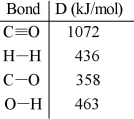 (b)The tabulated value of the (C-H)bond energy is 413 kJ/mol. Explain why there is a difference between the number you have calculated in (a)and the tabulated value.
 (Essay)
4.9/5 (70)
(70) A valid Lewis structure of __________ cannot be drawn without violating the octet rule.
(Multiple Choice)
4.9/5 (76)
(76) Determining lattice energy from Born-Haber cycle data requires the use of __________.
(Multiple Choice)
4.8/5 (75)
(75) The principal quantum number of the electrons that are lost when tungsten forms a cation is __________.
(Multiple Choice)
4.8/5 (85)
(85) Based on the octet rule, iodine most likely forms an __________ ion.
(Multiple Choice)
4.8/5 (78)
(78) There are __________ valence electrons in the Lewis structure of CH3CH2Cl.
(Multiple Choice)
4.8/5 (82)
(82) In the Lewis symbol for a sulfur atom, there are __________ paired and __________ unpaired electrons.
(Multiple Choice)
4.7/5 (89)
(89) 
Filters
- Essay(0)
- Multiple Choice(0)
- Short Answer(0)
- True False(0)
- Matching(0)