



 Chat with AI
Exam 10: Gases

Exam 1: Introduction: Matter and Measurement163 Questions
Exam 2: Atoms, Molecules, and Ions250 Questions
Exam 3: Stoichiometry: Calculations With Chemical Formulas and Equations178 Questions
Exam 4: Aqueous Reactions and Solution Stoichiometry180 Questions
Exam 5: Thermochemistry154 Questions
Exam 6: Electronic Structure of Atoms186 Questions
Exam 7: Periodic Properties of the Elements176 Questions
Exam 8: Basic Concepts of Chemical Bonding147 Questions
Exam 9: Molecular Geometry and Bonding Theories183 Questions
Exam 10: Gases175 Questions
Exam 11: Liquids and Intermolecular Forces124 Questions
Exam 12: Solids and Modern Materials84 Questions
Exam 13: Properties of Solutions160 Questions
Exam 14: Chemical Kinetics134 Questions
Exam 15: Chemical Equilibrium97 Questions
Exam 16: Acid-Base Equilibria139 Questions
Exam 17: Additional Aspects of Aqueous Equilibria116 Questions
Exam 18: Chemistry of the Environment126 Questions
Exam 19: Chemical Thermodynamics125 Questions
Exam 20: Electrochemistry114 Questions
Exam 21: Nuclear Chemistry178 Questions
Exam 22: Chemistry of the Nonmetals194 Questions
Exam 23: Transition Metals and Coordination Chemistry165 Questions
Exam 24: The Chemistry of Life: Organic and Biological Chemistry131 Questions
Select questions type


A sample of an ideal gas (3.00 L)in a closed container at 25.0 °C and 76.0 torr is heated to 270 °C. The pressure of the gas at this temperature is ________ torr.
(Multiple Choice)
4.9/5  (72)
(72) Zinc reacts with aqueous sulfuric acid to form hydrogen gas: Zn (s) + H2SO4 (aq) → Zn SO4 (aq) + H2 (g)
In an experiment, 201 mL of wet H2 is collected over water at 27 °C and a barometric pressure of 765 torr. How many grams of Zn have been consumed? The vapor pressure of water at 27 °C is 26.74 torr.
(Multiple Choice)
4.8/5 (75)
(75) A 255 mL round-bottom flask is weighed and found to have a mass of 114.85 g. A few milliliters of an easily vaporized liquid are added to the flask and the flask is immersed in a boiling water bath. All of the liquid vaporizes at the boiling temperature of water, filling the flask with vapor. When all of the liquid has vaporized, the flask is removed from the bath, cooled, dried, and reweighed. The new mass of the flask and the condensed vapor is 115.23 g. Which of the following compounds could the liquid be? (Assume the ambient pressure is 1 atm.)
(Multiple Choice)
4.7/5 (94)
(94) SO2 (5.00 g)and CO2 (5.00 g)were placed in a 750.0 mL container at 50.0 °C. The partial pressure of CO2 in the container was ________ atm.
(Multiple Choice)
4.8/5 (76)
(76) A sample of He gas (3.0 L)at 5.6 atm and 25 °C was combined with 4.5 L of Ne gas at 3.6 atm and 25 °C at constant temperature in a 9.0 L flask. The total pressure in the flask was ________ atm. Assume the initial pressure in the flask was 0.00 atm and the temperature upon mixing was 25 °C.
(Multiple Choice)
5.0/5 (81)
(81) The density of ammonia gas in a 4.32 L container at 837 torr and 45.0 °C is ________ g/L.
(Multiple Choice)
4.8/5 (81)
(81) The reaction of 25 mL of N2 gas with 75 mL of H2 gas to form ammonia via the equation: N2 (g) + 3H2 (g) → 2NH3 (g)
Will produce ________ mL of ammonia if pressure and temperature are kept constant.
(Multiple Choice)
4.8/5 (71)
(71) Of the following gases, ________ will have the greatest rate of effusion at a given temperature.
(Multiple Choice)
5.0/5 (75)
(75) Standard temperature and pressure (STP), in the context of gases, refers to ________.
(Multiple Choice)
4.9/5 (76)
(76) The rms speed of methane molecules at 45.0 °C is ________ m/sec.
(Short Answer)
4.9/5 (70)
(70) The density of N2O at 1.53 atm and 45.2 °C is ________ g/L.
(Multiple Choice)
4.8/5 (82)
(82) A gas vessel is attached to an open-end manometer filled with a nonvolatile liquid of density 0.993 g/mL as shown below. 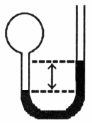 The difference in heights of the liquid in the two sides of the manometer is 32.3 mm when the atmospheric pressure is 765 mm Hg. Given that the density of mercury is 13.6 g/mL, the pressure of the enclosed gas is ________ atm.
 (Multiple Choice)
4.8/5 (73)
(73) A sample of a gas (1.50 mol)is contained in a 15.0 L cylinder. The temperature is increased from 100 °C to 150 °C. The ratio of final pressure to initial pressure [  ] is ________.
 (Multiple Choice)
4.9/5 (73)
(73) The pressure exerted by a column of liquid is equal to the product of the height of the column times the gravitational constant times the density of the liquid, P = ghd. How high a column of water (d = 1.0 g/mL)would be supported by a pressure that supports a 713 mm column of mercury (d = 13.6 g/mL)?
(Multiple Choice)
4.9/5 (90)
(90) Two deviations of real gases from ideal gases which are treated in the van der Waals equation are finite molecular volume and non-zero molecular attractions.
(True/False)
4.8/5 (80)
(80) The density of chlorine gas at 1.01 atm and 54.1 °C is ________ g/L.
(Multiple Choice)
4.8/5 (75)
(75) The reaction of 50 mL of N2 gas with 150 mL of H2 gas to form ammonia via the equation: N2 (g) + 3H2 (g) → 2NH3 (g)
Will produce ________ mL of ammonia if pressure and temperature are kept constant.
(Multiple Choice)
4.8/5 (83)
(83) Given the equation:
C2H6 (g) + O2 (g)→ CO2 (g) + H2O (g) (not balanced)
Determine the number of liters of CO2 formed at STP when 270.0 grams of C2H6 is burned in excess oxygen gas.
(Short Answer)
4.8/5 (82)
(82) What is the density (in g/L)of oxygen gas at 77.0 °C and 700.0 torr?
(Short Answer)
4.9/5 (74)
(74) Sodium bicarbonate is reacted with concentrated hydrochloric acid at 37.0 °C and 1.00 atm. The reaction of 6.00 kg of bicarbonate with excess hydrochloric acid under these conditions will produce ________ L of CO2.
(Multiple Choice)
4.8/5 (73)
(73) 
Filters
- Essay(0)
- Multiple Choice(0)
- Short Answer(0)
- True False(0)
- Matching(0)